
Goodbye Customer.
There are reasons customers leave. That is sometimes what we say, without knowing the full costs and burden that proposition means on the business. What we fail to acknowledge is the most effective customer retention programs produce excellent customer experiences in the first place.
Ironically, businesses are often unaware that their actions are pushing the customer away while at the same time trying to recover and retain them through expensive customer retention programs. Metaphorically, this is like pushing the customer away and pulling the customer back — at the same time. It is no wonder that customers have had enough.
Businesses push the customer away and pull the customer back — at the same time!
Awareness is the missing piece. Shmula.com has developed a simple framework that can serve as a helpful model for the true costs to the business and the burden on the customer — because of our push/pull activities.
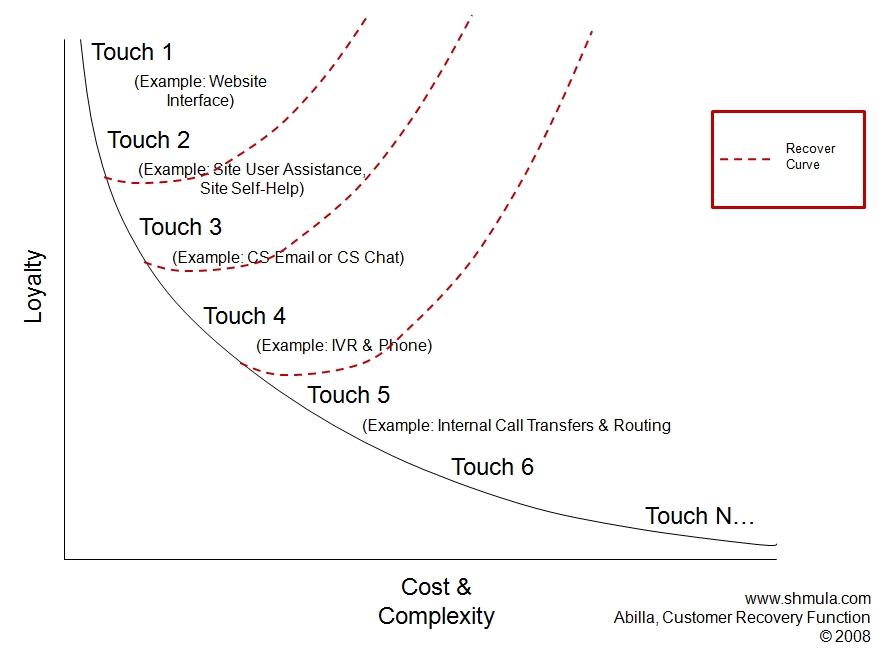
The function above attempts to highlight the relationship between costs, complexity, loyalty, customer touches or interactions, and recovery.
Our example shows an interaction between a customer and a website, but it could be an interaction between customer and anything: a device, a brick-and-mortar store, or any other business.
- Customer interacts with a company website for commerce
- Customer has a a question or problem, she searched the Help Pages or engages in some site self-help
- Customer has not resolved her concern, so she engages the live chat service
- Customer orders item, maybe. At some point, Customer has another concern, causing her to call the company
- Customer interacts with Intravoice Response System (IVR), a form of automated self-help
- Customer maybe interacts with a human
- More Customer Interaction. . .

At each point above, there is an opportunity for Customer retention and recovery, but there is a cost. Indeed, the Recovery Curve is such that the costs of recovery increases as there are more interactions, while at the same time decreasing customer loyalty.
The Goal is to Reduce Interaction
Aza Raskin, the Head of User Experience at Mozilla Labs1, and a good friend of shmula.com, has said:
the fundamental goal of interaction designers is to reduce interaction
From a customer’s perspective, they want to find something to buy, buy it, and move on. Indeed, proponents of Lean Thinking would clearly agree and so would the customer.
From the perspective of Lean Thinking, we think of Reducing Interaction as the reducing “non-value added activities” — activities that the customer would consider waste.
When There is Added Interaction
If there has to be a recovery activity, then the quality of that recovery activity must have the goal of increasing Loyalty. Doing this has a three-fold purpose:
- The sooner the business can resolve a customer concern, the better
- If (1) is satisfied, it prevents further unnecessary interactions, prevents further costs, and preserves or increases loyalty
- If (2) is satisfied, then this could potentially mean incremental revenue in the future from a repeat customer
A Case Study
Amazon.com clearly subscribes to the “Reduce Interaction” mantra. I can share many stories, but I won’t to preserve confidentiality. Zappos.com, on the other hand, has taken a stance on the “When there is Added Interaction” front by making Service a key differentiator and it has clearly helped them win market share. Now, both Amazon.com and Zappos.com are one big family.
Another Case Study
My experience at Home Depot has gained some popularity and will now be part of an upcoming book — details later. In that experience, I sent a tweet explaining my recent experience at Home Depot. That tweet quickly made its way to Facebook and the rest of Twitter. Home Depot communicated with me via their resident Twitter-er and then things ended there, without resolution. Clearly not a closed-loop feedback.
Home Depot has a call center, thousands of customer service representatives, and now a team of Twitter agents that monitor social media channels. When things don’t go well, costs grows and loyalty decreases. The framework above clearly describes my experience and the experience of most customers.
Reminder
Companies often speak in terms of Features, Shiny Objects, and the like. Companies often call this “Innovation” or some other buzz word. From a customer’s perspective, their mental model is this:
I won’t really remember your features or their details, but I’ll remember how I felt; I’ll remember my experience — both the good and the bad.
So, let’s design our products, services, and our business on behalf of the customer. Many people and businesses forget this simple fact; let’s get grounded in the customer — that is good for the customer and good for business.
- Aza Raskin is the son of Jef Raskin, the inventor or the Macintosh. Aza is the Head of User Experience at Mozilla Labs. Aza has been interviewed by shmula.com and that interview can be found here. ↩
Become a Lean Six Sigma professional today!
Start your learning journey with Lean Six Sigma White Belt at NO COST





Greg Glockner says
I can see how this will work for interactions that are not face-to-face, such as online or phone. Where does this go for face-to-face customer interaction – retail, banking, hospitality, travel, or even government agencies?
Dan Markovitz says
It’s true that Zappos goes out of their way to make customer interaction enjoyable, but I’d argue that the Amazon approach is better: customers don’t want to have to interact with the company. If they do have to, yes, it should be enjoyable and easy. But most people (at least the people I know) don’t want to be friends with Tony Hsieh or Jeff Bezos or Phil Knight: they want their product/service and never want to think about it again.
A consumer contacts the company because something is *wrong*, not because something is right. If you can eliminate all the wrong stuff, customers won’t need to call, and you won’t have to work so hard to make the subsequent interactions easy and pleasant — because there won’t be any.
Taking this line of logic to the nth degree, spending money on making those interactions as easy as can be is a waste of money that the customer doesn’t want to pay for. After all, if it’s right the first time, you don’t need such a fancy call center with so many employees.
Donna says
I don’t think the Zappo’s model quite fits this idea that the customer interaction wtih the company is because something is wrong. Buying shoes can be difficult even in a brick and mortar store. Zappo’s doesn’t require you to talk to somebody to make a purchase – they make it terribly easy to make a buy decision without talking to somebody – but if you need to talk to somebody, unlike most other companies, they are very happy to spend as much time as you need or want to make sure the product is right for you.
Brad Fredricks says
brilliant execution of example.
Thanks for that golden nugget.
B
Tim says
The shmula Recovery Function is damn fantastic. It makes sense. What is amazing is that the probability of establishing a relationship goes down the more touches there, which is contrary to popular view, but you make a very strong case for it.
Another thing is that each of the groups attempting to recover the customer relationship probably don’t even know each other or are aware of each others’ efforts — they don’t coordinate. This is certainly true at my company, the biggest internet auction house in the world — eBay. But, then again, eBay is full of the smartest people in the world who don’t know how to do anything 🙂 —
eBay sucks — we all miss you shmula, we’re all drowning at eBay since you quit. Quitting eBay was one of the smartest things you ever did — everybody hates working here, but stays anyway. Nice working environment, huh?
Shaun Moran says
Every business process exists in order to attain a goal. In some cases a touch point can be considered a defect because it is needed in order complete that particular instance of the business process e.g. helping a customer complete a payment transaction.On the other hand some business processes have the customer touch point built into the process as it is required to execute the business process without defect and get the org closer to it’s goal e.g a customer phones a home shopping Channel. It all depends on knowing what the outcome (ouput) of the interaction with the customer will be and what the effect the interaction will have on the customer. My 2 cents.
Sendsider says
Experience is everything in customer relationships.
Donna says
Agree that experience is everything. Some companies seem to hate their customers so much they make you sorry you were ever dumb enough to do business with them.