
 The red light flashing at Krispy Kreme is a good sign for our family: it means free, heart-stopping, artery-clogging, but tasty glazed donuts. On July 4, the light was flashing and calling our family over to get some.
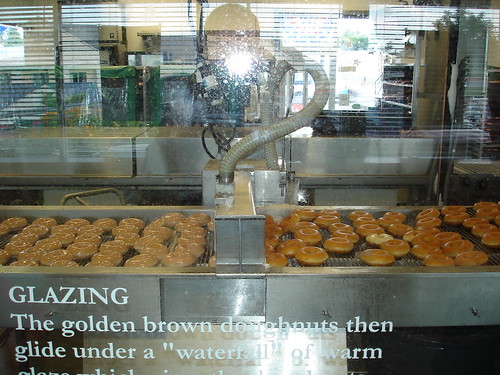
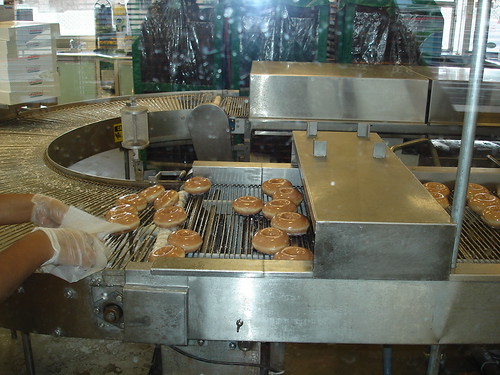
While there, I was impressed by the concept of free donuts and also with their process. At least, that was my perception.
Are the Donuts Really free?
I have 5 kids and a wife; so, 7 of us. We were all given 1 glazed donut for free. If I were really cheap, I would’ve taken the free donut and left. But, no, I’m too much of a wuss to take advantage of the man, so I had to buy something minimal so to not look too cheap. So, I bought a chocolate milk for ~$2.50 (not a big improvement from cheap-ness, I know).
 I imagine, though I don’t know, that most people are like me — they’re truly cheap and would take the free donut and run, but social convention, as economics teaches us, dictates that it’s not socially acceptable to take the donut and run, even though that’s the rational thing to do. Instead, we justify our cheap-ness by buying something. In my case, I bought a chocolate milk.
So, is it really free? In my case, the answer is “no” because I bought something I wouldn’t have bought if it weren’t for the free donut.
On the other hand, let’s say that I took the free donut and left. The cost to bring a customer in the store is a donut. The unit cost of that donut is trivial. In other words, the acquisition cost, or the cost to acquire the customer’s future business is really a donut, which is very cheap. The percieved benefits is large for the customer — c’mon, it’s a free donut. But the actual costs are very low. It’s a good strategy and a definite mutual win for both company and customer.
Krispy Kreme Process
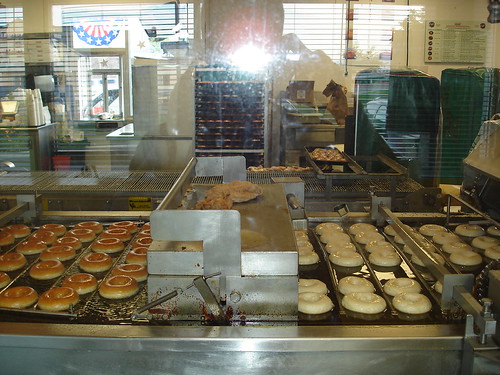
I was impressed by their process — the dough making, frying, glazing, then the packaging parts of the process. I don’t know anything about their distribution or supply chain processes, though, that would be interesting to learn also.
The in-the-kitchen process was impressive. I read a little history of the company and it started when the founder, Vernon Rudolph, cut a hole in his kitchen in order to get the donuts to the customer quicker. He was interested in a more Lean process, with as much value-adding processes as possible, ensuring warm donuts to the customer quickly. It was about the customer, for Vernon. This approach reminded me of a concept in Lean called Muda, or waste.
Note: I’m not claiming that Krispy Kreme is a Lean organization; I’m only stating that the founding history was focused on the customer, but accidentally implemented the notion of eliminating waste, which is the Lean approach.
+++++
Jim Womack and Dan Jones speak of the 7 types of waste. When I spent time as a Deshi at Toyota in Hebron, Kentucky, however, I learned that there really wasn’t a strict categorization of waste. Instead, the philosophy of the Toyota Production System enables a focus on value-adding activities and eliminates or reduces the non-value adding steps. The American version of TPS, which many know as Lean, does categorize muda, which I’ll explain here.
There are 3 types of activities:
- Steps that definitely create value.
- Steps that create no value, but are necessary given the current state of the system.
- Steps that create no value and can be eliminated.
(2) & (3) naturally create waste, of which there are 7 types:
- Over-Production: Producing more than is needed, faster than needed or before needed.
- Wait-time: Idle time that occurs when co-dependent events are not synchronized.
- Transportation: Any material or information movement that does not directly support immediate production.
- Processing: Redundant effort (production or communication) which adds no value to a product or service.
- Inventory: Any supply in excess of process or demand requirements.
- Motion: Any movement of people which does not contribute added value to the product or service.
- Defect: Repair or rework of a product or service to fulfill customer requirements.
The founder of Krispy Kreme was unfamiliar with Lean, but he understood his customer’s needs: the right donut, perfectly made, and on time. Pretty simple. So, his solution was to create a hole in his kitchen to the street in order to get the donut to the customer quicker: Simple innovation and very customer-centric.
When I was with Amazon, I led an industrial engineering project where I conducted a time study on a critical path process. This time study revealed several of the wastes mentioned above and are stratified in the Pareto Chart below:
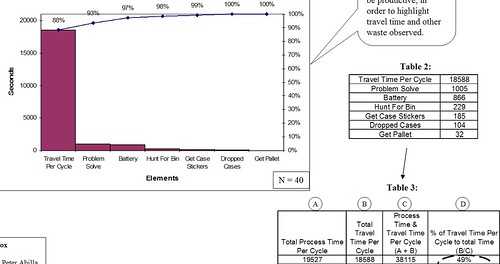
The Pareto above shows the non-value added activities. The largest bar in the Pareto is Travel Time, which is categorized as “Transporation” in the 7 wastes above. The other bars in the Pareto fall in one of the categories of waste also. The chart to the bottom right shows that total value added time was just over 51% of the total time; the other 49% was spent in non-value added activities.
This data clearly pointed to how to improve the process. Our team made some changes, non-value added time was reduced, Amazon saved money, and customer happiness increased.
Krispy Kreme’s free donut strategy is cool. Their process is fun to watch and their openness is impressive; their process also seems to be tight and motivated by making the customer happy. This is a winning strategy, to be sure. Learning to See muda in your business is an important way to squeeze more value out of your existing business by identifying and eliminating waste. The lean approach is applicable to any function and any industry, from sofware engineering to medicine. At the end of the day, the customer wins by providing her with a value stream that is more value-adding and has less waste.
Become a Lean Six Sigma professional today!
Start your learning journey with Lean Six Sigma White Belt at NO COST
Mark Graban says
Great post. I like how KK does “continuous flow” donut making. You can notice that even the rising of the dough takes place in slowly (but continuously moving) conveyors that go up and down (to save space). Even the glazing is done in the continuous flow manner with the “curtain” of glaze. I believe the excess glazing that doesn’t land on a donut is recirculated in what I hope is a closed (and clean) system.
One potential source of overproduction — I think the KK donut line only runs at one rate, “on” as opposed to “off.” Note that the “Hot Donuts Now” sign is not always on… a sign of overproduction. If you are not there at a peak time, you will get glazed donuts out of inventory that was built up earlier when production > demand.
Sure, in a given day, I’m sure they don’t overproduce, making sure production = demand. But, within the day, there are peaks of overproduction because demand is not leveled.
I’ve also wondered by KK can’t do chocolate glazed donuts by having a second glaze tank with some sort of instantaneous “quick changeover” process that wouldn’t require stopping the line. You would probably get a few special “half and half” donuts with white and chocolate icing… might make for a nice marketing opportunity or a way to pull people in (come see the icing changeover). Or maybe not. I still think the chocolate glaze would be tasty hot off that line.
I assume they make their other donuts (crullers, jelly filled) in a traditional batch process?
Mark Graban says
Oops, that should say “wondered why” in the 2nd to last paragraph.