
Change efforts sometimes fail.
Specifically, transformation or Change efforts sometimes fail. Despite the gravity of the crisis, our responses many times don’t meet the required focus and attention that is required. And sometimes, we come up against the Not Invented Here attitude, which can be cankerous to change.
In fact, the numbers are staggering – most of them fail. While the root cause is wide and varied, there are general themes or characteristics that are important to keep in mind in your own transformation efforts. Think of these as symptoms also — that a failure is around the corner if you see these characteristics creeping-up or, better yet, you can course-correct if there’s still time.
The data on Transformation failures is instructive:
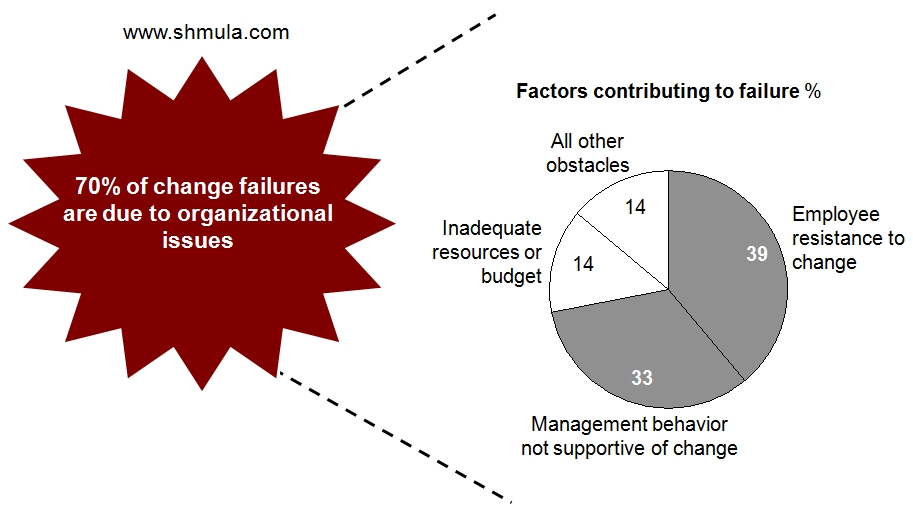
The main categories for why Transformations fail are 1:
- Employee Resistance to Change (39%)
- Management Behavior not supportive of Change (33%)
- Lack of resources (14%)
- Other (14%)
The top two reasons are instructive and actionable – the root causes for most transformation failures have to do with people: employee resistance and management behavior.
Management Behavior that is not supportive of the change and Employee Resistance are the main factors that lead to transformation failures
Typical characteristics in transformation failures are the following:
- There is no obvious connection to outcomes that the organization values
- The aspirations of the organization are not clear, concise, or communicated
- The desired behaviors are not role-modeled, trained, or reinforced
- The top team is not aligned
- The informal “how things get done” remain inconsistent with espoused values
- The change champions lose interest and move to the “next” change program
- The leaders charged with implementing the change do not possess the requisite knowledge, skills, and abilities
In the next post, we’ll discuss how to surgically address the failure characteristics above, create a transformation story that is rigorously architected along broad themes, the chapters in that story, and the key initiatives that those chapters produce, and the role of the leadership team in all of it.
- Beer and Nohria (2000); Cameron and Quinn (1997); CSC Index; Caldewell (1994); Gross et al. (1993); Kotter and Heskett (1992); Hickings (1988); Conference Board report (Fortune 500 interviews); press analysis; McKinsey analysis ↩
Become a Lean Six Sigma professional today!
Start your learning journey with Lean Six Sigma White Belt at NO COST


Jamie Flinchbaugh says
I disagree with the data, not that it’s real data, but that they are not causes of the failure. They sound more like excuses to me.
Employees resist change…first, most employees crave change, deeply. What they resist is fear that the change will be worse or that it will make their lives more difficult. And this is a universal condition so it can’t be a reason that your change failed and someone else’s succeeded. Maybe you didn’t sell it well enough, maybe it sounded good on paper but failed in execution, but resistance wasn’t the cause.
Lack of resources isn’t a cause either, it’s a complaint. You have what you have. You failed to plan around the resources you have.
What is really see in the data is a failure to reflect.
Jamie Flinchbaugh
Jamieflinchbaugh.com
Brian Buck says
I really like your point about “The informal ‘how things get done’ remain inconsistent with espoused values”.
I have seen many times when top management has espoused values they speak all of the time but they either turn a blind eye when when they see informal ways of doing stuff or worse never even go and see what is really happening.
psabilla says
Hi Jamie,
Thanks for your input and for taking the time to share it.
I haven’t been critical of Mckinsey’s data, but it actually makes sense to me. Your point on Employee’s resisting change is very good – it’s actually more of a failure of getting the right buy-in and in selling to the broader constituency. I agree with you.
Deming would go as far as saying that everything is the fault of the Leadership team – perhaps he is right now even as he was right even back then.
Shaun Sayers says
Recently I’ve been hearing some arguments that suggest that change programs are sometimes too slow and deliberate. Clearly there is a balance to be struck between going too fast too soon, but the basic thrust of this argument was that the longer you take, the less relevant your original program is likely to be given the increased probability of changing circumstances
Bob says
Ummmm… 33% + 39% = 70%?? A lot of transformations fail because people fail to check what they do.
Pete Abilla says
Yeah, that’s just an approximation – it’s 72%, but rounded to 70%.
Katarina Haddad says
I believe people might have misread this blog – the way I read it is that thousands of transformation projects have been assessed in this research and the outcome is that 70% of those projects have failed. This said, the percentage breakdown explained in the above graph are the REASONS that contributed or lead to the failure… not meant to be add up to 70%!
Katarina Haddad says
I believe that the people that have commented on this blog might have misinterpreted the data…
The way I read it: thousands of transformation projects were assessed, and 70% of those projects failed. The percentage breakdown explained in the above graph are the REASONS that contributed or lead to the failure…. not at all meant to add up to 70%!