Hoshin Kanri, sometimes called Hoshin Kanri A3, is a management tool used at Toyota to align business strategy and mobilize the entire organization toward the business strategy. Hoshin Kanri means “Shining Metal, Pointing Direction” or “Directional Needle”. In other words, Hoshin Kanri is a North Star or a Compass. This also includes a discussion on performance metrics. If you have no vision, then leadership will be utterly difficult.
An important element in Hoshin Kanri (download template) is the alignment of outcomes with how we achieve those outcomes. For example, environmental stewardship is very important to Toyota but so is profit. Under Hoshin Kanri, any means to achieve a profit is not acceptable, but achieving a profit without violating environment stewardship is appropriate and good.
In contrast, Management by Objectives is a popular strategic planning tool also, but doesn’t concern itself with how outcomes are achieved – it’s only concerned with outcomes. But, Hoshin differs from that in a significant way: the focus on outcomes as well as a focus on means.
Graphically,
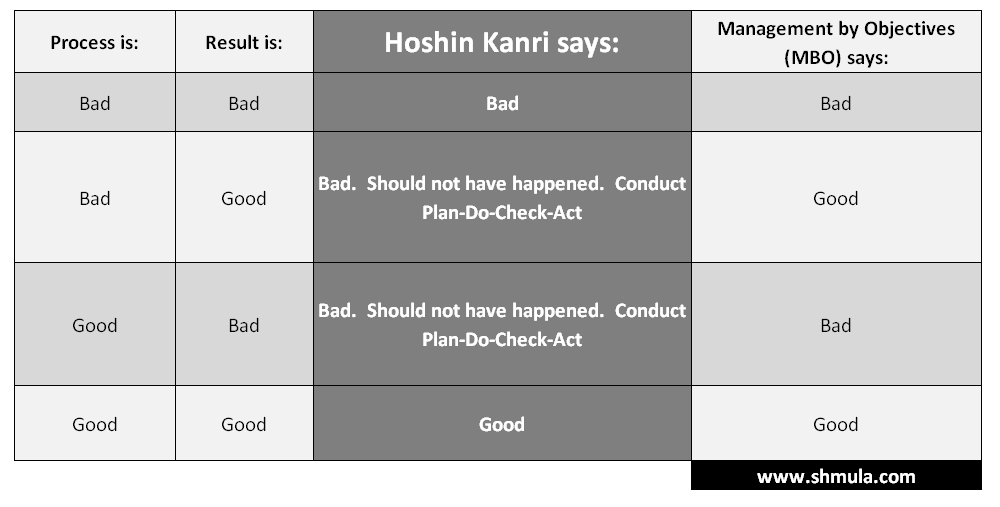
How we achieve the outcomes is very important.
Key Elements in Hoshin Kanri
- Driven by organization’s vision, not today’s problems
- It is a system to translate that vision into tangible and measurable objectives
- Alignment created by cross-functional planning to achieve short-term objectives each year
- At the heart of Hoshin Kanri is Plan-Do-Check-Act
- Catchball = alignment, clarification, and employee involvement
- Backwards from Perfect – is what starts most discussions
Definitions
- Vision = Where we are going.
- Mission = What do we do?
- Values = What do we stand for?
A Litmus Test
Do the lowest-level employees at your company know the business strategy? Can they articulate their place in it?
Go ahead, ask them! You’ll be surprised at what you learn…
If they’re not sure how they align to the strategy, then that is an opportunity for improvement.
A Business Strategy is most effectively executed when it is everybody’s story. Until then, it sounds nice, but lacks the power to mobilize the troops. It has to be everybody’s story.
Learn more about Hoshin Kanri and download a template
Become a Lean Six Sigma professional today!
Start your learning journey with Lean Six Sigma White Belt at NO COST



Jamie Flinchbaugh says
Great post.
I have seen companies that use management by objectives still pay attention to the how. Even GE under good ‘ole Jack Welch made it clear that if you got results and practiced the right behaviors, you were in great shape. If you didn’t get results, you clearly were in trouble. But Jack would say the tough decision was someone who DID get results but didn’t exhibit the right behaviors. While tough, those were people GE didn’t want either. But GE was an MBO company.
Is that fair, or perhaps were they really a hoshin kanri-thinking company without using the tool?
Jamie Flinchbaugh
http://www.jamieflinchbaugh.com
Dan Markovitz says
Pete, your definition of Vision/Mission/Values reminds me of something Jim Collins wrote before he became famous with “Good To Great” and “Built To Last.” In his book “Beyond Entrepreneurship,” he defined Vision as the “guiding star” for an organization — something that will never be reached, but sets the *direction* that the firm will take. By contrast, the “mission” is the short(er) term goal that the company is trying to achieve (e.g., become #1 in an industry, or invent the best laptop computer, etc.)