
If your organization leans more towards Consensus, rather than leadership actually providing, well, leadership from the top-down, then you’ve probably experienced the scenario where nobody can agree and so nobody makes a decision. I call this state-of-affairs an organizational paralysis. True, there’s something to be said for the executives that allow management to make business decisions — personally, I prefer a lot of autonomy to get things done — but, in some organizations, poor leadership leads to no decisions, no consensus, and nothing worthwhile gets done.
If your organization is consensus-based and you often find yourself in an organizational paralysis, then Digraphing might be for you.
Digraphs
Digraphing is a simple prioritization process based on reducing the decision process to (3) choices.
- Item A is more important than B
- Item A is less important than B
- Item A and B are equally important
Here are the steps to creating a Digraph:
- Write down your choices in an octagonal shape. It might be helpful also to write your choices down on sticky-notes and form the octagonal shape. Note: Do not have too many choices, otherwise this excercise could take very, very long.
- Then, as a group, pit each choice against the other. Ask person 1 “A or B”, and then draw an Arrow into her answer. Do this excercise for all the possible combinations and for each person in the group.
- Sum the number of inbound arrows and sort the items from highest to lowest.
Here is a visual representation of a Digraph:
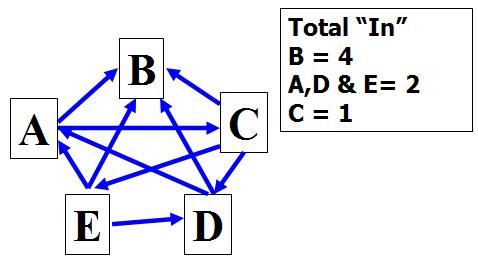
 In the example above, Item B had the most inbound arrows, which represents the collective consensus of the group that Item B is highest in priority.
A Note on Kumbaya Management
I have spoken about Kumbaya Management before. Decision, Innovation, and pretty much a lot of other things — done by committee — do not result in a breakthrough or innovative outcome. Instead, you end up with a mediocre outcome quasi-agreed to by the group. Digraphing can solve the Kumbaya problem, if the choices are good. Otherwise, you’ll have decision and prioritization made on poor choices. Use wisdom, but be decisive in your groups. If there isn’t a command-and-control or even basic leadership in your organization, then it’s up to you to make the decisions that your executives aren’t either willing or capable of making. digraphing can help you prioritize the choices into small, workable, action items.
Become a Lean Six Sigma professional today!
Start your learning journey with Lean Six Sigma White Belt at NO COST





Scott Sehlhorst says
Peter,
This is a very effective way to visualize “card sorting”, but it introduces a problem when trying to aggregate inputs from multiple people – it drowns out the “best ideas” and tends to promote the lowest common denominator of features. I wrote about this in the linked article.
I wonder if there is a way to augment this approach so that “passion” is not lost.