Reacting to Visual Cues

The Toyota Production System makes effective use of visual cues to mark location in time and space, boundaries, and to answer the question "How am I doing" in a production setting.  Visual Cues are a simple but effective mechanism.

The assumption — and, what empirical evidence supports — is that we react automatically to objects and spaces that we encounter.  The picture below is taken from the book Thoughtless Acts?: Observations on Intuitive Design — a highly recommended book:
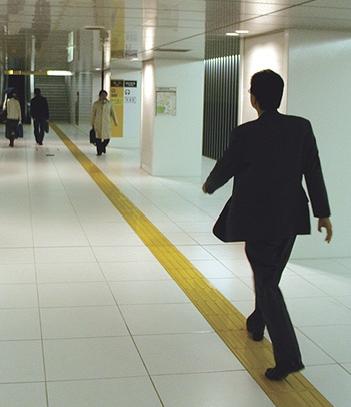
Was the yellow line designed to encourage travelers to walk on its path?  Was this an unintended consequence?  In either case, we learn something substantial from the picture: people react to and adjust to their surroundings. 

What types of visual cues cause you to react?  What types of visual cues could you design that encourage the desired reaction from your audience?

More articles on Genchi Genbutsu and Ethnography?


Short URL: http://bit.ly/xLqQ

Share This Post:


  • Digg
  • Facebook
  • del.icio.us
  • Suggest to Techmeme via Twitter
  • StumbleUpon
  • LinkedIn
  • email

2-pizza teams (10)
3 C's (3)
5S (38)
A3 Report (9)
adoption (7)
agile/software (59)
ajax (4)
amazon (53)
apple (3)
apple iphone (7)
axiom (3)
Aza Raskin (9)
backcountry.com (2)
berlin (1)
bill gates (1)
bill marriott (1)
blog tag (1)
book reviews (4)
bullwhip effect (5)
business (394)
business plans (3)
busm361 (13)
BzzAgent (12)
call center and queueing (11)
car buying (2)
Carbonite (1)
change management (5)
chicago (1)
click fraud (1)
click-to-ship (21)
clocky (2)
colin powell (2)
community (2)
company interviews (18)
company interviews (6)
complexity (32)
costs (8)
culture (7)
customer experience (10)
customer obsession (52)
customer recovery function (1)
customer segmentation (8)
customer service (17)
design thinking (14)
digg (4)
drum-buffer-rope (38)
dublin (1)
dynamic systems (24)
eBay (6)
economics (3)
efficiency (4)
ethnography (29)
family (18)
featuritis (15)
flexibility (1)
forecasting (2)
four performance dimensions (2)
Fun With The 2×2 Matrix (1)
game theory (7)
Gemba (67)
genchi genbutsu (68)
general (135)
germany (1)
google (15)
heijunka (65)
holidays (1)
hoshin kanri (1)
how to be a human (1)
IDEO (2)
image uploading (1)
iphone (5)
ishikawa (69)
IT at Toyota (67)
just-in-time (4)
kaizen (4)
kanban (46)
law of instinct (1)
Leadership (43)
lean (165)
Lean Consumption Maps (98)
learning curve (1)
licketyship (1)
mark cuban (1)
martin luther king (1)
mary poppendieck (1)
metrics (73)
microsoft (6)
milton friedman (1)
moving average (1)
muda (68)
nba fines (1)
net promoter score (nps) (1)
obeya (39)
Off-Topic (1)
onstar (1)
operations (108)
pageviews (3)
pareto principle (39)
patent (1)
peanut butter manifesto (2)
philosophy (3)
Poka-Yoke (6)
poppendieck (3)
powerpoint sucks (2)
private equity (4)
process measures (6)
product development (20)
productivity (4)
quality (41)
quasimodal design (1)
queueing theory (41)
Raffle (1)
rational choice (2)
regression analysis (18)
respect for people (6)
root cause analysis (60)
sarah+palin (2)
seth godin (1)
simplicity principle (10)
six sigma (128)
snowboarding (2)
social media (3)
spam (1)
statistical process control (46)
strategy (46)
suburban (1)
supply chain (24)
takt time (8)
teaching (2)
team size (9)
technology (104)
the beer distribution game (1)
the profit tree (7)
The Visual Factory (11)
theory of constraints (41)
time (2)
timeline (3)
tony+hsieh (11)
toyota (75)
travel (1)
trump bankruptcy (1)
turnaround (5)
twitter (8)
uspto (1)
utah deal flow (2)
variation (69)
venture capital (1)
Visual Management (11)
waste (59)
website traffic (2)
Wing Chun (2)
wisdom of crowds (1)
wisdom teeth (1)
word-of-mouth marketing (18)
yahoo (2)
zappos.com (12)
zero defects (3)

WP Cumulus Flash tag cloud by Roy Tanck and Luke Morton requires Flash Player 9 or better.


If you enjoyed this post, please consider to leave a comment or subscribe to the feed and get future articles delivered to your feed reader.

Comments

What a fantastic piece of visual management. As a keen runner it reminds me of the white line I follow on marathons (http://tinyurl.com/ytowxc). Once I go into the running zone I tend to focus on the next 10 meters in front of me and stick to the line religiously. Just as well really; my sense of direction is lousy!

Rob

Look closely at the yellow “line” – it’s meant to be the yellow brick road from Wizard of Oz, obviously!! Possibly to remind people they aren’t in Kansas anymore :-)

Cheers.

p.s. Love your blog.

When you spend any time at all pondering website usability, you realize that the entire web presentation is about getting the user to respond to visual cues. Click here for a menu, click here to submit your search query. This text is a link, this isn’t. We’re programmed to respond to red as danger / caution / stop. On a subconscious level, we’re programmed to respond to combinations of red, yellow, and orange with hunger. If you’ve never heard this before, look at the logos for McDonalds, Wendy’s, Burger King, KFC, etc. Wide, white bars across a pedestrian walk-way tell us where to cross, and if you watch someone start away from the bars, they’ll gravitate towards them by the time they reach the other side. We are SO programmed to respond to our environmental visual cues, it’s hard to recognize where they all are in our daily lives. I’d love to be part of a social experiment where we could change all the visual cues and see how people make mistakes and then re-learn their environment….

[...] Perhaps this guy should have attended a course there? That way he wouldn’t have painted as single orange line stretching for miles and miles! He may have read this post on visual management and decided to give it a go himself [...]

[...] Queueing Theory and Visual Management [...]

Leave a comment

(required)

(required)


Additional comments powered by BackType