
Ever since I discovered Twitter, I’ve been amazed at @ev, @biz, and @jack’s idea of simplicity and usefulness. Lately, @windley (Phil Windley’s article), @monkchips, and JP have approached Twitter from a more theoretical perspective. This article is my contribution to that healthy conversation (this blog post will be followed by a short tweet, of course).
Twitter as Asymmetric Follow
James Governor attempts to define a pattern found in Twitter and other social media and calls it “Asymmetric Follow”. He defines Asymmetric Follow as the following:
Asymmetric Follow is a core pattern for Web 2.0, in which a social network user can have many people following them without a need for reciprocity. Asymmetric Follow is unlike email for example, which tends to be within small groups, with all users knowing each other (newsletters are a clear exception here). If you see a social network where someone has 5000 followers and only follows 150 back – that’s Asymmetric Follow.
So, if I were to explain James’ definition to a teenager 1 , I might say something like:
“Asymmetric Follow is when the popular kid in school is admired by a bunch of less popular kids and when the popular kid speaks, everyone usually listens and when the less-popular kids speak, the popular kid can choose to listen or respond or do nothing”.
If I’ve been charitable in my understanding and summary of James’ definition of Asymmetric Follow, then his explanation and definition makes sense to me. From my experience as a former High School student of the less-popular type, that’s how life was.
I have to note, however, that James’ definition confounds the behavioral economics definition of Information Asymmetry — but he means something different. The historical definition has more to do with the direction of communication and the “stickiness” of that information and how that “stickiness” can impact decisions and rational choice. James Governor doesn’t address the definition in behavioral economics but does use a similar term.
Twitter as Combinatorics
But, let’s quantify what James is talking about. In fact, when we do, we’ll find out that it’s actually basic combinatorics.
Suppose there are persons A and B, who follow each other. In this scenario there are 2 communication links (AB, BA). Add person C who follows and is followed-by persons A and B, now we have 6 communication links, (ABC, ACB, BCA, BAC, CAB, CBA). So, inductively, as inter-followership 2 permutation grows, the raw combinatorial communication link counts grows quadratically, not linearly.
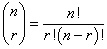
To demonstrate this, we use basic statistics of the form n-choose-r, where !, such as n!, is equivalent to n factorial, to arrive at the formula for how many pairs or permutations we can choose from n items:
For the number of pairs, we can reduce the above formula to the following:
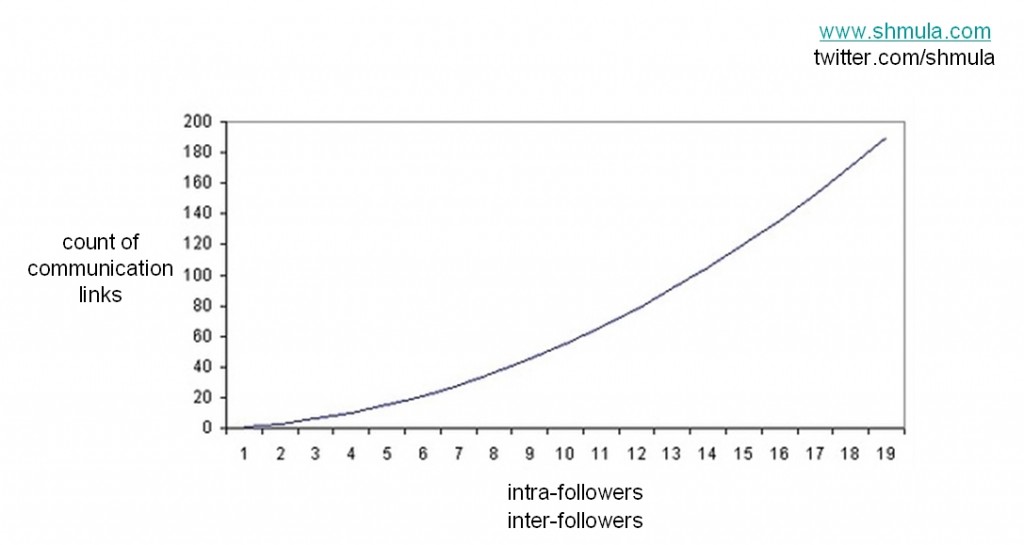
Visually, as inter-followership grows, the communication links grows non-linearly, but quadratically (n! grows exponentially) — in either case, the function is clearly not linear:

Mutually Exclusive, Comprehensively Exhaustive (MECE)
JP runs a really fun experiment that validates his hypothesis that tweets in the universe of Twitter are comprehensively exhaustive 3. What his experiment does not show is the exclusiveness of the tweets — that is, their uniqueness from each other. On its face, this is not a big deal, but in scientific inquiry, being able to compartmentalize objects in unique buckets is helpful.
One reason it is difficult to classify tweets as mutually exclusive in content is because there are Replies and Retweets. There is probably an innovative way to find the unique and mutually exclusive clusters in the corpus that is Twitter — that would be fun work for a computational linguist.
For this post, this is not a big deal, but I just make this point for clarity — really great experiment, JP.
A Conclusion
Ummm, I don’t really have a conclusion or a point, except for that I think Twitter is pretty amazing and that Twitter can and should encourage computer scientists, computational linguists, behavioral economists, combinatorial mathematicians, set theory geekzoids, game theory freakonomica, cultural anthropologists, and others to participate in and learn from this massively human experiment.
I really like Twitter — oh, by the way — retweet this post…
- my personal criteria for an atomic and pragmatic definition of a concept is if it can be explained to normally-functioning-and-average human that is 15 human years or younger ↩
- I make a distinction between inter-followership and intra-followership where the former is a set where each member follows each other and the latter is a set where the followership is disjointed. However, for the purposes of Twitter, inter-followership and intra-followership doesn’t matter so much since a follower has the same rank as the non-follower to the one being followed — their voices are not weighted differently ↩
- This is my term that I use to explain his point, but he does not use the terms Mutually Exclusive or Comprehensively Exhaustive in his writings. ↩
Become a Lean Six Sigma professional today!
Start your learning journey with Lean Six Sigma White Belt at NO COST

![[VIDEO] Understand the Lean Startup](https://opexlearning.com/resources/wp-content/uploads/2017/11/lean-startup-agile-innovation-creative-inspired-shmula-150x150.jpg?x26663 "[VIDEO] Understand the Lean Startup")


Dave Jenkins says
Your equations seem solid enough. What may be interesting is to figure out the ranking of someone’s ‘assymetric following’, which could be an indicator of their popularity.
1. If we assumed that the baseline model would be that everyone in a group connects to everyone else in that group, then we would have the n(n-1)/2 model. Let’s call this number B (for Baseline).
2. However, if someone has a huge following, then their number of connections would deviate from that baseline. As you state: [n r] [n!/r!(n-r)!]
3. Because r would be lower, r!(n-r)! would be smaller; the overall equation would be higher number. Let’s call this number C (for Cool factor).
4. The difference between B and C would be the degree to which someone has an assymetric following. It may be a way to rank their cult-like personality.
Oliver says
Great Henri Poincaré’s beard, you have made my day! I see you have more like this; amazing. Looking forward to plunging into the archives.