
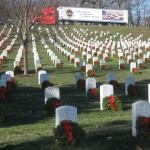
At least 211 United States veterans are in unmarked or unrecorded graves in Arlington National Cemetery 1. Army officials report that remains were found in graves listed as “empty” and several urns were discovered on a “pile of dirt”. Like most quality problems, this is most likely just the tip of the iceberg.
There are about 300,000 veterans buried in Arlington National Cemetery. Assuming no other quality defects are found. This means that 0.07% of the veterans buried in the Arlington National Cemetery are defective in some way.
This means that at least 0.07% of the veterans buried in the Arlington National Cemetery – their burial is defective in some way.
House Armed Services Committee Chairman, Ike Skelton, said:
Arlington National Cemetery is a sacred shrine and it breaks my heart to learn about mismarked grave sites, mishandling of remains, missing documentation, and failures to notify next-of-kin. This conduct is disgraceful and cannot be tolerated.
Like most quality problems, they can be prevented and are, in fact, avoidable.
It’s Your Turn
Would single piece flow work for the “death industry”? Indeed, “take one, put one” might prevent the grave “switcheroo” problem. How would you approach this problem?
- George Washington Parke Custis acquired the land that now is Arlington National Cemetery in 1802, and began construction of Arlington House. The estate was passed down to Custis’ only surviving child Mary Anna Custis Lee wife of Robert E. Lee, who was a West Point graduate and United States Army officer. When Fort Sumter was forced to surrender at the beginning of the American Civil War, President Abraham Lincoln offered Lee the command of the federal army. Lee demurred, because he wanted to see how Virginia would decide.
When Virginia announced its decision, Lee resigned his commission and took command of the armed forces of the Commonwealth of Virginia, later becoming commander of the Army of Northern Virginia. He quickly established himself as an able commander, defeating a series of Union generals, until his final defeat and surrender at the McLean House. Because of this decision and subsequent performance, Lee was regarded as disloyal by most Union officers. The decision was made to appropriate a portion of Arlington as a graveyard for mostly Union dead.
American military cemeteries developed from the duty of commanders on the frontier and in battle to care for their casualties. When Civil War casualties overflowed hospitals and burial grounds near Washington, D.C., Quartermaster General Montgomery C. Meigs proposed in 1864 that 200 acres (0.81 km2) of the Robert E. Lee family property at Arlington be taken for a cemetery.
The government had acquired Arlington at tax sale in 1864 for $26,800. Mrs. Lee had not appeared in person, but rather had sent an agent, attempting to timely pay the $92.07 in property taxes assessed the estate. The government turned away her agent, refusing to accept the tendered payment. In 1877, Custis Lee, heir under his grandfather’s will passing the estate in trust to his mother, sued the United States claiming ownership of Arlington. After the U.S. Supreme Court ruled 5-4 in Lee’s favor in 1882, deciding that Arlington had been confiscated without due process, Congress returned the estate to him. The next year Custis Lee sold it back to the government for $150,000 at a signing ceremony with Robert Todd Lincoln, Secretary of War.
Military burials were previously done at the United States Soldiers’ National Cemetery in Washington, D.C., but space was filling up. “We pray for those who lost their lives.”, Meigs wrote, “The grounds about the mansion are admirably adapted to such a use.” Burials had in fact begun at Arlington before the ink was even blotted on Meigs’s proposal.
The southern portion of the land now occupied by the cemetery was used during and after the Civil War as a settlement for freed slaves. More than 1,100 freed slaves were given land at Freedman’s Village by the government, where they farmed and lived during and after the Civil War. They were turned out in 1890 when the estate was repurchased by the government and dedicated as a military installation.
President Herbert Hoover conducted the first national Memorial Day ceremony in Arlington National Cemetery, on May 30, 1929 ↩
![]() |
![]() |
![]() |
||
This post was written by Pete Abilla | ||||


Jeff Bezos and Root Cause Analysis
The Apple iPhone Supply Chain
The Toyota A3 Report
Queueing, Disneyland, and FastPass
Quality and Continuous Improvement;
{ 0 comments… add one now }