
Podcast: Play in new window | Download
Subscribe: Apple Podcasts | RSS
This post will briefly explain and answer “What is a Control Chart?”
At the bottom of the page, you can grab a series of Control Chart Excel Templates that you can download for FREE!
First off: entire books and PhD dissertations are written about Control Charts – this short post won’t do it justice. So, please learn on your own what I will most likely not cover in this article.
Every process varies. There is an inherent variation, but it varies between predictable limits. There are two types of variation: “common cause” and “special cause”. If you are cutting diamonds, and someone bumps your elbow, the special cause can be expensive. But, in diamond cutting and no elbow was bumped, the process itself will inherently have variation – that is called common cause.
For many processes, it is important to notice special causes of variation as soon as they occur and appropriately respond.
All control charts have three basic components:
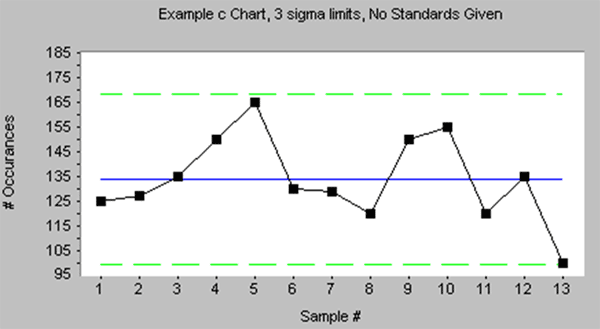
- A centerline, usually the mathematical average of all the samples plotted.
- Upper and lower statistical control limits that define the constraints of common cause variations.
- Performance data plotted over time.
Here is an example of a control chart:
Here are some popular control charts (included in the download below):
- Variable Data
- Individuals and Moving Range (X and MR or I and MR)
- Average and Range or Average and Standard Deviation (X-bar and R or X-bar and S)
- Estimated Weighted Moving Average (EWMA)
- Cumulative Sum (CUSUM)
- Attribute Data
- Proportions (P and NP)
- Defect Count (C and U)

Become a Lean Six Sigma professional today!
Start your learning journey with Lean Six Sigma White Belt at NO COST


Frank Sides says
I think you may have wanted to type “common cause” for the example of the diamond cutting with no elbow bumping.
Keep up the good articles. I enjoy them very much!
Pete Abilla says
@Frank – yes, thanks for catching that mistake. Corrected.