
Podcast: Play in new window | Download
Subscribe: Apple Podcasts | RSS
Shiny objects, Brilliant Basics – is it an either/or? From a feature, product, or service perspective, is it as dichotomous as doing the basics perfectly or providing something absolutely stunning and enjoyable and new?
The Kano Model, developed by Noriaki Kano, shows us, in an easy way, the relationship of features to customer delight – and it’s not an either/or.
Below is the Kano Analysis – one of the most important models that describe and can inform customer experience management, but it is also one that doesn’t get used enough.
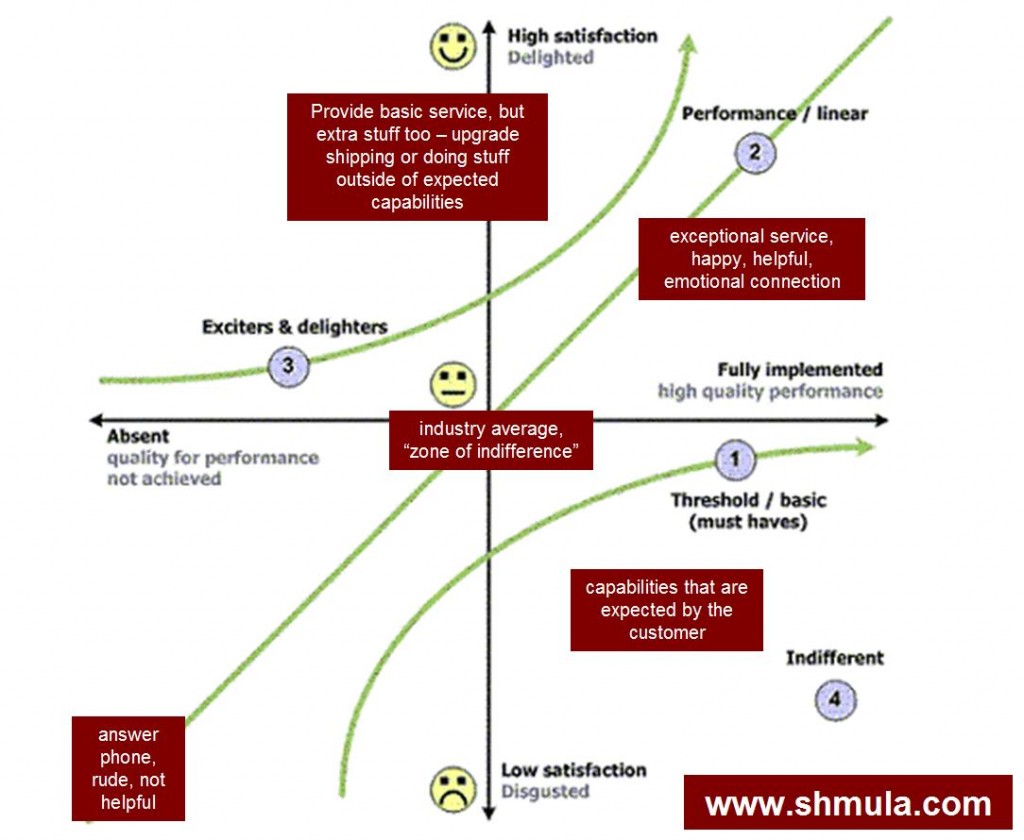
Now let me elaborate on each of the sections of this Kano Model:
Basic, Threshold, Must Have
The bottom curve shows capabilities that are expected by the customer but aren’t necessarily a selling feature. For example, if you buy stereo speakers, you expect them to work. If you buy a television, you expect it to render visual images on the screen. The presence of these features does not improve customer experience, but missing these basic features can severely harm the customer experience – missing these basic features can create a VERY strong emotional reaction from customers and WILL harmfully impact customer satisfaction, future sales, and the customer experience.
I bought a TV and the screen doesn’t work
Other examples that fall under the basic-threshold-must-have curve are:
- A retailer charges your credit card the right amount
- An ecommerce site ships you the right item, right quantity, and within the expected delivery window
- A phone that can make calls
Performance, Linear
The middle curve – Performance/Linear – are capabilities that have a linear relationship to customer satisfaction. In other words, the more you provide, the happier your customers will be.
For example, you manufacture a car that is capable of 20 miles per gallon (mpg); the next year, the same model and some tweaks now is capable of going 50 miles per gallon (mpg). Your satisfaction increases proportionally.
Other examples of capabilities that have a linear relationship to satisfaction:
- Increase in mobile coverage
- Caffeinated soda – more caffeine, but less bloat
- Increase in Google search speed
- Greater selection on Apple iTunes, Amazon, or other online storefront
Exciters and Delighters
The top curve shows capabilities that are unexpected by the customer. Their presence can improve customer satisfaction greatly, but not having them will not be a deal breaker for the customer. Here are some examples:
- You buy something from the store and they throw in a free gift
- You call AT&T with a question about coverage and they give you an iPhone for free
- You go to the Apple store to look around and Apple gives you an iPad just for “being there”.
- Free upgraded shipping on Zappos
- Calling Zappos for something they don’t sell – and, they actually provide it for you (call Zappos for Pizza, see what happens)
- An emergency room that guarantees only a 10 minute wait time
- Or a supply chain that allows you to track where your stuff is – visible material flow across geographies and processes (where’s my stuff?)
Most of the time, these unexpected and delightful features are what can create very loyal and satisfied customers.
Zone of Indifference
This zone, right below the Basics, Must Have, and Threshold curve, is the zone of indifference. This zone contains capabilities where more of or less of does little to nothing to customer satisfaction or to the customer experience.
Kano Zone of Indifference: no increase to satisfaction when provided, no decrease to dissatisfaction when absent
For example,
- $0.50 price difference between two product – no impact to satisfaction or dissatisfaction
- A Laptop that is colors other than black or grey
- Another social network
Why Care about Kano?
Knowing which features and capabilities meet your customers basic needs, which features will excite them, and which features they are indifferent to will help WHAT you decide to focus your resources on.
It’s Your Turn
What features or examples do you have that fall under the Delighter, Basics, Indifferent, or Performance curves? Does knowing Kano’s Model matter? How does Lean Thinking align with Kano’s Model?
Become a Lean Six Sigma professional today!
Start your learning journey with Lean Six Sigma White Belt at NO COST




Leave a Reply