
 ER Wait Times and Queueing Theory is an article exploring queueing and waiting times in healthcare.
The Emergency Room plays a vital role in patient care and plays an important role in communities and society. According to the CDC, there were 119.2 million visits to the Emergency Room in 2007 1. Indeed, the demand for emergency room care is great.
With the aging demographic, we can expect the demand for emergency care to only increase, compounding the already heavy burden on finite critical care resources. One outcome of this dynamic is that patients might have to wait longer in order to receive emergency care.
This, of, course, is antithetical to the notion of “emergency care”, which implies that you need care now, not in 2 hours. One way healthcare professionals deal with this is through preventive care and education – there are some ailments that don’t need emergency care. Reducing the number of inbound ER patients can reduce the burden and free-up capacity for those more in need.
 Another approach is to manipulate the natural Queueing System and its properties. One important property of Queueing Systems is that they are “bursty” – that is, things happen almost all at the same time. This is the “rush hour” phenomenon. But, on other times, things are really slow. How can the ER level demand ac
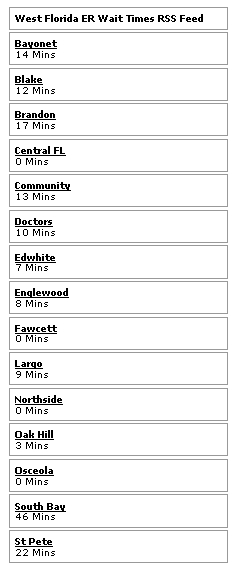 ross busy and non-busy times? To answer that question, healthcare professionals are publishing their Emergency Room Wait Times. They do this for several reasons:
- Publishing ER Wait Times is a form of Visual Management coupled with public scrutiny. If ER Wait Times are high, then it allows the ER Staff to self-assess and adjust accordingly to bring that Wait Time down. In other words, increase capacity by either bringing in more MDs and RNs or just working faster.
- Publishing ER Wait Times can be a strategic marketing move. If one needs to go to an ER, most people would prefer to go to one where the Wait Time is lower. Providing Wait Time information can help the patient make a better decision.
- Publishing ER Wait Times is a way for hospitals to level-load across busy times and non-busy times. But, the level-load is at the discretion of the patient – whether they decide to go to the ER during a busy time, wait until the wait time is agreeable, or go to another hospital. Of course, sometimes patients don’t have a choice, especially when the emergency is truly life threatening.
Door-to-Doc-to-Door: Emergency Room Process Steps
In general, the steps in an Emergency Room are the following:
- Patient Arrival
- Triage
- RN Assessment
- MD Assessment
- Initial Diagnosis and Treatment
- Diagnostic Testing
- Follow-up or Treatment Planning
- Discharge or Hospital Admit
While there are roughly 8 steps, as most of us know, the ER experience isn’t as simple as I make it out to be. The service delivery steps can be quite complex and the needs of other patients can impact the service you are receiving. In other words, unpredictability is a big factor. That is not to say that there isn’t waste in the service delivery process – because there is – but the greater unknown is the emergency that is greater than yours, which will impact the service you are receiving.
Emergency Room Statistics
Before going into the mechanics of Queueing, let’s look at some historical data on Emergency Room visits:
- Number of visits: 119.2 million
- Number of injury-related visits: 42.4 million
- Number of visits per 100 persons: 40.5
- Most commonly diagnosed condition: injury and poisoning
- Percent of visits with patient seen in fewer than 15 minutes: 22%
- Median time spent in emergency department: 2.6 hours
- Percent of visits resulting in hospital admission: 13%
- Percent of visits resulting in transfer to a different hospital: 1.9%
On Emergency Room Queueing
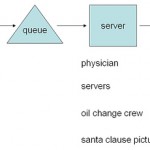
Important queueing properties of a system are the following:
- λ = Arrival Rate, or more specific, the time between arrivals. For most queues, we can assume that the arrival distribution can be approximated by a Poisson distribution; which means that the time between arrivals are not deterministic, but random. More specific, the Mean and Standard Deviation are approximately the same. We experience this as “traffic congestion” or “lunch hour rush” – it happens all at the same time.
- μ = Service Rate, or the time it takes to service an arrival. This can also be called Cycle Time in other contexts.
Here, we use a single-server model, which is a good approximation for most queues. Let us assume the following:
- λ = 50 patients / 8 hour day (480 minutes) = 6.25 patients arrive per hour on average
- μ = Assume that 12 patients are serviced per hour (in-and-out) on average
The assumptions above give us the following:
Occupancy, Traffic Intensity, Utilization
P = (λ / μ)
so,
P = (6.25 / 12) = 2.99 patients on average are served per hour
Door-to-Doc-to-Door: Total Time Spent in System
Ts = (1 / (μ λ))
So,
Ts = (1 / (12 6.25)) = .17 * 60 minutes = 10.43 minutes total time in system
Now, we know from experience that 10 minutes door-to-doc-to-door is not reality. I purposely made Average Service Rate greater than Average Arrival Rate, but in most cases that is not true. but we’re not too far off – CDC data tells us that 22% of ER cases were door-to-doc-to-door in under 15 minutes.
Design Thinking and the Emergency Room
Aside from the technical aspects of time and waste, there is a big opportunity for Design Thinking in making the experience from Door-to-Doc a more pleasant one. Design Thinking can be very powerful here.
Hospitals that Publish ER Wait Times
Below is a list of Hospitals that publish Emergency Room Wait Times. I’m sure I’ve missed many; if you know of one that I haven’t included below, please include it in the comments:
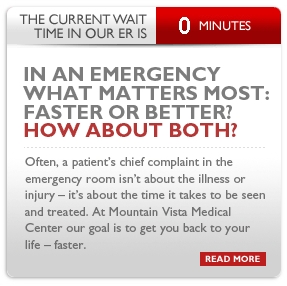
- Mountain Vista Medical Center
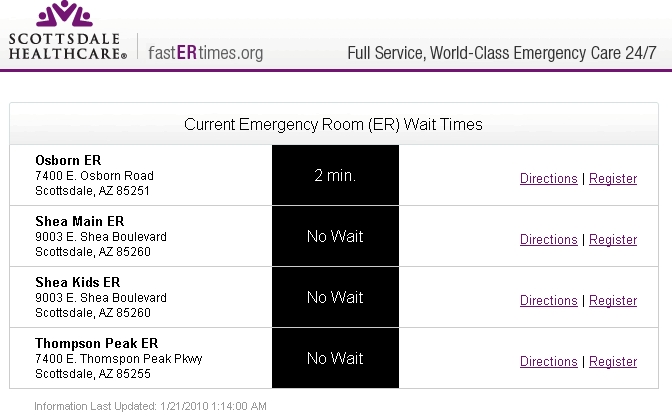
- Scottsdale Healthcare
- Osborn ER
- JFK Medical Center
- Aventura Health and Medical Center
- Blake Medical Center
- Brandon Regional Hospital
- Oak Hill Hospital
- Englewood Community Hospital
- Lawnwood Regional Medical Center
- North Florida Regional Medical Center
- Ocala Regional Medical Center
- Regional Medical Center at Bayonet Point
- Memorial Hospital of Jacksonville
- Osceola Regional Medical Center
- Lake City Medical Center
- Sun Coast Hospital
- Palms West Hospital
- Northwest Medical Center
- Source, CDC: http://is.gd/6ISBJ ↩
Become a Lean Six Sigma professional today!
Start your learning journey with Lean Six Sigma White Belt at NO COST




Wayne Guerra says
I am the Chief Medical Officer for iTriage. iTriage is a multi-platform symptom to provider acute care decision tool that helps patients make better health care decisions. We list ER wait times to our mobile users allowing them to access this information when they away from their computers. Our application is free in the iTunes and Android stores and can be used on any smartphone or desktop computer at:
http://www.itriagehealth.com. To see a demonstration search ERs in the 33180 zip code.
Karen Wilhelm says
Our local hospital system has fake ER service promises. You do have a very short wait in the general waiting/triage area, but long waits alone in a treatment room.
Example, for a cut hand, nurse applies dressing within 10-15 minutes, recommends and administers tetanus shot. 5 minutes later, led to a treatment room. In the next 15 minutes, doc comes in room, assesses damage, and determines stitches are the solution. No tendon damage, serious contamination risk, infection. Long wait for person qualified to put in stitches to appear. Total time, pretty long.
I’ve also gone there for back pain, with long waits in treatment room for doc, long wait to get an x-ray, long wait for doc to come back to treatment room to see x-ray. Result: no idea what’s causing the pain. Suggestion I see my rheumatologist to see if she wants to do an MRI. Three or four hours consumed.
Sarah says
I watched a patient interaction today that kind of ties into queueing questions, albeit differently: IV PCA (patient-controlled anesthesia) use.
The principle is a powered IV that is programmed by the anesthesiologist to allow measured boluses of the painkiller to be delivered into the IV line each time the patient presses a button. The bolus can only be delivered after a specified lapse from the previous dose (say, 8 minutes minimum), and there is a maximum combined dose per hour (say, 4 boluses max).
What was interesting was seeing how the patient reacted to the IV PCA, how he responded both to the sense of control (the button) and the sense of “out-of-control” (repeated button pressing because he didn’t know when the press would actually deliver medicine). Also interesting was how his behavior changed once he was given the information as to when the next bolus was available.
Also odd were the reactions of the pain nurse and doctor, who admitted that they intentionally do not provide guidance in device use, because they want to review the device reports (how many presses, how often) to use as a gauge of pain level over time “in case the patient can’t tell us”. [It was pointed out that the device includes a display that indicates time remaining until next dose available. The nurse countered that “it isn’t intended for the patient to see.”]
Another stated reason was that if the patient understands about the timed doses, he will watch the clock constantly (therefore not resting) and push the button whether he needs the pain control or not (and then “overdose” ” the doctor’s word). [It was pointed out to the doctor ”!” that the IV PCA system requires the *doctor* to program in both the size of the boluses and the hourly maximum delivery, so it is under the MD’s control.]
I wonder if the pacing lessons learned in queueing theory could be applied to improving pain control?
David Van Sickle says
Thanks for this great article.
A while back, I put together a small, simple site that aggregates ER wait times published by hospitals but also makes it possible for people to report their times for any hospital / urgent care.
I’ve been adding hospitals gradually and am up to ~60 or so. There’s a list on the site of all known facilities that publish times online. If I’m missing any, please send me a note.
Most of all, I’d be interested to hear your thoughts about whether or not this has any potential public utility.
Thanks again for the thoughtful and informative post.
David
Kaley says
I have used the iTriage application (mentioned by Mr. Guerra below) on my Android phone… it is an awesome application! It definitely saved me time and money by directing me to the nearest Urgent Care (AfterOurs) rather than going to the ER.
Eileen Benson says
It was interesting when you talked about how queuing systems need to be able to handle the “rush hour” phenomenon that can cause a lot of things to happen at once. When I think about it, it must be especially important to account for this in the ER where medical emergencies are common. I enjoyed reading your article and learning more about the factors that make up an effective queueing system!