You are here: Lean Six Sigma Home » Operations Management » Introduction to Forecasting

Introduction to Forecasting

by Pete Abilla on January 22, 2007

Interested in a free 25+ eBook on the 7 Wastes? Please DOWNLOAD HERE.

introduction to forecasting, demand planning

This article is part 1 of a series on Forecasting.

A forecast is an estimate of the future level of some variable. That variable is most often demand but could also be supply or price. Most companies forecast in order to help the firm in strategic planning activities such as inventory purchasing, capacity planning, labor planning, etc.

There are different forecasting techniques — both qualitative and quantitative. In this article, I will only discuss quantitative techniques, where to use which model, and the strengths and weaknesses of each model.

Laws of Forecasting

  1. Forecasts are Always Wrong: No forecasting approach or model can predict the exact level of the future variable. Point estimates are almost always off by some amount. Just understand this fact up-front, and deal with the risks (which we’ll talk about too).
  2. Forecasts for the near-term tend to be more accurate: Predicting tomorrow’s gas price will likely be more accurate than predicting gas price 6 weeks from now.
  3. Forecasts for groups of products or services tend to be more accurate: Predicting the demand for trucks will likely be more accurate than predicting for green trucks with a 6-disk cd player.
  4. Forecasts are no substitute for calculated values: If you know actual demand, then this is more accurate than a forecasts. This is trivial, but let me explain: for example, you manufacture widgets and your customer has placed a purchase order of 6000 widgets. That purchase order is an actual future value of widgets that you need to manufacture. Use that number instead of a forecast using historical data.

There are several quantitative forecasting methods available. Where there is historical data available and the variable of interest appears to be a function of time, then the following models are available: Moving Average, Weighted Moving Average, Exponential Smoothing, and Linear Regression. Where there is historical data available and the variable of interest appears to be a function of something other than time, then Linear Regression and Multiple Regression make sense to use. Below is a decision tree which shows which models make sense to use and when:
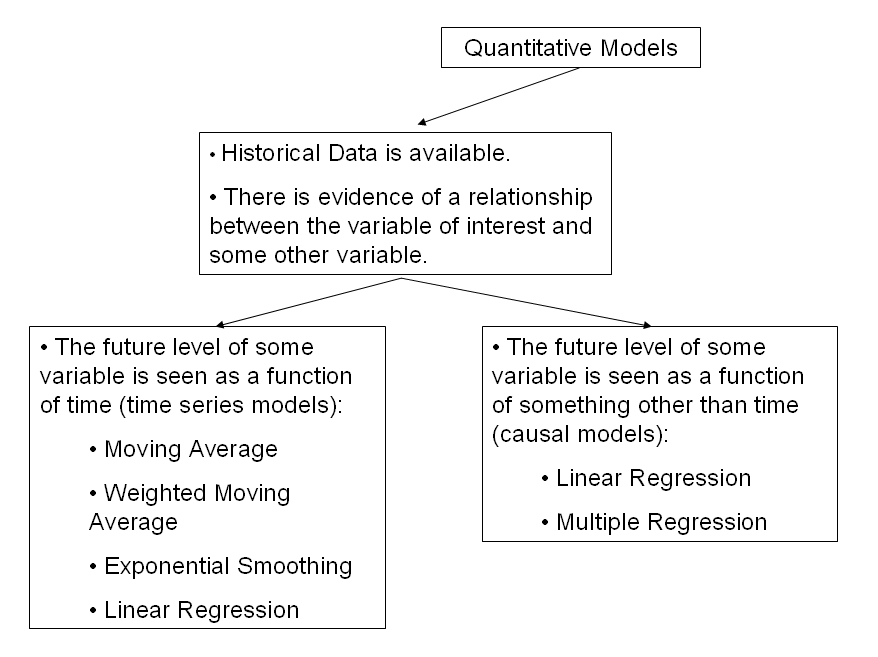
shmula.com, introduction to forecasting


In the proceeding articles in the Forecasting Series, we will discuss Moving Average, Weighted Moving Average, Exponential Smoothing, Linear and Multiple Regression. We will also discuss measure of Forecast Accuracy, most notably Mean Forecast Error and Mean Absolute Deviation. Toward the end of the series, we will discuss alternative approaches to Forecasting such as Sales & Operations Planning, and the Toyota Production System or Lean response to Forecasting Law #1, such as Heijunka. Stay tuned.

search terms for this article:

introduction to forecasting, introduction of forecasting, FORECASTING introduction, Laws of Forecasting, lean forecasting, toyota forecasting methods, introduction to business forecasting, introduction to Forecasting techniques, is there a correlation between lean and just-in-time and forecasting?, discuss forecasting demand, introduction to forecasting methods, forecasting in production management, forecasting for production planning principles, forecasting laws, 4 laws of forecasting, itroduction of forecasting, business law forecast process, introduction of forcasting, methods and techniques of business forecasting ebook, principles of forecasting in production and operation management, principles of forecasting+operation management, principles that forecASTS NEED TO FOLLOW, qualitative and quantitative methods of forecasting in strategic planning, quantitative forcasting in production operation management, quantitative model for decision making, quantitative techniques toyota, sales forecasting methods in toyota, principles of business forecasting, is there a correlation between lean and just-in-time and forecasting, predicting the future an introduction to the theory of forecasting free ebook, models of forecasting in business, measure and forecast demand of toyota, moving average forecasting applications in business, manufacturing business forecasting examples, what are principles of forecasting in context of prodution and operation management, lean principles in the forecasting process, operations four basic principles of forecasting, operations management forecasting quantitative qualitative, sales forecasting methods LAW PRACTICE, six sigma and buisness forecasting, toyota method of forecasting demand, toyota production forcast for different models, toyota qualitative approach, various forecasting technique in manufacturing, various forecasting techniques in operations management, various forecasting techniques in production and operation management, weakness ofquantitative forecasting method, What are Forecastvariables in production and operation management, what are the four laws of forecast, what are the rules of forecasting demand, what are the strenghths and weaknesses of quantitative and qualitatrive methods in forecasting?, what are three principles of forecasting, what is the difference between forecasting methods and just in time, toyota forecasting tools, toyota forecasting technique, Strength and weaknes of Qualitative method in forecasting, strength and weakness of forecasting technique, Strength and weakness of qualitative and quantitative methods of forecasting, strength and weakness of quantitative and qualitative forecasting methods, strength and weaknesses of qualitative and quantitative forecasting, strength and weaknesses of quantitative method of forecasting, strength of quantitative method in forecasting, Strengths and weakneses of qualitative and quantitative forecasting methods, strengths and weaknesses of toyota, techniques for forcasting and production, toyota demand forecasting, toyota forecast planning, toyota forecasting model, why toyota using qualitative and quantitative method forecasting, An introduction to the theory of forecasting, financial forecasting laws, financial forecasting principals, financial forecasting principles, forecast introduction, forecasting in lean systems, forecasting introdcution, forecasting introduction to operation management, forecasting lean, forecasting lean systems, forecasting legal implications, forecasting methods for toyota sales, forecasting methods of toyota, examples of forecasting methods, example sales forecasting historical data moving averages regression, articles for qualitative vs quantitative forecasting in operations management, business forecasting methods, Business Forecasting methods or techniques, businesses that use forecasting methods#sclient=psy-ab, correlation between Lean and Just-in-Time and forecasting, demand forcasting qualitative methods, demand forecasting for production management, demand forecasting introduction, demand forecasting toyota, discuss the weakness and strength of qualitative and quatitative methods in forecasting, DISSCUSS QUANTITIVE METHOD OF DEMAND FORCASTING, do lean companies forecast, forecasting model for toyota, forecasting model strengths and weaknesses, introduction of basic business principles, introduction of demand forecasting

Related Articles:


This post was written by

Leave a Comment