
Last year sometime, while I was in Dallas, Fort Worth, for business, a few buddies and I ate at a highly-recommended restaurant called Texas de Brazil. It’s one of those all-you-can-eat meat places, with gourmet-style meats, a great salad bar, and just an excellent atmosphere. While I’m not a huge carnivore, I have to admit the food was very, very good.
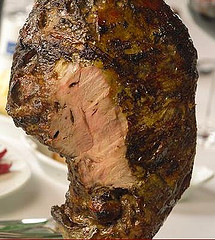
Another thing was impressive about their restaurant operations: they actually used elements of Lean: Kanban and Takt Time:
 What is Kanban?
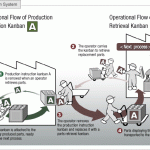
Kanban is an important step in the Toyota Production System. Kanban is a visual control that signals to the previous step that it is need of more resources, material, or something other. Kanban is similar to a gasoline light in a car. When a car is in need of gasoline, the gasoline light blinks as a signal to the driver to get more gasoline. At Toyota, every step in the manufacturing process has a Kanban, creating a “pull” effect that cascades backwards to the beginning of the manufacturing cycle. It’s a simple, yet very powerful way of satisfying customer demand, where the customer “pulls” and the Kanban is used to signal to every step in the process the need for resources.
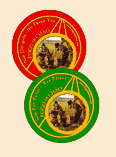
At the restaurant, they had their own version of the Kanban. They had 2 colored coasters: Green and Red. Green is a signal for more meat; red is a signal to stop. Again, this was a simple system, but a powerful one. The coasters signals to the server, and when the server runs out of meat, he visits the kitchen for more meat, where they have their own Kanban system set-up. The cascade continues, beginning at the customer who “pulls” for resources and cascades all the way to the start of the process, in this case the cook in the Kitchen. It was fascinating and remarkably powerful and easy.
What is Takt Time?
Takt time comes from a German word “takt”, which means rhythm or beat. Takt time is not the same thing as Cycle Time or Lead Time, though Takt Time has a very real relationship to both. Takt Time must be measured through a simple calculation:
(Takt Time) = (Net Available Time per Day / Customer Demand per Day)
Takt time is measured as (Time/Piece), not the other way around. This is important because the operator knows that he or she only has so much time per x.
In my restaurant experience, there were several servers on the floor. But, it appeared that they were moving to some beat. As they visited tables to serve meat, I qualitatively noticed that they were at the table for ~20 – ~30 seconds. This appeared to me to be some sort of soft Takt Time, such that they have (30seconds/table) in order to keep the rhythm or beat in constant motion — to a large measure, Takt Time is about the maintenance of “Flow”, which is very important in queueing efficiency. This, of course, is not a strict example, because people eventually stop eating meat, but the volume of people this restaurant had, I think, justifies Takt Time for servers.
Kanban: A Conclusion
All in all, the food was great. And, I was able to see an innovative manifestation of Kanban and Takt Time. A great experience.
Become a Lean Six Sigma professional today!
Start your learning journey with Lean Six Sigma White Belt at NO COST
Mark Graban says
Peter – let me know if you’re ever back in the DFW area!
I’ve seen the red/green indicators before. I’d be curious about how far back the pull really goes…. depending on the lead time to cook more meat, they’d have to keep some “stock” I’d imagine, a kitchen “re-order point” if you will about when to start cooking more of a particular meat? That would be fascinating to see.