
At the beginning, we introduced the the principles of Lean for Service Operations.
In subsequent posts, I attempted to explain each principle and showed examples and case studies of lean for service operations along the way.
Today, I share a before and after of how the principles of Lean Consumption or Lean for Service Operations were applied to the benefit of the customer and service provider.
Lean For Service Operations: A Case Study
In the United States, it is an annual exercise to register your car or vehicle. That means taking your vehicle to the department of motor vehicles, showing that the car meets the safety and emissions standards for the state, and paying the annual motor vehicle tax.
I had to do this recently and I recorded the steps. Below is a picture of the steps I took to register my car or motorized vehicle (click on image to see a larger view):
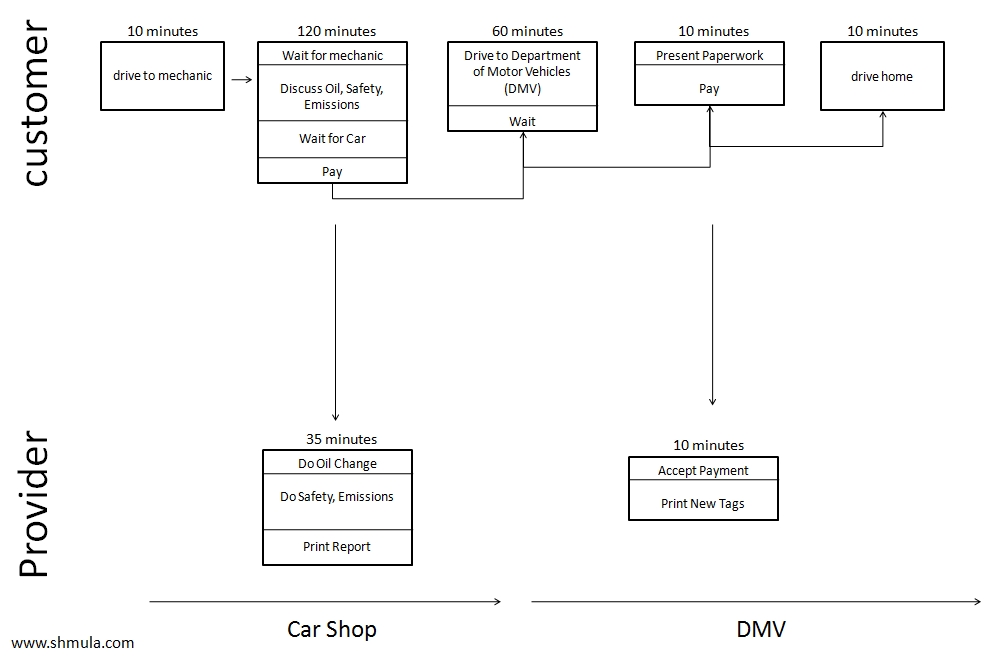
Notice that it took me over 210 minutes to drive, have my oil changed, get safety and emissions test performed, drive to the department of motor vehicles (DMV), show them my papers, pay my annual motor vehicle tax, and get my 2011 stickers to place on my car.
For the two providers – the Car Mechanic and the Department of Motor Vehicles (DMV) – it took both service providers a total of 45 minutes to serve me.
But recently, in the State of Utah, Jiffy Lube and the State of Utah has a partnership. That program is called On-The-Spot Renewal, which significantly changes the process above.
With this program, the services of the Department of Motor Vehicles (DMV) are handled by Jiffy Lube. This is an example of service aggregation. Because of that, now look at the “After” Lean Consumption Map below to see the difference:
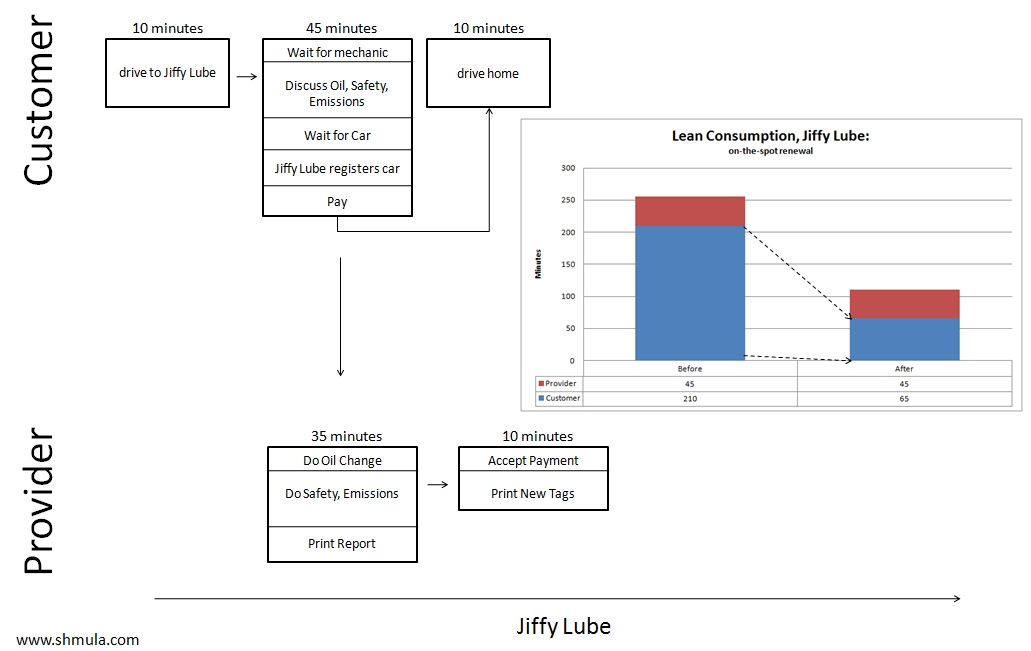
From the perspective of the Customer, there was a very big improvement – a large reduction in wait time and hassle. This application of the principles for Lean for Service Operations is innovative and is responsible for revenue lift for Jiffy Lube. Some estimate that the revenue lift for Jiffy Lube because of this service is in the 9% range, which is non-trivial for a $150 million dollar company.
It’s Your Turn
In the business you are in, how will you apply the principles of Lean Consumption or Lean for Service Operations?
Become a Lean Six Sigma professional today!
Start your learning journey with Lean Six Sigma White Belt at NO COST




Leave a Reply