
The principles of Lean Thinking 1 has gone well beyond the factory floor. With the rise of more consumer – provider services, the service industry2 is quite ripe and in need of the principles of Lean Thinking.
In an article back in 2005, Womack and Jones expand the principles of Lean Thinking in an article published in the Harvard Business Review (HBR) as “Lean Consumption”.
In this series on Lean Consumption, I’ll lay the groundwork for what Womack and Jones detail in that paper and share a personal, real-world example of a process before the principles of Lean Consumption were applied. Then in subsequent posts, I’ll explain each of the six principles in detail and show how the process and service3 experience is improved through the application of Lean Consumption principles to the benefit4 of both customer and service provider.
In subsequent post in this series, I’ll explain each of the above Lean Consumption Principles in detail.
Lean Consumption: A Case Study
In the United States, it is an annual exercise to register your car or vehicle. That means taking your vehicle to the department of motor vehicles, showing that the car meets the safety and emissions standards for the state, and paying the annual motor vehicle tax.
I had to do this recently and I recorded the steps. Below is a picture of the steps I took to register my car or motorized vehicle:
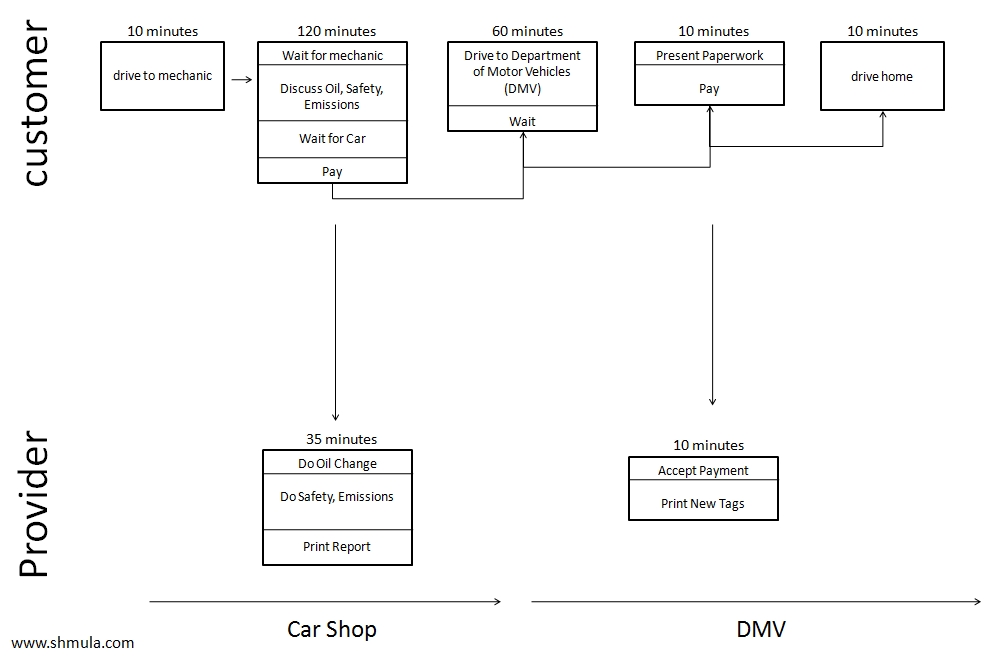
Notice that it took me over 210 minutes to drive, have my oil changed, get safety and emissions test performed, drive to the department of motor vehicles (DMV), show them my papers, pay my annual motor vehicle tax, and get my 2011 stickers to place on my car.
For the two providers – the Car Mechanic and the Department of Motor Vehicles (DMV) – it took both service providers a total of 45 minutes to serve me.
Practice Over Theory
Okay, Lean Thinker, now consider the following:
- Which steps for both consumer and service provider would you consider waste?
- Given the principles of Lean Consumption, what might be done to alleviate the burden on both customer and service provider?
In the next post, I’ll show how one company saw this problem as an opportunity and created a business around it. Indeed, they saw this problem and created an innovation that is now responsible for 9% of revenues, which is significant for a company with revenues over $150 million.
- Also known as (Lean Management, Lean Enterprise, Lean Manufacturing, Toyota Production System) ↩
- Service Operations – or, Lean Services – includes effective and efficient customer service, which has a critical impact on customer acquisition, customer retention and cost management. Service operations that are tailored to the needs of key customer segments – while balancing quality and cost objectives – play an integral role in any company’s success. ↩
- Frontline and Field Service Operations can capture value by driving customer-facing, frontline transformation. Working directly with line management and frontline employees, using a variety of transformation tools and techniques based on Lean Management and Six Sigma can help develop lean operations and a culture of continuous improvement ↩
- Creating a Lean Service involves an end-to-end transformation approach”developed from learning while working at Toyota, the world’s best operating system”to bring proven techniques to significantly improve client service operations through uniquely tailored solutions. Heavily leveraging practical lean and Six Sigma approaches and sector-specific expertise in designing and implementing an improved operating system while ensuring long-term sustainability through effective management systems and building organizational mind-sets and capabilities ↩
Become a Lean Six Sigma professional today!
Start your learning journey with Lean Six Sigma White Belt at NO COST


Michael says
The drive from mechanic to DMV. Why couldn’t the DMV have an arrangement where local mechanics, after performing the emissions test, can take care of the fees and paperwork? Failing that, why not set up its own mechanic’s shop to run emissions tests, other required checks, any preliminary maintenance (having never needed an emissions test, I don’t know if your oil change was a necessary part of the process or not) and all associated paperwork in-house?
Michael says
You already came to that conclusion. Never mind:P