
In a tight economy, there is an added emphasis on cost reduction, to maintain healthy profitability for the company. At these times, many organizations turn to Six Sigma and / or Lean methods for help. But, the traditional corporate finance worldview prevents Lean and or Six Sigma from effectively helping the organization in the long-run because the traditional corporate finance model is almost antithetical to the fundamental tenets of Lean Thinking.
Let me explain 1.
Cost Plus Model (Traditional Corporate Finance)
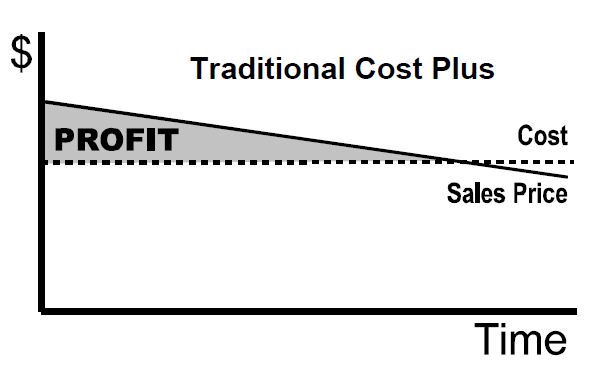
Most organizations believe and build their models based on the following model:
Cost + Profit Goal = Sales Price
For example, suppose I sell lollipops and I want to make $0.75 profit and each lollipop cost me $0.25, then I’d price the lollipops at $1.00.
$0.25 + $0.75 = $1.00
This simple example describes, in general, the corporate finance worldview. The main assumption and emphasis in the traditional corporate finance worldview are the following:
- Costs is fixed (not controllable)
- Price is determined by the company policy or profitability goal
The corporate finance worldview might be illustrated as a traditional cost plus model:
Lean Thinking Model (Costs are Controllable)
In contrast to the traditional corporate finance worldview, the Toyota Production System (also known as the Toyota Production System, Lean Management, Lean Thinking, Lean Manufacturing), views the model differently and with a different emphasis:
Profit = Sales Price – Cost
In the Lean Thinking model, the belief and emphasis are the following:
- Costs are controllable and can be reduced through the application of lean manufacturing methods
- Sales Price is determined by what customers are willing to pay, not by company profitability policies (EBITDA Goals)
In the lollipop example, the market (customer) would define the price of $0.75 per lollipop, and with a cost of $0.25, then the profit would be $0.50. In order to increase the profit, the focus would be on reducing the cost below $0.25, not increasing the cost to the customer (and reducing overall sales and dissatisfaction).
The Lean Thinking model might be illustrated like this:
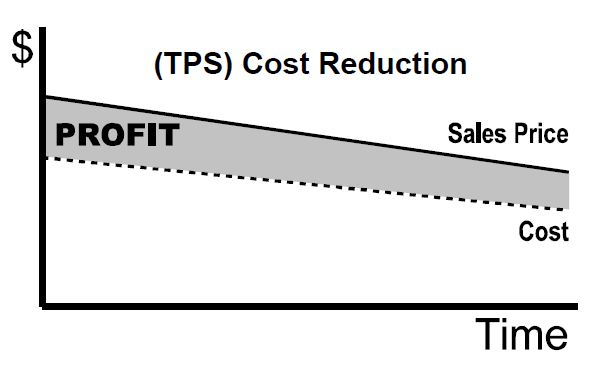
Mathematically, both equations are identical, but the difference in assumptions and emphasis have a significant impact on company behavior, actions in the market, marketing, and the impact on employees and customers.
For example, following the cost-plus or the traditional corporate finance model can lead too pricing products or services above what customers are will to pay, leading to early irrelevance in the market; not to mention, almost completely antithetical to common sense economics.
Why are they Opposed?
 Suppose Lean Methods are adopted to effectively reduce costs from fundamental operations and nothing changes from a corporate finance perspective. In this scenario, the firm could still price itself out the market AND still reap the benefits from lean methods. But, is the firm any better? Perhaps a little – it’s improved the performance and cost of its operation, but sales could be simultaneously plummeting because the price is set at a level customers aren’t willing to pay.
The opposite is also true: perhaps the price customers are willing to pay is higher than where the firm has set it; then, profitability in this case is not maximized.
It’s Your Turn
What do you think? What examples have you seen that follows one of the models above and what was their impact on the employees, customers, and the business?
- inspired by Art Smalley and his numerous writings on this subject ↩
Become a Lean Six Sigma professional today!
Start your learning journey with Lean Six Sigma White Belt at NO COST





Leave a Reply