Featured Image

Interested in a free 25+ page eBook on the 7 Wastes?

Topics covered are the 7 Wastes in:

Software Engineering, Human Resources, Affiliate Marketing, Paid Search Marketing, the Office, Customer Service, the Environment, Product Development, and Medical Billing


47,176 other people have already downloaded it!

You are here: Lean Six Sigma Home » Pareto Principle » Pareto in the Wild: The Forbes Billionaire List

Pareto in the Wild: The Forbes Billionaire List

by Pete Abilla on September 21, 2010

The Pareto Principle is often called the 80/20 rule because it is a visual representation that separates the “vital few from the trivial many”. It is a principle that is most often associated with the quality movement (Lean Six Sigma and Joseph Juran) 1, but its roots are found in Economics and the social sciences. Specifically, the Pareto Principle came from Vilfredo Pareto in 1906 and his studies of the distribution of wealth.

In his discovery, he concluded that 80% of the land in Italy was owned by 20% of the population. Generalizing more broadly, 80% of the wealth in the world is owned by 20% of the population.

Fast forward from 1906 to 2010. Has anything changed?

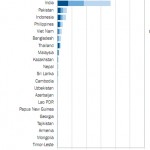
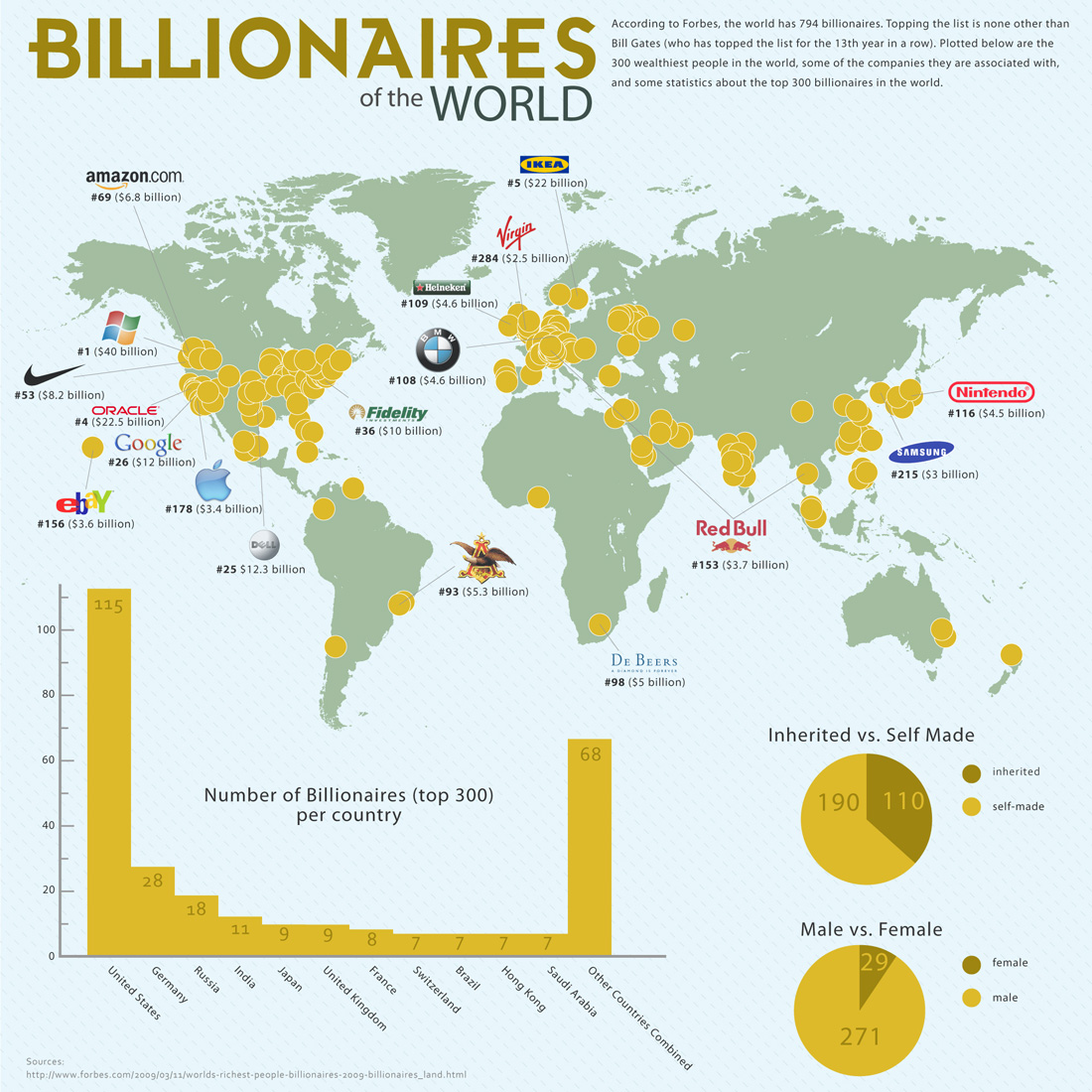
Forbes Magazine publishes its annual Billionaire list 2. The Billionaire Infographic below shows very nicely the Pareto Principle in practice, where the billionaires are stratified by country. You see that the majority are found in the USA.

Question: In what other contexts have you seen the Pareto Principle be applied?

  1. How to Use the Handbook.
    · How to Think About Quality.
    · The Quality Planning Process.
    · The Quality Control Process.
    · The Quality Improvement Process.
    · Process Management.
    · Quality and Income.
    · Quality and Costs.
    · Measurement, Information, and Decision-Making.
    · Computer Applications to Quality Systems.
    · The ISO 9000 Family of International Standards.
    · Benchmarking.
    · Strategic Deployment.
    · Total Quality Management.
    · Human Resources and Quality.
    · Training for Quality.
    · Project Management and Product Development.
    · Market Research and Marketing.
    · Quality in Research and Development.
    · Software Development.
    · Operations.
    · Inspection and Test.
    · Job Shop Industries.
    · Customer Service.
    · Administrative and Support Operations.
    · Process Industries.
    · Quality in a High Tech Industry.
    · Automotive Industry.
    · Travel and Hospitality Industries.
    · Government Services.
    · Health Care Services.
    · Financial Services Industries.
    · Second-Generation Data Quality Systems.
    · Quality and Society.
    · Quality and the National Culture.
    · Quality in Developing Countries.
    · Quality in Western Europe.
    · Quality in Central and Eastern Europe.
    · Quality in the United States.
    · Quality in Japan.
    · Quality in the People’s Republic of China.
    · Quality in Latin America.
    · Basic Statistical Methods.
    · Statistical Process Control.
    · Acceptance Sampling.
    · Design and Analysis of Experiments.
    · Reliability Concepts and Data Analysis.
  2. infographic courtesy of http://www.sizzledtech.com/wp-content/uploads/2010/08/billionaires-of-the-world.jpg

This post was written by

{ 0 comments… add one now }

Leave a Comment