
This article is about the Bystander Problem Application in Business: The Reply All Dilemma – how to detect it and overcome it and gain freedom.
In 1964, 38 people in Queens, New York, witnessed the murder of one of their neighbors, a young woman named Kitty Genovese. A serial killer attacked and stabbed Genovese late one night outside her apartment house, and these 38 neighbors later admitted to hearing her screams; at least three said they saw part of the attack take place. Yet no one intervened.
Social Psychologists call this phenomena the Bystander Problem or Bystander Dilemma or Bystander Effect. I believe the same effect happens in “Reply All” email communication.
Shortly after the incident, psychologists John Darley and Bibb Latané sought to understand this phenomena: How can a handful of people aware of a murder fail to do nothing — how can rational people choose to not help another human being? In answering this thesis, they arrived at one of the most replicable social experiments even to this day.
Cubicle-Seizure Study
 College students sat in a cubicle and were instructed to talk with fellow students through an intercom. They were told that they would be speaking with one, two, or six other students, and only one person could use the intercom at a time. There was actually only one other person in the study ” a confederate (someone working with the researchers). Early in the study, the confederate mentioned that he sometimes suffered from seizures. The next time he spoke, he became increasingly loud and incoherent; he pretended to choke and gasp. Before falling silent, he stammered:
If someone could help me out it would it would er er s-s-sure be sure be good¦ because er there er er a cause I er I uh I’ve got a a one of the er sei-er-er things coming on and and and I could really er use some help ¦ I’m gonna die er er I’m gonna die er help er er seizure er ¦.
The results of the experiment:
- Of the 2 person room, 85% left their cubicles to help.
- Of the 3 person room, 62% left their cubicles to help.
- Of the 6 person room, 31% left their cubicles to help.
Diffusion and Confusion of Responsibility
Notice that the more humans there were, the likelihood of receiving help decreases — there appears to be an inverse relationship between the likelihood of receiving help and the presence of other humans. John Darley and Bibb Latané believed that the root cause of this behavior is attributed to a Diffusion and Confusion of Responsibility.
Smoke Room Study
Another experiment:
They asked participants to fill out questionnaires in a laboratory room. After the participants had gotten to work, smoke filtered into the room ” a clear signal of danger. How would the participants respond if they were alone versus if they were accompanied by other humans?
The results:
- When alone, 75% percent left the room and reported the smoke.
- With 3 people in the room, 38% percent left to report the smoke.
- With two confederates (working with psychologists) instructed not to show any concern, 10% reported the smoke.
In two seperate and distinct studies shown above, the results were similar. John Darley and Bibb Latané conducted many more similar studies and other social psychologists have done a number of novel studies since, and the results are starkly similar and behavior is depressingly predictive: When others are involved, most of us are Bystanders.
Most of us are Bystanders
“Reply All”
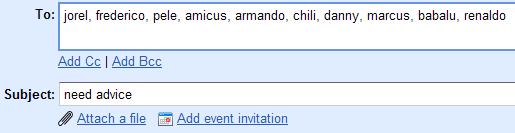
In a business setting, the most egregious situation that invites Bystander behavior is the “Reply All” email. When others are included in the “To” field, I submit most of us either glance the email or delete it wholesale.
Why?
John Darley and Bibb Latané would most likely attribute that response to a diffusion of responsibility — when many people are included in the email, we’re either confused of the request or believe that the request will be satisfied by one of the people for which that email was addressed — we believe that at least 1 of the 15 people will respond.
Unfortunately, this assumption is often wrong.
Indeed, when we engage in this type of email communication, we are creating an environment in which we invite others to be Bystanders.
We sometimes create an environment in which we invite others to be Bystanders – we are sometimes the root cause for others Bystanding
Anti-Bystander Behavior
Fortunately in the email communication space, the countermeasure to Bystander behavior is simple:
- Address only the relevant people in an email – and not too many people
- Address, by name, the person to whom you are requesting advice, help, or approval
- Be clear, concise, and make your request explicit — do not leave the recipient guessing
In this setting, the countermeasure is simple, intuitive, effective — but it’s not simplistic.
Conclusion
Let us not create business environments that encourage bystander behavior — let us act for good, let us do good, and allow others to do the same.
Become a Lean Six Sigma professional today!
Start your learning journey with Lean Six Sigma White Belt at NO COST



Brian Buck says
I like this post Pete. This bystander problem makes me think of the chellenges we face trying to make problems visible. If we have cells full of many people, maybe problems will not be brought to light. Cells with less people might be a solution!
Julia says
I don’t think it’s connected to bystander effect. An unpersonal snail-mail has the same effect.
Chris P says
The original events on the Genovese story were misreported.
http://www.onthemedia.org/transcripts/2009/03/27/05
The research may be valid, but the index case you point to pushes into myth.
When you are drowning, point to someone and say, “Hey you in the blue trunks, help!”
Gustavo B says
Funny you mentioned these studies. I recently finished reading The Tipping Poing, by Malcolm Gladwell and he mentions the same studies.