
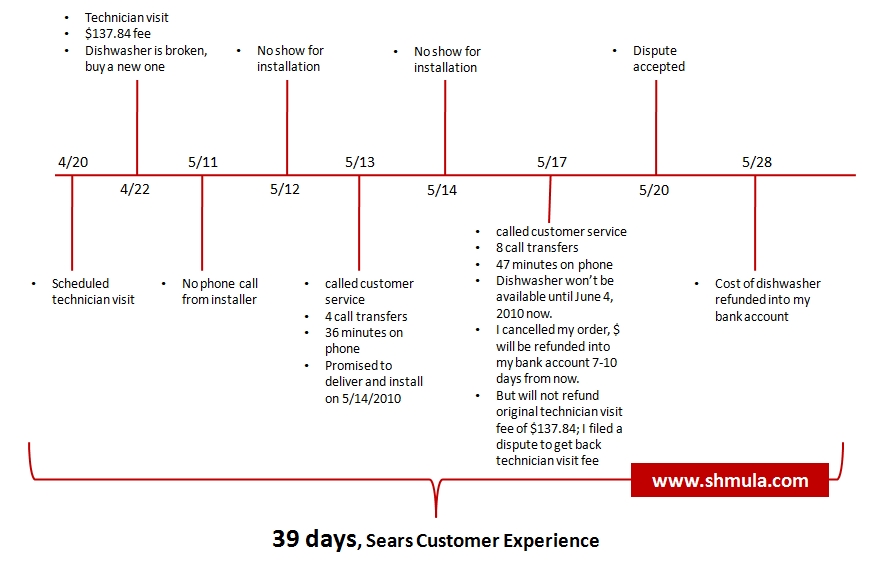
In Part 1 of my experience buying a Kenmore Dishwasher from Sears, I shared the detailed steps of what happened, what did happen but should have happened, and quantitative details such as how many phone calls I made, how many call transfers occurred, how long I was on the phone with Sears Customer Service, etc.
In Part 2, I shared what I think the flow of information looks like for the Sears value streams I interacted with. I also introduced Sears Key Performance Indicators that would help to explain the level of service and the metrics that should be in place to improve the overall performance of the Sears service, Sears brand image, and Sears operations.
This is a series on my experience with Sears as I tried to buy a Dishwasher and have it delivered and installed.
- Part 1 of Customer Experience with Sears
- Part 2 of Customer Experience with Sears
- Part 3 of Customer Experience with Sears
In this final piece, Part 3, I’ll provide recommendations on how to improve Sears Customer Experience: Sears can improve so that other customers won’t have the same experience that I had. I’m interested in exposing problems – “no problem is a problem” – but I’m also very interested in helping organizations improve. Bad mouthing isn’t my thing: improvement is.
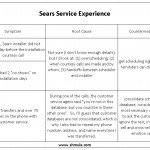
Symptom, Root Cause, Countermeasures
Let me be clear here – I don’t know a lot. All I know, in fact, is my experience. I’m completely blind to internal information related to Sears processes, Sears information technology, or other. So, my attempts at Symptom, Root Cause, and Countermeasures are limited. But, here is what I know:
- Sears failed to make a day-before-the-installation courtesy call.
- Sears failed to show up twice – no phone call or apology.
- I, the customer, was on the phone with Sears a lot, Sears call transferred me a lot, and Sears made me repeat my information a lot.
Given the above, here’s what I propose:
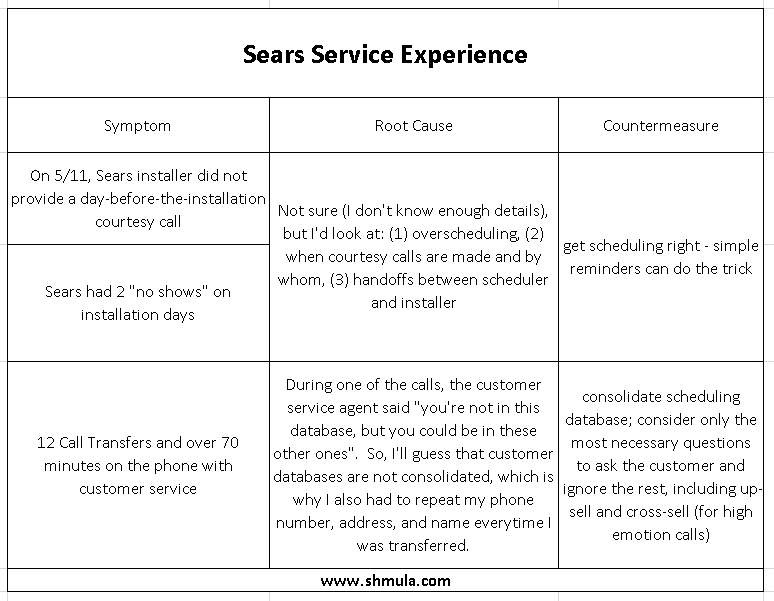
- Sears should get scheduling right – simple reminders can do the trick.
- Sears should consolidate customer databases. I suggest this because one of the Sears Customer Service agents said during a call “you’re not in this database, but you might be in this other one, please hold while I transfer you.” In other words, Sears did not know me, who I was, what my interaction with Sears is, or where Sears should send me. Sears – get your Customer Relationship Management System right (CRM).
Again, with the little I know of internal Sears systems, my attempt at helping is limited. But, this is my attempt.
Conclusion
Sears lost a $600.00 sale because of bad service. As with most things, my experience is most likely just the tip of the iceberg – I’m sure that my situation is not isolated and that there will be more customers that will experience what I have experienced while shopping at Sears 1. That is unfortunate.
I hope Sears gets its house in order. If not, I doubt it will be around much longer. There’s far too many competitors and to lose business, potential repeat customers, and revenue because of Sears poor customer service is just not sustainable or acceptable in today’s business climate.
Good luck Sears. I hope that this material will be helpful to you. I wouldn’t want any customers to experience what I’ve experienced.
This is a series on my experience with Sears as I tried to buy a Dishwasher and have it delivered and installed.
- Part 1 of Customer Experience with Sears
- Part 2 of Customer Experience with Sears
- Part 3 of Customer Experience with Sears
- Organizing the company so it could handle orders on an economical and efficient basis, Chicago clothing manufacturer Julius Rosenwald became a part-owner in 1895. Alvah Roebuck had to resign soon after due to ill health, but the company still retained his name. By the following year, dolls, refrigerators, stoves and groceries had been added to the catalog.
Sears, Roebuck and Co. soon developed a reputation for both quality products and customer satisfaction. By 1895, the company was producing a 532-page catalog with the largest variety of items that anybody back then could have thought of. In 1893, the sales topped 400,000 dollars. Two years later they exceeded 750,000 dollars.
In 1906 Sears opened its catalog plant and the Sears Merchandise Building Tower. And by that time, the Sears catalog had become known in the industry as “the Consumers’ Bible”. In 1933, Sears, Roebuck and Co. produced the first of its famous Christmas catalogs known as the “Sears Wishbook”, a catalog featuring toys and gifts and separate from the annual Christmas Catalog.
Alvah Roebuck returned to the organization during the Great Depression, and worked as a spokesperson until his death in 1948. Part of the reason Roebuck left Sears in 1895 was due to the stress the business placed upon him, and he later took some delight in pointing out his longevity versus the much shorter life of Richard Sears. In the 1970s, the name “Roebuck” was dropped from the trade name of the stores, though not from the official corporate name. ↩
Become a Lean Six Sigma professional today!
Start your learning journey with Lean Six Sigma White Belt at NO COST



Leave a Reply