A SIPOC Diagram helps us to determine which metrics matter and which metrics we can afford to ignore. This article discusses the metrics for which a SIPOC Diagram can help us identify. To learn more about SIPOC as a process, you can watch this HD Premium Video.
Most companies talk of “metrics”, often citing the term as an holy grail – a carrot or a stick: a stick for those who aren’t meeting the metric, and a carrot to those who aspire to meet the metric. In all of this, the term is still nebulous; almost mystical. Okay, not quite, but it’s still, for the most part, vague and undefined in most people’s minds, in my experience.
We know from a previous post that almost everything is a process. A process involves an input, some work, then an output. A process can be found in any business — both virtual and physical businesses. A nice model to keep in mind is the SIPOC model. SIPOC stands for Supplier, Input, Process, Output, and Customer.
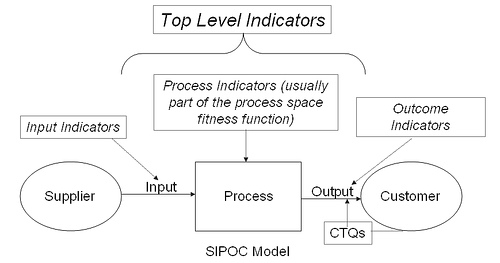
Out of this model, we can then begin to see where we might be able to obtain data that will eventually constitue something we can call a “Metric.” Consider the SIPOC Metrics below:
- Top-Level Indicators: This is most likely what senior management — Directors, VP’s, and C-level folks would be most interested in. Data at this level provide overall business health; it’s a high-level perspective for all stakeholders including customers, shareholders, and employees.
- Outcome Indicators: Data at this level is an appropriate measure used to determine the quality of product or service provided to the customer (internally and externally). These data are often “trailing” or “lagging” indicators, often obtained after the service or product has been provided.
- Input or Process Indicators: These are the upstream measures, taken at critical points in the process, for the assessment of the quality of the input to a process and can serve as early warning signs that something will soon be wrong in the Outcome of the process. The term often used to describe these data are “leading indicators” or “predictive indicators.”
- Critical to Quality (CTQ): CTQ metrics are measures of the customer’s expectations of the product or service — that is, what is the customer’s experience with our service or product in both quantitative and qualitative terms.
You can modify the SIPOC model to fit your particular situation. In some situations, there might not be a supplier; in others, the Customer is involved at the beginning and also is the recipient of the output — involved at the end. You decide how this model fits your situation.
Remember, that “metric” is a word derived from the word “measure”. Whatever metric you decide to use will depend on the process and whether data can be obtained at steps within that process — data that is meaningful and representative enough to judge work, effort, quality, timeliness, and satisfaction.
Become a Lean Six Sigma professional today!
Start your learning journey with Lean Six Sigma White Belt at NO COST