
The etymology of words has always been fascinating to me. I’m a student of Leadership and have though often about team dynamics and how to best lead a team. Then, it dawned on me what others have called their teams — I’ve heard them call the group of people that they work with as “Team” and I’ve also heard “Staff.” I wonder what etymology has to teach us regarding these two words. Plus, these all have to do with culture.
Staff
 The etymology of the word “Staff” as it relates to a group of people one works with finds its history in the military. Accordingly, it means: “group of officers supporting a general.” Physically, a “Staff” is also a walking stick, or a device used to help the person stand or walk. The metaphor here is important: a Staff can literally be understood as the group of people that hold-up the leader.
So, then, a Staff is a group of people that hold-up the leader. The Staff is the group of people that the leader can count on and trust they they will not let her fall.
Team
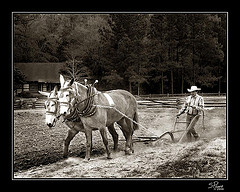
Team finds its history in agriculture. A “Team” is etymologically a group of animals that are yoked together and bridled or governed by a set of rules. There are several very interesting concepts at play here:
Yoke
Yoke is a physical harness that brings a group of animals physically together. This is important because as the Team pulls the carriage, proximity to each other is critical so that the team heads one way and the point-of-control for the leader is isolated to just the yoke, making the job of the leader easier.
Bridle
Bridle means “govern”. In other words, the team of horses are “governed” by a set of agreed-to rules; a set of convention that makes their interaction with each other transparent, expected, and understood.
So, a Team, then, is a group of people that are “yoked” together with a purpose and are “governed” by a set of rules that makes the team run well, smoothly, and predictably.
Team or Staff?
The etymology of both Team and Staff is rich in military and agricultural history. How we use these words in the workplace has subtle, but, important implications for “how” we see the group of people we work with. On the one hand, a Staff is a group of people that a leader can rely on and trust and hold her up. Team, on the other hand, uses the metaphor of “yoke” — which is an above-all-of-us purpose that unifies all members of the group with a common purpose. Moreover, “bridle” or “govern” is a metaphor that is very appropriate in how teams can work well together.
Think of your daily language; what history do they have and how does that history affect the way you work or see the world?
Become a Lean Six Sigma professional today!
Start your learning journey with Lean Six Sigma White Belt at NO COST




Karen Wilhelm says
In the military, and in business for many years, “staff” and “line” differentiated between two groups. Staff, as you said, supported the general. They did maps, consolidated intelligence, developed strategies, and so on. Line officers were the ones doing the work, in charge of the combat troops, who were the ones holding the line. I don’t really know if “line” referred to the direct line of command, or the line drawn on the map the general looked at in assessing the status of the battle. I could look it up, but am going to be lazy.
In business, “line” managers direct the work being done – they are the ones on the org chart who connect with each other in the chain of command. “Line workers” are associated in our minds with assembly lines, but maybe that’s not the original meaning of the word. Line managers don’t always manage value-added work, they also can be responsible for accounting or marketing.
Doubtless a foray into the etymology of these terms will correct some of these offhand comments. But a team can exist in the line organization or the staff organization, if we still used the terms in that way. Since we don’t, Peter’s reflections on the meanings and origins of staff and team are good thoughts for how we look at work today.
Richard Durnall says
I’ve been having a lot of similar conversations lately around the use of the word ‘resource’ in the context of humans and human resources. I really hate it’s application to people. When other project managers use the term resource it cuts right through me. I think it encourages a detachment from people as being living, breathing things with feelings and leads to (often good) people thinking of others as anonymous machines. I’m strongly encouraging the people I work with to ditch the term resource in the context of people.
I think as leaders the choice of our language is key; as a consultant I’m always conscious of when I use ‘I’, ‘we’ and ‘you’. It can have a huge impact. Interesting post.
Karen Wilhelm says
I have to agree about “human resources.” It implies that people are interchangeable parts. It doesn’t respect the knowledge, experience and wisdom you need from people working together to accomplish some goal. Finding a name is hard. “Personnel” management was an older term. It sounds even more remote. “People” management, or “Team” can sound really fake. I suppose that if an organization is rife with fakery, it doesn’t matter what you call things. I had an experience with an “organizational development” department that became a witch hunt and blame factory, and cringe whenever I hear that as well. Language picks up meaning through experience.
V Soter says
Completely disagree with this concept. A team relates to sports. Teams work together for great outcomes…wins. Teams operate, hopefully, with sportsmanship. Teams receive lots of training. Teams play using strategy. The concept of team being viewed as farm animals yoked together is beyond antiquated and out of touch with messaging in the 21st century.
Mikkel Pates says
As an agricultural journalist, I was surprised to see any link to agricultural animal teams, which have gone out of practical use in the 1950s. I think the term “team” is far more associated sports teams. I’m nosports fan. If given a choice, I’d prefer the term “staff,” but mostly I am indifferent.