Yesterday for class, we played the Beer Distribution Game, which is a game developed by the Systems Dynamic Group at MIT back in the early 1960’s. This game simulates what can happen in a traditional supply chain and exposes some interesting dynamics that happen in real-world supply chains and invites us to think about the positive impact a lean fulfillment stream would have and overall logistics management.
The players of this game take on the role of Retailer, Wholesaler, Distributor, and Factory. The retailer sells barrels of beer to a consumer and orders barrels of beer from the wholesaler, the wholesaler sells barrels of beer to the retailer and orders barrels of beer from the distributor and the distributor sells barrels of beer to the wholesaler and orders beer from the factory (brewery). The factory brews the beer. The beer supply chain is shown below:
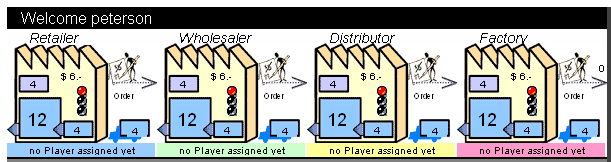
Each player is directly linked, and beer cannot skip the adjacent position. For example, the Wholesaler orders beer from the Distributor, and ships beer to the Retailer. The goal of the game is to minimize team total costs — each barrel of beer has a cost, which is calculated at the end of the game. Information Flow proceeds from Retailer to Factory; Material Flow proceeds from Factory to Retailer.
Beer Game Definitions
- Orders received: This is the demand vor the current period at this position. For the Retailer the demand is determined by the Computer itself. For all positions, this demand reflects an order placed by the downstream position in the supply chain during the previous period.
- Backlog: This is the demand that has not been met to date at this position. When a position does not meet demand by shipping barrels of beer, the backlog amount is increased. At no time should there be inventory items and a backlog simultaneously.
- Current Costs: This is the total cumulative costs for the position (barrels * $).
- Order: This is the field to insert the order for the actual round for each position.
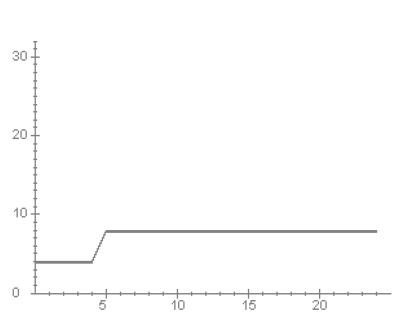
The order quantities of the retailer was the same after week 4. From week 1 – 4, the order quantities was 4 barrels. From week 4 until the end of the game, the order quantity was 8 barrels. But, the players didn’t know this fact. This is what the order quantity chart looked like:
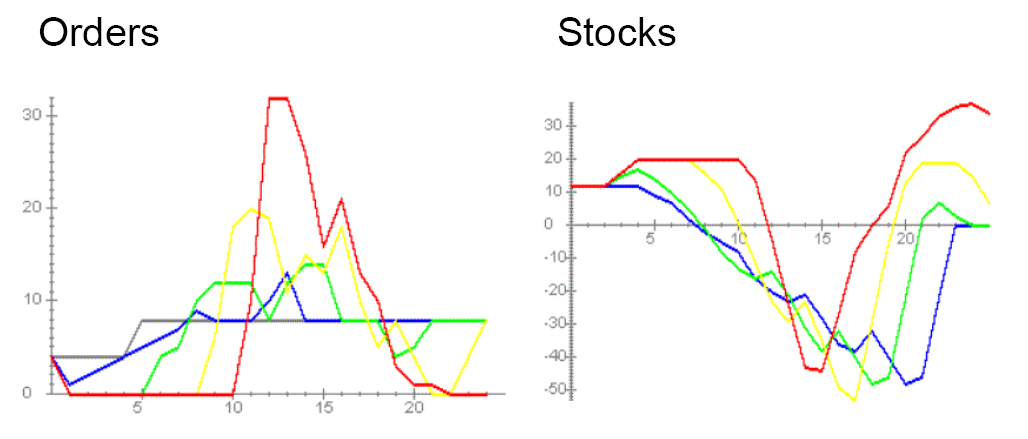
Despite the contant order quantities for the entire game, the results are very surprising — this is what demonstrates the Bullwhip Effect:
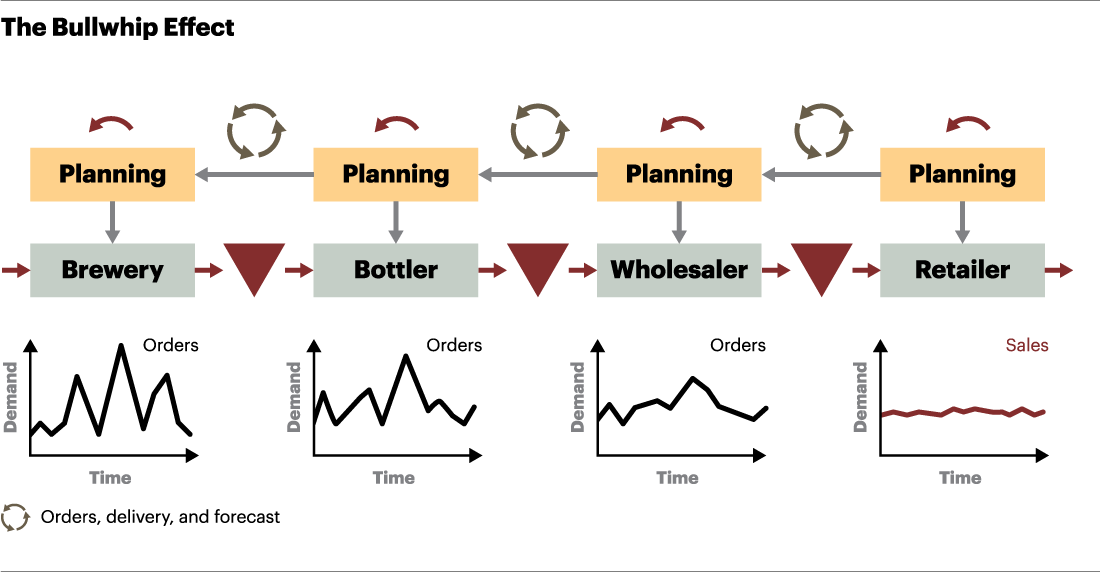
The Bullwhip Effect
In the studies conducted with a simple four-step supply chain, small variations in initial demand could lead to order amplitudes of 900 percent only four steps down the supply chain.
These studies demonstrated that the main cause for erratic fluctuations of order sizes and inventory levels in supply chains was actually not the amount of uncertainty of the demand function but the characteristic of the supply chain and the behavior of the supply chain managers.
Supply Chain Observations
- Variation os Stocks and Orders increases up the supply chain from customer to supplier.
- The longer the lead time of information and material, the more exaggerated the bullwhip effect is.
- The system is to blame: (a) If customer demand sinks or levels, then supplier needs to empty pipeline in order to minimize costs; (b) if customer demand increases, then supplier pipeline needs to be filled in order to avoid a backlog. The phenomena produces a feast/famine scenario in the supply chain.
- Procurement or purchasing in batches adds variability.
- Changing forecasts lead to a change in safety stocks. This creates variability in the system.
- Promotions impact variability of demand.
- In times of a shortage, tier x suppliers tend to order more than actual demand in order to avoid a backlog.
- Related to (7), customers tend to order more in times of shortage; when shortage is over, cancellations occur adding stock variability to the system.
The Main factors Influencing Supply Chain Amplitudes Are:
- Length or number of steps in the supply chain
- Speed, or replenishment time, that is the time between order and order fulfillment
- Incentives that lead to over reaction and panic ordering as inventory levels decrease
- Available information about supply chain status
How to Manage the Bullwhip Effect
I’ve experienced the Bullwhip Effect, and I can tell you that I have not learned to effectively manage it or avoid it. But, below are some true and tried principles for how to manage the Bullwhip Effect:
- Reduce lead time of information (orders, demand and capacity forecasts, point-of-sale data for the entire supply chain).
- Reduce lead time of material.
- Reduce variability with effective use of the Heijunka and one-piece flow.
- Cooperation and good relationships with your supply chain partners.
Bullwhip Effect: History
The Bullwhip Effect (or Whiplash Effect) is an observed phenomenon in forecast-driven distribution channels. The concept has its roots in J Forrester’s Industrial Dynamics (1961) and thus it is also known as the Forrester Effect. Since the oscillating demand magnification upstream a supply chain reminds someone of a cracking whip it became famous as the Bullwhip Effect. You can read about the Bullwhip effect in the Oil and Gas industry.
Beer Game: Hansei, Reflection
Yesterday was a fascinating study into human behavior. As I walked around the room, I heard phrases such as “let’s assume orders will always be between 5 and 15 barrells” or “let’s make more now so that we won’t run out so fast” or “let’s order double each time so that we will always have inventory.” Without knowing it, the players yesterday over and under forecasted; they over-compensated on inventory; they tried to “rush” production and didn’t follow pace — system and human behavior that is so classic in real Operations and Supply Chains.
Beer Distribution Game, Applications
There are many applications for this simulation:
- Obviously, to simulate material flow in a supply chain
- To simulate information flow in software development
- To simulate information flow in marketing
- To simulate information flow in Advertising, Creative, and Marketing
- To simulate information flow in the Legal Profession
- Many others…
Videos on Supply Chain Beer Game
Below are a few videos that show how to simulate supply chain shocks and issues that arise in managing supply chains. Below is the Beer Distribution Game.
Beer Distribution Game, Introduction
The Beer Distribution Game (The Beer Game) is a simulation game created by a group of professors at MIT Sloan School of Management in early 1960s to demonstrate a number of key principles of supply chain management. The game is played by teams of at least four players, often in heated competition, and takes from one to one and a half hours to complete. A debriefing session of roughly equivalent length typically follows to review the results of each team and discuss the lessons involved.
The purpose of the game is to meet customer demand for cases of beer through a multi-stage supply chain with minimal expenditure on back orders and inventory. Players can see each other’s inventory but only one player sees actual customer demand. Verbal communication between players is against the rules so feelings of confusion and disappointment are common. Players look to one another within their supply chain frantically trying to figure out where things are going wrong. Most of the players feel frustrated because they are not getting the results they want. Players wonder whether someone in their team did not understand the game or assume customer demand is following a very erratic pattern as backlogs mount and/or massive inventories accumulate. During the debriefing, it is explained that these feelings are common and that reactions based on these feelings within supply chains create the bullwhip effect.
Beer Distribution Game, Part 1
Beer Distribution Game, Part 2
Beer Distribution Game, Part 3
Beer Distribution Game, Part 4
Beer Distribution Game, Part 5
Beer Distribution Game, Part 6
Beer Game Distribution Transcript and Show Notes
Larry Navarre: To begin with, a few acknowledgements. First to Provost Simpson for the opportunity to do this. It actually caused me to learn something I didn’t realize and I’ll hopefully have a moment to talk about that later. Colleagues, students, especially – I’m delighted to see students here – and Dr. Terri Lynch-Caris. I’d forgotten but I recall that the beer game actually came from her suggestion, so I have a great debt of gratitude to you. It’s been a great fabulous exercise for me and my supply-chain courses and so I greatly appreciate that.
With me is Dr. Thomas Ngniatedema. Dr. Ngniatedema is going to be helping me with the data entry so that during the game, I can interact more freely with the participants. I really had a hard time with the title of this speaker series because I’m either the indistinguished or the non-distinguished professor. I want to emphasize that perhaps I’m distinguished in different ways, given my experience before I’ve come here at Purdue. I’ve always wanted to teach at the collegiate level and so it’s a great pleasure to be at Kettering. I’ve only been here four years. I’m very new. As you’ve heard, I’m not a doctor. In the business department, we like to call ourselves “pracademics” and that’s a practitioner who’s gone to the dark side to become an academic. No research yet. Even as we were looking at this, maybe there’s some opportunities in the area of innovation development, which has been my primary focus of new coursework and has been my long-term joy in my career, has been the process of business process of product development.
So supply chain management to me, when I was in industry, was a buzzword. It’d been going around and people had been talking about it, but now I actually teach it. Imagine that. Supply chain. What is a supply chain? It’s all the activities involved directly or indirectly in fulfilling a customer request. And this typically includes the suppliers, manufacturers, transporters, warehouses – everybody in the supply chain out to the customer, but it also includes within each company, the functions involved in fulfilling a request. And I’m delighted to see that Professor Chopra from Northwestern University has identified product development, because it kind of begins there, with the new ideas and things that are the innovations that are coming into the organization and of course, through marketing operations, distribution, finance and customer service.
Supply chains are dynamic network systems that require effective coordination of information up and down the supply chain. Generally, we look at supply chains this way, and Thomas and I use a text that has this illustration in it, talking about people who want ketchup. And so the consumers here buy from the retail grocery store, who gets it from the ketchup factory. And I notice there’s quite a bit of distribution here that doesn’t occur but they identify upstream: tomato paste factories, grading stations and tomato suppliers – which will of course be the farmers. And we often talk about tiers in the supply chain, and it’s very common in the automotive industry and in southeast Michigan. The interesting thing is that not only are you managing the product as it’s moving this way, but your managing information flows back and forth and cash flows, of course, coming back as people get paid.
Here’s a generalized model of a supply chain. That comes from the text I use. One of the texts I use is Supply Chain Logistics Management by Bowersox, Closs, Cooper. They are professors from Michigan State University. Michigan State actually has a really good competency in supply chain and logistics management. And so I found their text to be one of the best for my courses. And I have this illustration: a supply chain is sourcing materials through a supply network, which has a lot of nodes on this. The one thing you’ll see about a supply chain is that it’s very much like an information network. Lots of nodes, paths, product moving, information moving, into your enterprise. Your enterprise purchases, manufactures, produces, distributes and sells to customers, which they call customer accommodation. And then you’ve got a distribution network of wholesalers and distributors that move this product physically through the distribution channels to the customers.
Typical supply chain services are these. Generally a supply chain has value in that it buffers time between production and consumption. The most obvious example of this is the farmer in our food products. We really like to eat in the winter time, but food is only produced in the summer time. And so, they’re buffering time in the supply chain. We also span distance. The location of production and consumption is dramatically different, typically, and so a supply chain has an important function in spanning distance. We call that logistics and if you’re with UPS, you heart logistics.
Quantity. Producers specialize in large quantities and of a limited assortment. So as a manufacturer, we have a certain product line, we produce a truck load, rail– car load quantities and we ship that out to the distribution channels. But assortment is what customers want. Customers want small quantities in wide assortment. So these are the values that supply chains provide to the market place. When I was studying supply chain management, to begin to teach it, I realized I’d been in supply chains for the bulk of my career. But I really didn’t understand what this phenomenon called supply chain management was. And so part of my learning was kind of boiling it down. I like to make things simple and – that way I can understand it – this is what I found.
There are three things that summarize the practice. The characteristics of supply chain management are performance excellence, customer satisfaction at the lowest total cost. What you’re going to hear are some common themes if you’re familiar with total quality management, lean systems. All of these things have the same holistic approach and supply chain management simply adopts those. There’s truly a belief that we can do things much better and do it lower cost, which improves profitability, sustainability for the organization and value for the shareholder – of a public corporation.
The second is collaboration with supply chain partners, coordinating operating activities. Modern supply chain practitioners do very much to coordinate the activities between enterprises. We don’t have a history of doing that, especially in the United States. We’re very independent managers, and so this kind of approach and philosophy is somewhat new. Information technology. Without information technology that we have now in high power software and low cost computing performance, we cannot do the things that we do now in supply chain management. So these are the three things that are driving supply chain management as a phenomenon.
Now we’re going to set up the beer game. And this will take some time, and hopefully we’ll have some fun with this. But I want to explain the principles of the beer game as an exercise in understanding the dynamics of operating systems. Here is the beer game supply chain. It’s very simple. You’ll never find a supply chain this simple in the business world. You have only one participant in each stage. Commonly, there’s a network of enterprises that are involved in a supply chain. Here we have a factory that purchases materials and places orders for materials and they brew beer. They send that off to distributors and distributors place orders with the factory when they need beer and the factory ships them beer when they need it. The wholesaler does the same thing. They place orders with the distributor and beer gets shipped to the wholesaler. Then the retailer. Orders get placed, beers get shipped and eventually the consumer gets their beer.
This is what’s known as a traditional supply chain. An echelon structure where we have one step after another. This structure is important in supply chains and very important in understanding the principles of the beer game. So the structure is one thing. And then the operating processes. The participants in the beer chain will only have to do these three things: ship beer, manage inventory and order beer. Actually, in reality, you only have to order beer because the worksheet that Thomas will be working will take care of shipping the beer automatically, as soon as you have the orders and the inventory. And it will also manage the inventory for you. It’ll do the classic inventory calculation which we teach in accounting, and Kathy, I can’t remember your last name. I apologize, I’m panicking here, but give me a moment here to get, oh yes, so, onto the beer game.
Here’s the beer game situation and, if you’ve been in my courses, I’ve used the Bulldog beer bottle too many times. We have a demand forecast. It is mid-May, in Michigan. Winter is gone and temperatures are rising. Beer is seasonal and demand rises in the summer and peaks around the holidays. Recently, demand has been steady at 4 pallets per week. This has been the demand at the retailer. Sales are expected to rise with temperature, the Memorial holiday weekend and a sales promotion that the beer brand is going to be operating. We have a performance goal. Pricing is market-driven. Beer is very fungible. If I don’t beer here, I’ll go down the street and get beer from another retailer. To maximize profit, we do that minimizing cost.
Now, we have two costs. This is very simple. We only have an inventory holding cost of $1 per pallet, per week and we have a $2 back-order cost per pallet, per week. So one dollar to hold inventory, and if you run out of inventory, the cost is two dollars per pallet per week. Okay, so let’s play. Thomas, we’ll get you up here.
Now, to help me a little bit, I’m going to pick the retailers right here. Katie, you want to game the system? You’re welcome to. Okay, so we’ll have these three people right here. So you are going to be our retailers. I even got a name tag for you, everybody knows who their retailer is. Katie, you know the drill. Okay. What’s that, Matt?
Matt: Are they old enough to have beers?
Larry Navarre: Oh, I forgot to mention. This exercise has nothing to do with drinking beer. Did I fail to mention that? Oh, I am so sorry. Yeah, this has nothing to do with drinking beer. Would you two gentlemen like to be our wholesalers?
Student: Sure.
Larry Navarre: Can you do that for us? Okay, you’ll be our wholesalers.
Student: I don’t know what that involves, but that’s okay.
Larry Navarre: Oh, you’ll learn quickly. Schaffer, Kathy Schaffer. Doctor Schaffer, sorry. Let’s see, you know this. Do you? They don’t. Okay, here, we’re going to do them. They’re going to be in the beer game. Okay, you’re going to be our distributors. Neil and who wants to – you guys? Who wants to do it? The more the merrier.
Student 2: All four of us.
Larry Navarre: Oh, good, all four of you. They’ll never make a decision. Okay, so, we have our retailer, our wholesaler, our distributor and our factory teams. Okay, you’re management, you have to manage the beer game. You can see here that everybody has inventory of twelve pallets of beer, in every stage of the supply chain. Things are good here in week zero. There are no back-orders, there is no inventory cost, and in fact, we have no orders placed on the supply chain. So your job is to manage the supply chain.
I will ask you place orders for beer, and you will manage your inventory level to minimize your inventory cost, but try to avoid stocking out. If you do, then you’ll have a back-order cost, and of course, the whole objective is to minimize the total cost of the supply chain. So everybody will be able to see. We have all the information here. All the calculations are taken care of. All you have to do is order beer.
So, let’s go. Let’s see. I’m so used to working that spreadsheet. Thank you so much, Thomas, I greatly appreciate it. Okay, retailers.
Retailers: Four.
Larry Navarre: They want to order four pallets of beer. Okay, wholesalers?
Wholesalers: [inaudible 00:14:42].
Larry Navarre: You have to order beer. Manage your inventory. You want five? You want five. Okay, they want five. Okay, we’re doing well, we’re doing well. Five, they’re gonna do five. Okay.
Factory: Is this us?
Larry Navarre: What’s that?
Larry Navarre: You want to order beer? Okay, did I mention we have to do 50 weeks? Okay, 50 weeks is my target. We really gotta move.
Factory: Five.
Larry Navarre: Okay, five. Five. Okay, this is a new strategy here. Now, retailers.
Retailers: Give us four.
Larry Navarre: You want four? Okay. Wholesalers?
Wholesalers: Two.
Larry Navarre: Two? Ha, see, wisely managing their inventory. Minimizing that inventory cost. Distributor, five. And factory.
Factory: Four.
Larry Navarre: Four, okay. Very good. Retailers.
Retailers: Four.
Larry Navarre: Four, four, okay. Wholesalers?
Wholesalers: Five.
Larry Navarre: Five, okay, five. Four, okay, they want to manage to four. Every guy is doing really well. The retailer’s inventory is getting a little low. Okay, and factory.
Factory: Three.
Larry Navarre: Three, okay, three. Managing that inventory, reducing their – yeah, they got the highest inventory carrying cost. You’re not getting any orders, are you? Okay, okay. It takes a little time to brew beer and get it out there into the sea- yeah, there’s a little bit of lag. Okay, retailer?
Retailer: Eight.
Larry Navarre: Okay, eight.
Wholesalers: One.
Larry Navarre: One. One. Very managing that inventory. Four? Four for the distributor and for for the factory?
Factory: Zero.
Larry Navarre: Zero. They’re not brewing any beer, no need for beer this week. Everybody gets a vacation. Retailer?
Retailer: Eight, please.
Larry Navarre: Eight. Wholesaler?
Wholesaler: Three.
Larry Navarre: Three. Four for the distributor. And factory?
Factory: Zero.
Larry Navarre: Zero, good. Okay, very good. Oh, gee, what’s happening, you don’t have any inventory. What’s going on here? You have to order some beers, let’s go.
Factory: Eight.
Larry Navarre: Eight, okay, they’re ordering eight. Wholesaler?
Wholesaler: Yeah, five.
Larry Navarre: Five, okay, they’re going to do five. Distributor? Zero. And factory?
Factory: We’ll need five.
Larry Navarre: Five, okay, five. Retailer?
Retailer: Eight.
Larry Navarre: Eight. Wholesaler?
Wholesaler: Ten.
Larry Navarre: Ten. Ten, okay, 10.
Larry Navarre: Distributor? Zero. Factory?
Factory: Ten.
Larry Navarre: Ten, okay, 10. Okay, the factory is realizing they’re running out of beer. Retailer?
Retailer: Eight.
Larry Navarre: Okay. Eight. Wholesaler?
Wholesaler: Five.
Larry Navarre: Five, okay.
Student: Could I just ask a quick question?
Larry Navarre: Distributor, yeah.
Distributor Student: Why hasn’t my inventory changed?
Larry Navarre: It takes time to get beer. One week to order, one week to deliver, and you have to have a source of supply. Your inventory’s not changing? That’s because the inputs are equally the outputs and so everything’s fine. Is this a problem?
Distributor Student: If you say so.
Larry Navarre: I’m sorry?
Distributor Student: If you say so.
Larry Navarre: Oh, okay. How much do you wish to order?
Distributor Student: Four. Four.
Larry Navarre: Four. Okay, good. Factory?
Factory: Three.
Larry Navarre: Three. Retail?
Retailer: Eight, please.
Larry Navarre: Eight. Wholesale?
Wholesalers: Shucks. Eight.
Larry Navarre: Eight. Distributor?
Distributor: I’ll go with seven.
Larry Navarre: And factory?
Factory: Two.
Larry Navarre: Two, two. Okay. Retail?
Retailer: Eight, please.
Larry Navarre: Eight, please, okay. Wholesale?
Wholesalers: 10.
Larry Navarre: 10. Distributor?
Distributor: 10.
Larry Navarre: 10. Factory?
Factory: Three.
Larry Navarre. Three. Okay. Retail?
Retailer: Eight, please.
Larry Navarre: Eight? You got some back-orders here. You might want to take care of that. No? People will wait for their beer? Wholesaler?
Wholesaler: 12.
Larry Navarre: 12. Distributor?
Distributor: 20.
Larry Navarre: 20! He’s gonna make up for that problem. Okay, factory?
Factory: Five.
Larry Navarre: Just 2-0. 2-0. Twenty.
Factory: Let’s not do five. Let’s do 10.
Larry Navarre: Okay, 10. Hey, alright. Just a little couching there, a little management education. Okay, retailer?
Retailer: 16.
Larry Navarre: 16?
Retailer: It’s Oktoberfest.
Larry Navarre: Oh, it’s Oktoberfest! Wholesaler?
Wholesaler: 16.
Larry Navarre: 16, okay. Distributor?
Distributor: 20.
Larry Navarre: 20, okay. Factory?
Factory: 20.
Larry Navarre: 20. You’re going along with the program. Retailer?
Retailer: Eight.
Larry Navarre: Okay. Wholesale?
Wholesaler: 12.
Larry Navarre: I’m sorry?
Wholesaler: 12.
Larry Navarre: 12. Okay, distributor?
Distributor: 20.
Larry Navarre: 20. And the factory.
Factory: 30.
Larry Navarre: 30, okay.
Factory: We cranked it up.
Larry Navarre: Yeah, let’s go. Retail?
Retailer: 10.
Larry Navarre: Ten. Okay, wholesale?
Wholesaler: 15.
Larry Navarre: 15. Distributor?
Distributor: 20.
Larry Navarre: 20. Factory?
Factory: 20.
Larry Navarre: 20. Retail?
Retailer: Eight.
Larry Navarre: Eight. Okay. Wholesale?
Wholesaler: 12.
Larry Navarre: 12. Distributor?
Distributor: 20.
Larry Navarre: 20. Factory?
Factory: 20.
Larry Navarre: 20. Okay. Retail?
Retailer: Eight.
Larry Navarre: Eight. Wholesale?
Wholesaler: 10.
Larry Navarre: 10. Distributor?
Distributor: Six.
Larry Navarre: Six for the distributor. Factory?
Factory: We’ll go down to eight.
Larry Navarre: Eight. Man, there’s a lot of beer in this supply chain, but retail’s only using eight. Okay, retail?
Retailer: 10.
Larry Navarre: 10, okay. Wholesale?
Wholesaler: 12.
Larry Navarre: 12. Distributor?
Distributor: Six.
Larry Navarre: What?
Distributor: Six.
Larry Navarre: Six, okay. Factory?
Factory: Four.
Larry Navarre: Four. Managing that inventory. Retail?
Retailer: Eight.
Larry Navarre: Eight. Wholesale?
Wholesaler: Nine.
Larry Navarre: Nine. Distributor?
Distributor: Six.
Larry Navarre: Six. Factory?
Factory: Four.
Larry Navarre: Very good. Four. Okay, retail? Only about 30 left to go, so.
Retailer: 16.
Larry Navarre: 16. Wholesale?
Wholesaler: 15.
Larry Navarre: 15. Distributor?
Distributor: 10.
Larry Navarre: 10. Factory?
Factory: Eight.
Larry Navarre: Eight. Retail?
Retailer: Four.
Larry Navarre: Four. Oh, you getting too much inventory? Oh, yeah. Wholesale?
Wholesaler: Five.
Larry Navarre: Five. Distributor?
Distributor: Six.
Larry Navarre: Six. Factory?
Factory: Six.
Larry Navarre: Six. Okay, settling down here. Retail?
Retailer: Seven.
Larry Navarre: Seven. Wholesale?
Wholesaler: Two. Zero.
Larry Navarre: Zero. Okay, good, managing that inventory. Distributor?
Distributor: Zero.
Larry Navarre: Zero. And, factory?
Factory: Zero.
Larry Navarre: Zero. The people are lining up at the unemployment line right now. Retail?
Retailer: None.
Larry Navarre: Nine?
Retailer: No, sorry, zero, not nine.
Larry Navarre: Oh, zero, zero. Okay, wholesale?
Wholesaler: Zero.
Larry Navarre: Zero.
Distributor: Zero.
Larry Navarre: Zero. And factory?
Factory: Play that not-zero. Zero.
Larry Navarre: Zero. Retail?
Retailer: Zero.
Student: I see where this is going.
Larry Navarre: Oh, Tom, this here advanced to one week. Click it back one week. Just click it down one week. There, that’s reflecting the proper week. After we enter in week 23, then we update. Wholesale?
Wholesaler: Zero.
Larry Navarre: Zero. Distributor?
Distributor: Zero.
Larry Navarre: Zero. And factory?
Factory: Negative two.
Larry Navarre: Two. Two whole pallets, two whole pallets. Now click, there we go. Okay, thank you, Tom. Retail?
Retailer: Zero.
Larry Navarre: Zero. Wholesale?
Wholesaler: Zero.
Larry Navarre: Zero. Distributor?
Distributor: Oh, we shut down.
Larry Navarre: We shut down. Some are shut down. Factory?
Factory: Zero.
Larry Navarre: Zero. Okay, retail?
Retailer: Four.
Larry Navarre: Four. Oh yeah, you’re in third. [inaudible 00:25:09]. Wholesale?
Wholesaler: Five.
Larry Navarre: Five.
Distributor: Zero.
Larry Navarre: Zero for the distributor. And factory?
Factory: We’re good at zero.
Larry Navarre: Good at zero. Retail?
Retailer: Four, please. Oh, eight, please.
Larry Navarre: Oh, no inventory and you’ve got some back-orders. Wholesale?
Wholesaler: Two.
Larry Navarre: Two. Okay.
Distributor: Zero.
Larry Navarre: Zero for the distributor. Factory?
Factory: Zero.
Larry Navarre: Zero, okay. Retail?
Retailer: 20.
Larry Navarre: 20. Wholesale?
Wholesaler: 16.
Larry Navarre: 16. Distributor?
Distributor: 12.
Larry Navarre: 12. Factory?
Factory: Eight.
Larry Navarre: Eight. Retail?
Retailer: 30.
Larry Navarre: 30. Wholesale?
Wholesaler: 25.
Larry Navarre: 25. Good, keeping up with those retailers. Distributor?
Distributor: 20.
Larry Navarre: 20. Factory?
Factory: Let’s go 18.
Larry Navarre: 18. Retail?
Retailer: Eight.
Larry Navarre: Eight. Wholesale?
Wholesaler: 10.
Larry Navarre: 10. Distributor?
Distributor: 12.
Larry Navarre: Factory?
Factory: We’re 20.
Larry Navarre: 20. Okay. Retail?
Retailer: Eight.
Larry Navarre: Eight. Wholesale?
Wholesaler: Nine.
Larry Navarre: Nine. Distributor?
Distributor: 20.
Larry Navarre: 20. Factory?
Factory: 30.
Larry Navarre: 30. Not going to run out of beer.
Factory: No. Can’t do that to the people.
Larry Navarre: Retail?
Retailer: Zero.
Larry Navarre: Zero. Wholesale? Fifteen. Distributor?
Distributor: 12.
Larry Navarre: 12. Factory?
Factory: It’s five. Five.
Larry Navarre: Five. Okay, retail?
Retailer: Eight.
Larry Navarre: Wholesale?
Wholesaler: 12.
Larry Navarre: 12. Distributor?
Distributor: 12.
Larry Navarre: And factory?
Factory: Five. Five.
Larry Navarre: Retail?
Retailer: Eight.
Larry Navarre: Eight. Wholesale?
Wholesaler: 10.
Larry Navarre: 10. Distributor?
Distributor: 14.
Larry Navarre: 14. Factory?
Factory: Let’s do 10.
Larry Navarre: 10. I think we’re good. What do you call that? Where the professor passes the horizon where you tell him it’s 50 where you really only did 30 or so. I’m getting the false impression that there is no end to the game but the game is done. And Thomas, thank you so much. Let’s look at the charts.
Fascinating. Now, tell me, Katie, Katie’s actually done this. Were you truly trying to game the system? You started out trying to manage your inventory. You were – and then what happened?
Katie: Well, it says on the instructions that you can choose to add more variations to the game. So I decided to take that risk.
Larry Navarre: Oh, okay. So you chose to add – and they really pumped it in there. I’ve had students who have done it before do it both ways. Some try to game the system and some try to optimize the system. The reality is that in weeks one, two and three, it was four pallets a week. Actual demand. And they are the only ones that see actual demand. And this is typical of the traditional way of doing supply chains. And in week four, it jumps up to eight pallets per week and then it stays there the rest of the game. Eight pallets per week. This is called a step change. And it provides a disruption to the dynamics of the system, which everybody tries to compensate for throughout the remainder of the game.
But the nature of system dynamics is that you’re already losing. It’s just too difficult to manage the supply chain. So let’s discuss some of the principles of this. No, this is great, you did a super job. Up, down, up, down, that’s exactly what we want to see. Well done!
I’m always kind of worried whether it’s going to work out or not. I’ve done this about 10 or 12 times and it’s always worked out quite well. Let’s take a look at the data. Or, not the data, let’s take a look at the principles.
Okay, this is an exercise to illustrate system dynamics. It was created by MIT. It’s available as a board game and a software simulation. Our beer game is an acceleration of the whole process. Normally, if you look at this – this is actually Brandeis University – and they use this exercise as an MBA weekend orientation introduction to explain the complexities of business. And this is a video of the software simulation that’s also available. Let’s review the beer game. Participants typically crack the whip. In fact, this phenomenon is known as the “bullwhip” effect. And the idea is that a little change over here by the consumer translates into big changes up the supply chain. The game starts with steady demand, and increase in demand is generated just once. And this induces variation in the system. Participants try to compensate but errors are amplified. The whole exercise, I absolutely love, because it’s an exercise in expectation failure.
We learned this word from Ken Bain’s book What the Best College Teachers Do which on a Friday – thank you also – Professor Lynch-Caris and I were studying this in our book club. And what’s great about this is, it really sets up the whole course for the remainder of the term for me. Students realize that this whole thing isn’t so easy. And it’s nice to have this exercise to demonstrate how what you think would be pretty straightforward causes the problems in the system. Then we can use the principles of supply chain management to explain what is going on. The most important in supply chain dynamics is variation reduction. Reducing variation is a primary objective of a supply chain manager. The sources of variation in a supply chain are not obvious in this dynamic supply chain system. And the bullwhip effect is a phenomenon that occurs when, acting in isolation, with limited information, supply chain managers make decisions that are magnified upstream.
And it results in stock-outs and over-stocking throughout the supply chain. So that is the principle that is utilized in supply chain management. Here are the factors that contribute to the bullwhip. There’s a lead time impact on the supply chain. It takes, in the game, one week to order and one week to receive product. So that two week lag causes a delay in the system, which is difficult to monitor. There’s an impact of batch ordering. You can order a lot or a little, but we’re only ordering on a weekly basis. That batching introduces more problems to the system. There are also magnifying effects of inflated orders. When someone puts a large order into the system, well, the person next in the supply chain thinks, “Oh my gosh, I’m going to run out,” and they order even more. That’s because, as supply chain managers, inventory availability is our number one priority. We have to have the material there to sell to the customer or provide for production. And so there’s a psychological effect that causes people to not have just-in-time inventory, but just-in-case inventory.
There’s also demand forecasting inaccuracy. You didn’t know what the real demand was. And traditionally, that was the case in the supply chain. People simply reacted to what they were seeing in the next participant in the supply chain. And finally, information and decision isolation. Why weren’t you guys talking to each other? Nobody talked to each other. Supply chains typically don’t have the ability to talk to each other, at least traditionally. And here we are in the room, I’ve given you perfect information, you had everything you needed to know, the only thing you could’ve done was talked. You could’ve talked to each other. And that didn’t happen. Interestingly, in the board game that’s done at MIT, they actually have a rule: you cannot talk to each other. I have never, ever said that in the beer game, and nobody ever talks to each other. We’re Americans. We make our own decisions.
Believe it or not, this is fifty years old. This phenomenon was known in distributions in the thirties and the forties but Professor J.W. Forrester of MIT created a mathematical model to simulate the effects. Here is the 10% step change in retail sales. That translates into a 16% step change in distributor orders, which translates into a 28% increase in factory warehouse orders from the distributors, which translates into 40% increase in factory production output. And you can see the swings. You’ve got the same sort of relationship that occurs throughout the supply chain until it settles down. Notice that it does start to settle down, at 10% or above. What’s interesting is if you have seasonality where you increase retail sales and reduce your retail sales the whole thing goes haywire. And I say this in my industry. And compound on that factory capacity.
What happens is that the factory goes up and it stays flat because it can’t produce anymore. And it makes the swing even worse because people panic, because there’s a rush on goods. There’s not enough in supply. Professor Forrester saw these three principles in system dynamics. Structure: multi-step organization chains like his original observation create structural problems in a supply chain. And, in fact, way back in 1961, he said, “You know, if we could get rid of some of these steps in the supply chain, it’d probably work out a lot better.” And he simulated it and demonstrated it. That lead to some other principals we’re seeing in modern supply chains where you order direct from the manufacturer. Delays. There’s implementation and information delays. We don’t have perfect information, we get updates late, it takes time to implement improvements or expansions of production capacity. These kinds of things are delays in the system which compound the problem, and that creates amplification. We overcompensate our decisions to take into account the things that we perceive are going on in the system.
This was his original chart and unless you were alive at this time, which thankfully it was only one year before my birthday. More than 50 years ago, you’d do this all manually. There were graphic artists that created it. His computer output, on a really old IBM, was dot matrix kind of thing that showed symbols going up and down. And somebody made a very beautiful illustration of system dynamics showing the relationships. All of this he programmed with mathematical equations and he got this knowledge from his electrical engineering background in servomechanism control systems. He built on some of the first concepts in servocontrol. And they utilized the information feedback controls as part of system dynamics. They are curvilinear equations. We in business, we’re straight-line people in business. We like nice linear relationships. Engineering, you like these things, these are your domain. This is challenging for us business people. But he also did a continuous variable simulation. I’m very big in management science techniques, I’ve done a lot of simulation work, but mostly discrete event. This is high power stuff.
Here are strategies to mitigate the bullwhip: reducing uncertainty by providing centralized information about demand, reducing variability by delivering reliability and promotional volume spikes – limiting those spikes, reducing lead time by improving responsiveness, collaboration by information sharing across the supply chain. The bullwhip affect illustrates the necessity of all three of the characteristics of modern supply chain management. The supply chain revolution of the 21st century was built on the 20th century, where things were very slow to deliver. We had poor delivery reliability. There were large inventories in the system. Transportation was slow and regulated. We have now days to move product, high delivery reliability, inventory is sized and placed to meet customer needs, transport is very efficient and economical.
Supply chains have anticipatory elements and responsive elements. Generally, where the customer order arrives determines whether you’re more of the responsive business that pulls your product through the supply chain, or the anticipatory business that feeds or pushes the product to the customer. If you think about food, we’re way out here. As a customer, we go to the shelf and pick up the food off of the shelf. Everything is occurred for us up to that time. If you’re Dell computer, your customer order arrives back here, and the only thing they’ve done is prepare the design and materials. And then they rapidly produce it to deliver to the customer after the order arrives. Here is the traditional distribution supply chain. Customers go the store, the store gives them the products. When they run low, they have more delivered from the distribution center. The manufacturers deliver to the distribution center and honor requests for orders, much like the beer game. The flexible network structure at Dell says the customer doesn’t even have to come to us. They just send us a communication signal through the Internet and we assemble the product from all of the computers that we have available, in just a few hours and deliver it in a few days. Well, if you also bundle with it a wide screen TV, Dell can provide that, and they send a signal out to their supplier of that and actually send it to a UPS hub and have that order merged together as one order to deliver to you, the customer.
Network structures have importance in design. Much of what Dr. Sanders, Dr. Lynch-Caris deal with IME is this: designing the network structure. The whole purpose of a network structure and warehouses within the network structure are simply to minimize transportation costs. And we do that by consolidating truckload shipments of our goods. So that is the only purpose of a warehouse. Here is the cross-dock distribution center of Walmart. Notice the traditional Sam’s Club distribution center right next to it. This is storage. This is flow. Every morning, trucks come in, they all line up, by the afternoon all of these trailers are full of product going to the Walmart stores. Inventory doesn’t sit, it flows through the system. Sales and operations planning is one of the strategies in supply chain management that is an important business process that’s dramatically changing the way we do supply chain management.
I’m running out of time, so let me briefly scan through these. This is an outline of that business process. We use optimization methods in supply chain management. These are operations research models, we have facility location models, sales and operations planning models, product availability models, and transportation models. All these vary by the the steps in the supply chain and the level of detail and time-frame of the planning horizon, from many years out to the day-to-day operations of the supply chain. Here’s an example of an aggregate planning model. Real math! It’s pretty neat stuff. And these are the things that are actually very enjoyable to do. This is a quite simple one. Often these models have thousands of variables, equations and constraints.
I’m going to close with this because we’re out of time. Careers in supply chain management. They are challenging. We have complex, big problems to solve. There are new expectations and innovations driving changes. It’s changing. IT advancements are driving improvements and the adoption rate remains low. What’s remarkable about modern supply chain management is that so few companies are really implementing it effectively. It’s growing. It’s difficult to export. Logistics, you need to do it if you want to sell things. And globalization is actually driving opportunities for students. Then finally it’s leading. Leading supply chain practitioners are high-quality firms – Amazon, Apple, Dell, the list goes on, many of the firms we know, the brands that we identify with – have behind it a very, very competent supply team management capabilities.
So I can’t conclude with some of the things – and I apologize to my colleagues because I wanted to show some of their work and conclude with some of the things which I’m interested in pursuing – but I’m gonna stop right there.
Become a Lean Six Sigma professional today!
Start your learning journey with Lean Six Sigma White Belt at NO COST



Kulveer says
Hi,
Looking for administrating “Beer Supply chain simulation” for 15 of my executives. I am looking for hardcopy/pen paper type simulation. Is that possible? If yes please share the pricing.
Thanks
Brion Hurley says
You might look at this beer supply chain simulation software at http://beergame.org/