
Podcast: Play in new window | Download
Subscribe: Apple Podcasts | RSS
A Spaghetti Diagram Example Healthcare – is a simple visual tool to demonstrate the flow of material, flow of information, and flow of money in a process. The word “spaghetti” is descriptive because it describes flow that is not easily understood, can’t easily be followed, or if the flow is literally all over the place. Indeed, a Spaghetti Diagram represents a point-of-departure: what does the current state look like and what are the exact improvements we need to make?
Put another way, a Spaghetti Diagram is a visual representation of how bad things really are and are used to expose Waste and Opportunity.
How Bad are Things, Really?
Sometimes, through poor thinking and poor choices, Spaghetti Diagrams aren’t just representations of how things are, but they can be representations of what we have created: sometimes, we turn our processes into Spaghetti Diagrams; this is precisely the case with the U.S. Government and the current Healthcare Debate.
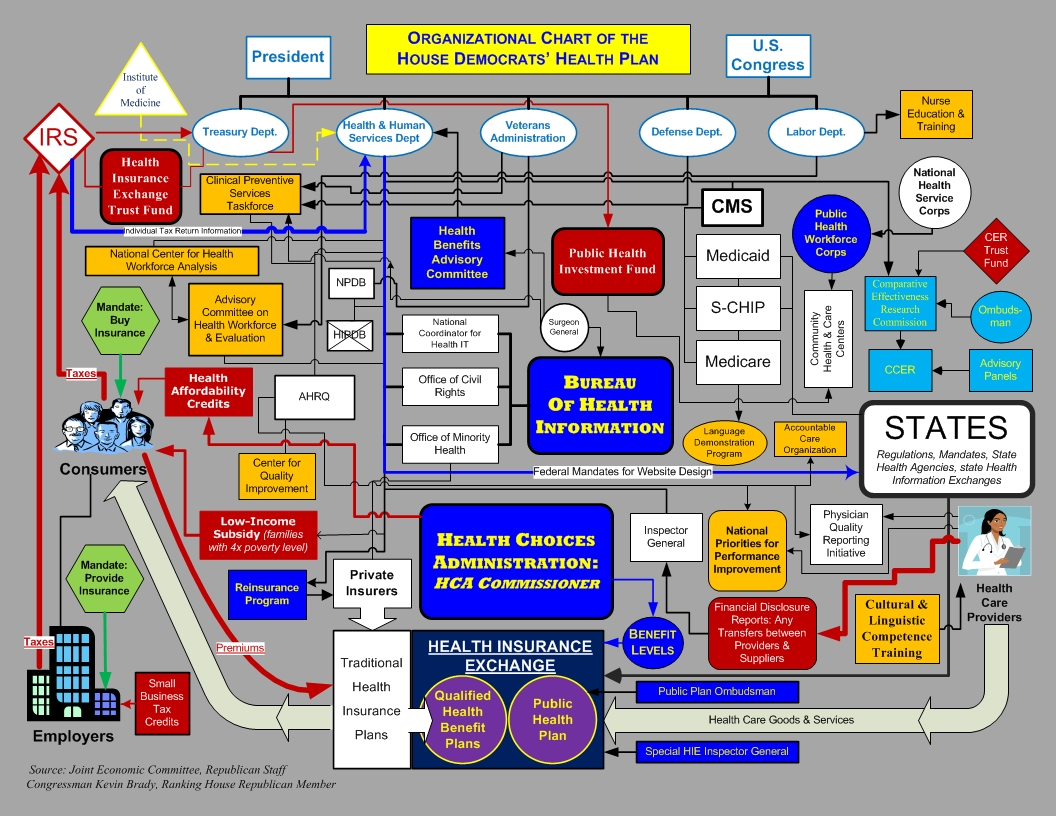
The Democratic Party’s proposed Healthcare scheme is below 1:
This map begs several questions:
- Where does it start?
- Where does it end?
- Are all motions equally important?
- What are the value-added steps?
- What are the steps we can do without?
- Can a 15 year old understand what is happening on this map?
It is safe to conclude that the map above is clearly bloated — complexity at its worst.
For me, I have a question that drives clarity and honesty in my thinking:
Can a 15 year old understand this?
If the answer is “No”, then I need to work harder to make my idea clearer and simpler. Using that question as a litmus test for the Healthcare Scheme above, I believe the answer would be a clear “No.” In other words, the Map above is a starting point, not an ending point: there is much to improve.
One area not exposed by either of the above maps is, perhaps, the most insidious of all: amidst all the confusion and motion are people that could potentially be harmed. The patient is the true casualty in either of the above maps: she gets lost in it — indeed, we forget that at the center of Healthcare is the patient. Broken processes enable our forgetfulness of people.
Broken process unfortunately helps us to forget people
Another map worthy of Spaghetti-like accolades is below 2:
Again, the presence of many squiggly lines means one thing: OPPORTUNITY for improvement. This is clearly a starting point, not and ending point. There is so much to improve.
To be fair, creating a future-state of the above is not trivial, underscoring the fact that Healthcare is clearly complex. One thing is clear, if anything needs and begs improving, it is Healthcare where the biggest opportunities lie 3.
- Source: House of Representatives ↩
- Source: The New Republic ↩
- Credit to Kevin for the inspiration ↩
Become a Lean Six Sigma professional today!
Start your learning journey with Lean Six Sigma White Belt at NO COST



Matt Williams says
Dan Roam has posted about this issue, specifically in respect of healthcare reform, and is going to be working on it himself – I’m looking forward to the results: http://digitalroam.typepad.com/digital_roam/2009/08/clarifiying-health-care-dont-expect-much-from-the-media.html
Chris P says
The first diagram was meant to be an explanation of the new plan, but as a statistician I am trained to ask, “Compared to what?” when I see data. I have yet to see a similarly designed diagram for the current system. If the point of the diagram was to show that this is a complex system with multiple points of regulation, then it has succeeded, but it is not evidence that the reform is worse than status quo.
Levi says
You should note that the diagram in question was created by Republican Staff Congressman Kevin Brady, who is the ranking Republican on the committee. Do you think he intended to portray the plan as clearly as possible, or did he perhaps want to make it look as confusing as possible?
No doubt the plan itself is very complex, but one must be careful to distinguish a bloated and complicated *representation* of the plan from the plan itself. Taking a representation designed by an opponent of the plan as the simplest possible representation is probably a bad idea.
Robert Edward Cenek says
Ditto to Chris P and Levi. No more complicated than the current system.
Michael Donegan says
psabilla, Could you please contact me concerning you Wharehouse article kast year. I am writing a business plan and have some questions. Thanks