
We can learn powerful lessons on visual communication from hospital visual management yes, even in the maternity room.
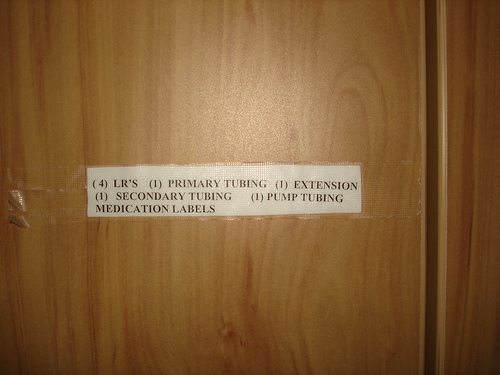
A few months ago we adopted our baby girl, Mylie. During that hospital experience, I had an encounter with a faucet fraught with featuritis and one that wasn’t humane and, during that same time, I noticed a piece of visual management in the hospital room that wasn’t effective in its intention to provide or share information. This involved a sign in one of the cabinets, where the sign indicated in text the contents of the cabinet. Below is a picture of what I saw:
In the context of the entire cabinet, below is a picture of what a typical user might see:
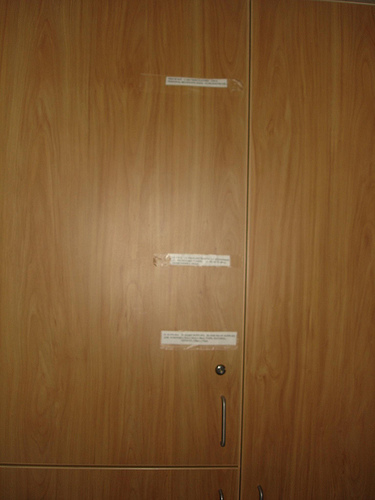
The taped signage is small, doesn’t distinguish the writing from the wood-colored background very well, and is confusing since there are 3 signs on the same cabinet.
I wonder if the nurses or doctors can easily tell what is in the cabinet? If the more seasoned hospital staff know the contents of the cabinet from experience, then I wonder if new hospital staff could easily tell what was contained in the cabinet? My hypothesis is that new staff would have to open the cabinet in order to see what was contained inside. If that is true, then the intention of the signage fails to meet its promise.
Why Visual Management?
As I indicated in this post regarding Visual Management and teaching kids the principle of work, effective Visual Management can be a control as well as a display:
- Visual Management as Control: As a control, effective Visual Management can prevent defects or warn of defects. For example, the noise of metal-to-metal screeching in car brakes is a signal to change your brakes — the machine is warning the human that there is a defect (audible management). Effective Visual Management as Control answers the question: “If I am doing something wrong, how will I know?”
- Visual Management as Visual Display: As Visual Display, effective Visual Management can aid in effective information sharing or encourage standardization in processes. For example, a Standard Operating Procedue (Standard Work or SOP) is an instantiation of this principle. An SOP answers the following questions: “Am I doing this right?” and “How do I know that I am doing this right?”
Back to the Hospital
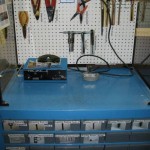
The signage on the hospital cabinet was an attempt at information sharing — sharing with hospital staff the contents of the cabinet. Unfortunately, it wasn’t effective. Below is an example of a simple and effective Visual Management as Display (courtesy of mike):
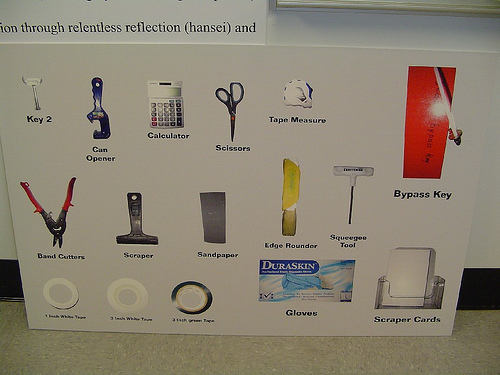
This is a simple shadow board that displays pictures of the items. As a display, the above is pretty good. But, it misses the point of the principle of display. How? Well, a shadow board is meant to inform the human that an item is missing; which is why a simple outline of the item with text is more effective than the picture of the actual item. Nevertheless, the above is a good attempt and a step better than the hospital cabinet.
Here is an effective and simple example of Visual Management as Display (courtesy of my friend jon miller):
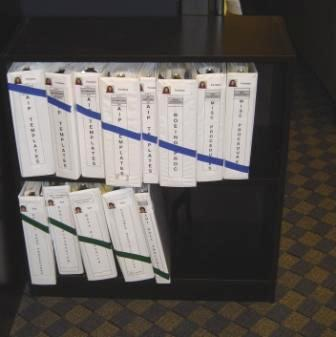
The horizontal stripe across the binders presents a quick and easy way to realize and discover that a binder is missing or a binder is not in the proper sequence. For example, if the top-left binder was on the top-right side, then the user would immediately know that it is is out of place. This simple Visual Management technique supports the principle of informing the user if something is wrong. It’s simple and elegant.
Back to Principles
It’s easy to get caught-up in the language and “tools” of the Toyota Production System, popularized in America as Lean Manufacturing. But, it is about principles, concepts, and how “tools” support those principles. The tools change and are improved, but the principles remain.
Become a Lean Six Sigma professional today!
Start your learning journey with Lean Six Sigma White Belt at NO COST


Leave a Reply