
In Lean, inventory is often viewed in a negative light. Indeed, inventory is one of the 7 deadly wastes. Is the traditional position of Lean justified in thinking so negatively against inventory and the warehousing that goes along with it?
There are at least 3 critical items that allow you to reduce costs and increase service level in warehousing:
- Tight and Necessary Warehousing Processes
- What Warehouse Metrics do you have in place to help you determine if your processes are going well or not.
- You warehouse location is optimal in the first place to meet service level commitments.
- These together will help you reduce costs in your warehouse.
Single Piece Flow, while an ideal state for a company to be at, is not realistic when it comes to warehousing. Why? Well, there is a fixed cost any time product is transported. This is especially high when the carrier is ship or plane or train; and to amortize this fixed cost it is necessary to fill the carrier to capacity. Consequently, a distributor may consolidate shipments from vendors into large shipments for downstream customers.
Similarly, when shipments are consolidated, then it is easier to receive downstream. Trucks can be scheduled into a limited number of dock doors and so drivers do not have to wait. The results are savings for all involved in the supply chain.
Put another way, suppose there’s a large retailer with thousands of suppliers. Imagine if those suppliers replenished each retail store directly. That scenario would mean that each trailer would leave the supplier mostly empty or Less-than-truckload (LTL). The model might be illustrated as follows:
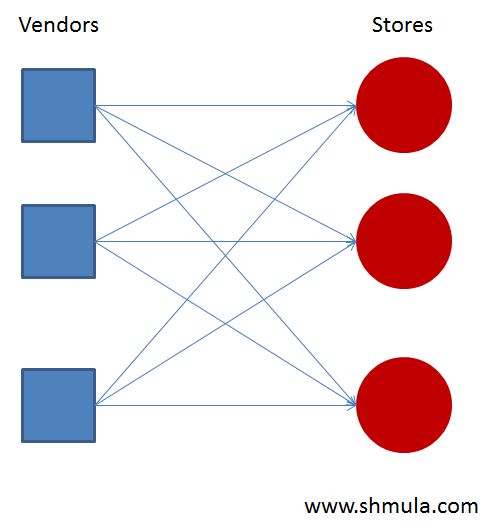
In the example where each supplier replenishes each store directly, we achieve the following transportation plan:
Vendors v * Stores s = # of direct shipment transportation runs.
And, each direct shipment will likely be less than truckload and the consequent costs will be much higher.
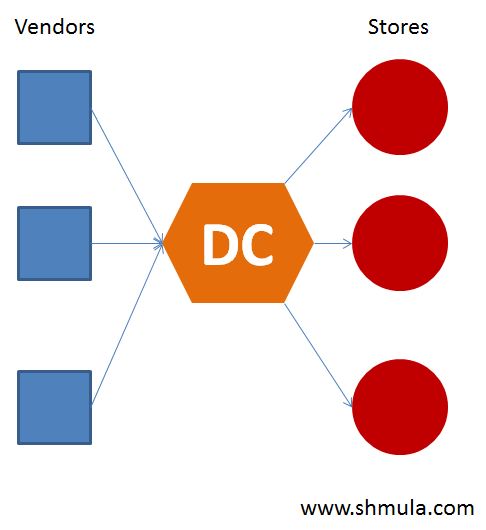
The alternative is to have a consolidation warehouse. In this scenario, we have Vendors or Suppliers that have inbound shipments to a consolidation warehouse, then that warehouse delivers direct to the stores. The result is the following transportation plan:
Vendors v + Stores s = # of direct shipment transportation runs.
In this scenario, the costs incurred is much lower and the shipments will likely be larger with lower fixed costs. This model might be illustrated by the picture below:
So, despite the negative attitude toward inventory and the field of warehousing in general, lean advocates need to understand the warehousing can be strategic and can actually reduce the overall landed costs in the supply chain.
Become a Lean Six Sigma professional today!
Start your learning journey with Lean Six Sigma White Belt at NO COST


Rob van Stekelenborg says
Pete,
Inventory, weherever it sits, still wastes time, resources and money. That you try to “optimize” only points at obstacles in the way to the ideal and is an example of stepping into the efficiency trap. Instead ask: why are producers so far away from their market? Why are transportation resources expensive? What is it, that makes us feel the need to put in the waste of inventory and a DC? (Think about Rother’s Kata in that respect).
I’m not saying we can be in an ideal world tomorrow, but in the meantime many other possibilities exist to eliminate the warehouse in a supply chain. For instance: use direct deliveries for certain value streams bypassing the DC, use milk runs and EXW conditions instead of DDP and point-to-point transportation. And when you really have to go by a DC, limit its use, e.g., by merge-in-transit and crossdocking.
What’s then left in terms of value stream and processes in the DC can then still be subject to Lean principles. But we should never forget that in the end, it is not about doing efficiently what shouldn’t be done at all.
Best regards,
Rob van Stekelenborg
Stephen Stanley says
Good post! It emphasizes something I try to fight in the various Lean and Six-Sigma forums, slavish devotion to the tools of the disciplines. A few nights ago a speaker at our ASQ meeting used the metaphor of the Cargo Cults in the South Pacific following World War II: After the war, they built runways, control towers and even effigies of airplanes to try to make the airplanes that had delivered good things come back. The Seven Wastes represent absolutes, ideals that can never be attained in the real world. Inventory is one: Until I have a Star Trek molecular assembler in my home big enough to produce anything I could possibly want, there will be inventory and even in the molecular assembler case, there have to be molecules to assemble from. Slavish devotion to the tools will not generate an effective Lean implementation and the wastes, expressions of an ideal state, are nothing other than tools.
Good post. Thanks!
Jason Morin says
Very refreshing article. It is sometimes difficult to be both a Lean advocate AND work in warehousing where you are surrounded by thousands of pallets of inventory. The enjoyable part of the job though is helping those in warehousing learn how to apply the principles and tools of Lean to the operation of the warehouse. Warehouse managers usually can’t control the levels and mix of inventory, but they *can* control how to effectively unload, store, pick, and load that inventory efficiently and effectively.
K K GANGADHARA says
Well explanation, thanks for every one