
I’ve been part of several turnarounds and have led a few in my short career. One thing that I’ve learned is this: one cannot underestimate the people-side of a turnaround. In fact, it’s very likely that your turnaround will fail, if your people aren’t with you.
In this article, I’ll share a simple, pragmatic model that has proved effective for me in the past and, in proceeding blog posts, I’ll show several examples of how you can implement this model in your various turnaround efforts — from very small to very large.
A Crisis
Most turnaround efforts begin with a recognition that the business is in trouble. This recognition typically comes through the review of a troubled balance sheet, or struggling EBITDA numbers or losing several key customer accounts simultaneously. These are decent indicators, but they are clearly lagging indicators. Most likely, the morale of the organization — if one has the awareness and the sense to feel — is a more accurate leading indicator for the health of a company. Indeed in some cases, morale precedes financial trouble.
Creating Urgency
Once awareness of a crisis is realized, then productively channeling, communicating, and creating a sense of urgency for the entire organization is the next and ongoing step. What the organization — what each person in the organization — will need to know, feel, and remember is found below:
- How is the company doing: to be shared with complete, emotional honesty, and NOT intellectualized or sugar-coated in any way. In a crisis, the organization cares more about emotional connection, not about intellectual or detached positions from the leadership team. We’re all in this together should be the banner call.
- This is what we’re going to do about it — short-term and long-term: An appeal and a return to company values can be very powerful here. Remind the troops of what made the company great, the values that underpin the behavior of everybody, and how those values will be a guiding light in how to navigate through the crisis. Then, be very specific about the steps to be taken and milestones we expect to reach and when we expect to reach them. Doing this will give confidence to the organization and will empower them to ask themselves “How can I help?” or “What can I do?”
- Here’s what you can do – specifically: Your employees will want to know exactly how they can help navigate the organization through the crisis. They are yearning to do something meaningful and important — help them find a way to contribute in a meaningful way.
Your employees are adults and they can take bad news with dignity. Be honest. Don’t sugar-coat. Emotional connection is the key here; people will see right through any statement or behavior that isn’t authentic or sincere.
The Plan and Change Management
Your plan should be very specific, addressing the key themes and parts of your company crisis. That plan will most likely require change — it has to: if you keep doing the things you were doing before the crisis, then you’ll just extend the crisis even longer. You must do things differently — which requires change management.
If you keep doing the things you were doing before the crisis, then you’ll just extend the crisis even longer
A simple model that I’ve used in past turnaround efforts — both big and small — is the model below:
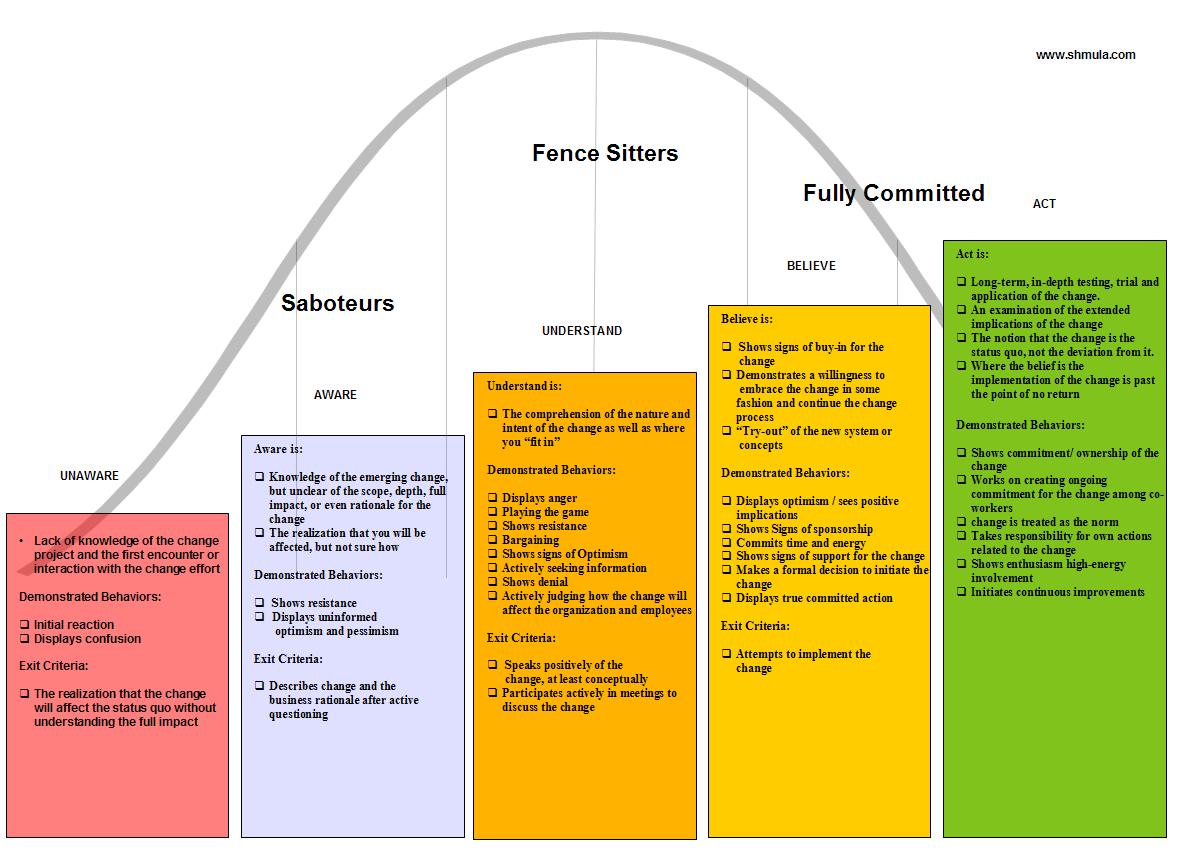
The model follows basic human development patterns of Unaware, Aware, Understand, Believe, and Act.
In any change effort, you will probably have, in general, people that might be considered Saboteur, Fence-Sitter, and Fully-Committed. This model also explains the specific behaviors that define what it means to be Unaware, Aware, Understand, Believe, and Act.
In proceeding blog posts, I’ll explicate on each role in this change model and how to build a strategy from it.
Become a Lean Six Sigma professional today!
Start your learning journey with Lean Six Sigma White Belt at NO COST

Samuli Pahkala says
Good companies have learned that they have to change. They change before they muts to – before they are in a crisis. Same change managament laws apply also then and they are harder to implement as people do not see the necessity to change when thinks are going well.
Sarah says
Would love to see the fine print in the Fence Sitters et al chart you posted there at the bottom. But it’s too lo-res…any chance for a higher resolution image or PDF link? Thanks!
Sarah
Pete Abilla says
testing facebook connect application on shmula.com
ikogsakanding says
nice article……
Business Management says
Management trends come and go. They are good or bad depending on many variables: industry; company culture; education level of workers; existing contracts and laws; etc. Mostly, however, they are good or bad depending on how well they are applied.
web graphic design says
A matched pairs comparison of successful and unsuccessful firms under these conditions reveals very different patterns of strategic measures taken. One of the significant differences is that the successful firms make changes in the management area very early, while the unsuccessful firms make them very late. the results are used for a theoretical reflection focusing on the following two questions: (1) Are organizations basically inert of adaptive? and (2) What is management’s role in organizational change? the central theme of the discussion is that in the literature too little attention is paid to timely management changes as an element of organizational change strategies.
Heidi De Wolf says
Wow, that puts a different spin on Rogers Diffusion of Innovation Model (http://www.smartinsights.com/marketing-planning/marketing-models/diffusion-innovation-model/). I suppose it’s all a matter of perspective? o_O