
Podcast: Play in new window | Download
Subscribe: Apple Podcasts | RSS
There are some arguments not to begin a Lean Transformation with 5S. I agree with this. But, this article is not about the broader Lean Tranformation, but about the method itself.
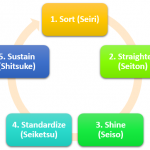
5S is part of the Toyota Production System, anglicized in the US as Lean. 5S is a reference for standardized cleanup, order, or tidyness. Defined,
- Sort (Seiri): This refers to the practice of sorting through all the tools, materials, etc., in the work area and keeping only essential items. Everything else is stored or discarded. This leads to fewer hazards and less clutter to interfere with productive work.
- Straighten (Seiton): Focuses on the need for an orderly workplace. Tools, equipment, and materials must be systematically arranged for the easiest and most efficient access. There must be a place for everything, and everything must be in its place.
- Shine (Seiso): Indicates the need to keep the workplace clean as well as neat. Cleaning in Japanese companies is a daily activity. At the end of each shift, the work area is cleaned up and everything is restored to its place.
- Standardize (Seiketsu): Allows for control and consistency. Basic housekeeping standards apply everywhere in the facility. Everyone knows exactly what his or her responsibilities are. House keeping duties are part of regular work routines.
- Sustain (Shitsuke): Refers to maintaining standards and keeping the facility in safe and efficient order day after day, year after year.
The 5S supports other Lean ideas such as the Visual Workplace, SMED (Single-Minute-Exchange-of-Dies), Total Productive Maintenance (TPM), and to some small measure Just-in-Time (JIT). 5S is also a foundation for Safety in the workplace.
I’ve seen companies try 5S and fail. The Toyota Production System, besides all the jargon and pragmatic concepts is, at bottom, a culture. 5S is part of the Toyota culture. When I’ve seen 5S fail, it was because it was part of a mandated program, not a self-organizing, organice one, that is supported and pushed by the workers.
Here’s an example: At Toyota, Hebron, Kentucky, at the end of the shift it was expected as part of the culture to clean your work area. But, there was a short time where some workers were systematically *not* performing 5S after their shift. Why?
A self-organized team quickly got together, and conducted a root cause analysis, and followed the Plan-Do-Check-Act pattern. They brainstormed and used an Ishikawa Diagram to help them arrive at the root causes for why 5S wasn’t being performed at the end of shift. This Kaizen activity was done in just a few hours, and the output of which were root causes and a detailed plan to eliminate them with a deadline and people responsible for making it happen.
Once ingrained in the culture, concepts such as 5S, JIT, SMED, NVA, etc, are just part of work. Doing them and participating in them is part of the collective consciousness of the workplace.
5S is an important concept; a foundation for safety and exposes the time-traps and non-value-added activities that might be present in your process or workplace. But, to fully benefit from 5S, it’s important to try to make it part of the culture; part of the collective consciousness of the workplace.
Download the free training packet below!
Become a Lean Six Sigma professional today!
Start your learning journey with Lean Six Sigma White Belt at NO COST




Michael says
Pardon my ignorance, but was/is Toyota a union shop? I wonder if perhaps that has something to do with employee self-motivation and a team environment. In Texas it is hard to see that sort of organization (at least in my experience) due to a self-centered work ethic and poor union integration into the mainstream industries.
Perhaps it is due to how self-contained many office-type jobs are, especially in the customer service industry, versus the naturally team-driven manufacturing industry. Or maybe I just work for a company intent on preserving an every-man-for-himself attitude about things. *shrug*
Wally says
Is there a bigger version of that root-cause-analysis doc?
Mark Graban says
Toyota is non-union here in the U.S., but I believe they have “company unions” in Japan, which are quite different than what the UAW would be.
Pete is right in pointing out that 5S should be in place to expose problems and to help reduce waste. 5S will fail when it’s seen as management just telling people to be organized or the “neat freaks” come and put tape around everything. A 5S program, done incorrectly, can be wasteful.
5S should support employees. When you organize things so that the most frequently used tools are closest to the employees, that is solving a problem for them. When items aren’t missing anymore because they are always put back in the same place, that’s reducing waste and frustration for the employees. The focus needs to be on the employees, not just looking good for tours and outside visitors.
Daniel Jaramillo says
I liked so much your blog; please tell me where I can find more information about Kaizen and application examples. I’m from South America and I’m trying to improve those topics at my work and show the examples to my coworkers to create a 5 S culture.
Mike Stone says
I was interested in examining the root-cause analysis document, but it was of insufficient resolution to be legible. Is it possible that a higher-res version might be posted?
V. Balaji says
There is no process which does not involve waste. It starts from your bathroom tap to preparation of sandwich in kitchen to utilization of your living or dining hall for optimum usage. It is your ability as to how you minimise the waste or able to recycle the waste is what the question. There is no hard and fast rule that the must be developed in one particular fashion. You can develop your own system which must ultimately lead to waste elimination or waste reduction.
It requires high degree of planning and executing. It is totally a team work and every individual must feel within the need for such waste reduction.