
Batch-and-Queue or Single-Piece Flow in Peanut Butter and Jelly Sandwich Making. Having as large of a family as mine, we need all of our internal processes optimized. You know what I mean?
To be able to effectively manage a large family, we run on a pretty strict routine — I didn’t say “schedule” here because our family operation is also very flexible and agile. But, we have a routine and we, for the most part, stick to it. One routine is that I make the kids’ lunches every night for school the next day.
During one late evening last week while making peanut butter and jelly sandwiches (PB & J), I noticed that this was an opportunity to test batch-and-queue versus one-piece flow.
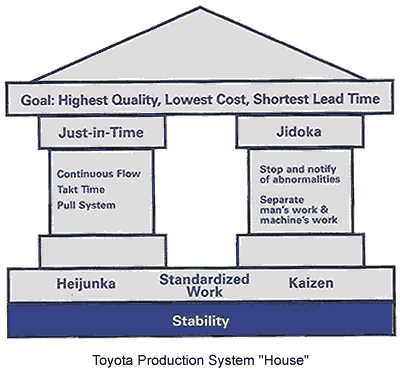
One-Piece Flow
One-Piece Flow comes from the Toyota Production System, anglicized in the United States as Lean Manufacturing. One-Piece Flow is also known by various other names such as the following:
- One-piece Flow
- Make-one, Move-one
- Single-piece Flow
- Continuous Flow
- Flow Manufacturing
TPS emphasizes right-sizing your batches because batches that aren’t the right size leads to queues, which leads to waiting time, which leads to poor space or resource utilization, increased Work-in-Process (WIP) or Things-in-Process (TIP), longer cycle times, which are all forms of wastes or muda.
On the other hand, the Batch-and-Queue approach teaches us to build stuff, let it queue in front of the next step, all throughout the system. Batch-and-Queue systems lead to poor space utilization because of the batches of work waiting to be served that take up space on the production floor, longer cycle times, a higher probability of defects because you build stuff and let it sit and, lower morale because batch-and-queue leads to large sizes of work-in-process, not finished goods — the psychological message is that you’ve created a bunch of unfinished stuff, further burdening the team with thoughts of “man, we have so much more to do.”
Peanut Butter Sandwiches, One-Piece Flow
There are two ways to build sandwiches — the Batch-and-Queue method or the One-Piece Flow method.
- Batch-and-Queue: To build sandwiches the Batch-and-Queue style I would take 3 pieces of bread (3 lunches to make) and place peanut butter on it. Then, let the 3 pieces of bread with peanut butter sit, while I take 3 pieces of bread and place jelly on it. Then, I’d marry the two sides of the bread and be done with 3 sandwiches.
- Single-Piece Flow: For Single-Piece Flow, I’d take one piece of bread place peanut butter on it, then take one piece of bread and place jelly on it, and then marry them. I would do this 3 times.
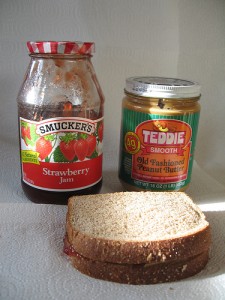
Single-Piece Flow approach is much better because there’s no waiting involved, cycle time is shorter because I’m completing sandwiches at each motion, and I feel better because I can visually see what I have completed.
One-Piece Flow and Other Processes
One-Piece Flow can be applied to many other processes. Here are a few examples:
- Software: Most software is built modularly — that is, in small modules, where one class can consumes or uses the services of another module. Ideally, modular code is of the right size such that the engineer can build each module to completion including dependent modules, instead of building several modules in parallel, leading to task-switching, which is a waste.
- Software Requirements: Requirements documents are historically chubby, batchy documents. a one-piece flow approach is to follow the Agile method by creating user stories, sizing them by effort and prioritizing them, then unpacking each story into atomic units we call “tasks” with time attached to it. Each tasks represents the take-one put-one approach and forces continuous flow in software development. Joel (Joelprah) talks about task-switching for software and simulated the huge negative impact it has on productivity. The one-piece flow approach embraces iterative development and rejects the Waterfall approach, which is akin to Batch-and-Queue.
- Order Fulfillment: At Amazon it was mandatory to complete an order at a time, instead of several orders at a time. The associates had a difficult time understanding this concept until we showed them that the batch-and-queue approach leads to “switcheroos” — that is, mistakenly putting an item in the wrong order. The one-piece flow approach avoided this defect altogether and led to shorter cycle times, enabling the order to meet shipping deadlines.
There are many, many other processes where you can employ the principle of One-Piece Flow. A few things to keep in mind before employing One-piece flow:
- Process must be highly capable of consistently producing high-quality product. If there are serious and consistent quality issues, then one-piece flow will be difficult to implement.
- Process must be repeatable.
- Where equipment is involved, uptime should be close to 100%, otherwise interruptions will disrupt flow.
Today, take a look at the processes around you. In what ways can you implement one-piece flow in your environment?
Become a Lean Six Sigma professional today!
Start your learning journey with Lean Six Sigma White Belt at NO COST





Levi says
I’m afraid I don’t buy your conclusion in the PB&J example. When implemented by a single person, there is just as much waiting involved in the single-piece flow model because the bread you are not currently using ‘just sits’ without peanut butter on it, as opposed to with peanut butter for the batch and queue model.
Although the first complete PB&J sandwich is completed earlier with the single-piece flow model, I would argue that the entire process of creating 3 sandwiches must necessarily have some negative side-effects that would be absent in the batch queue model. The possible side-effects would be: additional time taken to clean knives between application of peanut butter and jelly, cross-contamination of peanut butter and jelly due to not taking that time, or an additional knife to clean at the end if two knives are used.
Finally, you’ve got to be kidding me that visually completing one of three sandwiches a few moments earlier gives you a noticeable ‘better feeling’ than completing all of them a bit later but around the same time and before your final process would be complete otherwise. If it did, I would argue that it was only because you were /expecting/ such a feeling due to your feelings about batch and queue vs. single-piece flow.
I imagine that there’s a lot of data to back up the Toyota Production System’s usefulness, but your little sandwich example is not among them. You’re simply applying the conclusions from those other data onto your example rather than bothering to measure and create your own conclusion from your experiment. Probably because doing so wouldn’t support the conclusion you want to make at all!
Anyway, I don’t mean to be excessively negative; I appreciate reading most of your blog entries, but this one just made me shake my head.
psabilla says
@ Levi,
What a great response; thanks for reading my blog.
To your point — yes, this was a toy example of a much broader principle. Single-piece flow is part of a whole system — the Toyota Production System. My world-view is clouded by my experience and I view things and process with a TPS lens. You’re completely right about that.
Please be patient with the toy example of PB&J. It was only meant to illustrate, in a small way, the concept of single-piece flow.
Again, thanks for reading.
gman says
I agree with Levi. Having worked in foodservice I can tell you I was a LARGE percent faster with the batch and queue style than the one piece flow.
Maybe this example will work better. Think of putting a slices of tomato, ham and cheese on a ham and cheese sandwich.
one-flow
* Take out one piece of bread
* grab bag, take out enough ham for one sandwich, put it on bread
* peel off once slice of cheese from stack of cheese, put on bread
* slice one slice off tomato (pick up knife, pick up tomato, cut) and place on bread
* take out one more piece of bread to finish
* repeat 10 times
batch.
* Take out 10 pieces of bread and lay them on the table
* pick up large stack of ham and put a few slices on each piece of bread
* pick up large stack of cheese and put a slice on each piece of bread
* cut tomato into slices
* with several slices in your hand put one on each sandwich
* Take out 10 pieces of bread an finish the 10 sandwiches
I guarntee you if it I time myself the batch method will be more than twice as fast as the one-flow method.
It will even be faster in general with more people. Disneyland uses the batch-flow method for services all their guests as do most large cafeterias.
Maybe you can come up with a better example for you point.
Steve says
Everyone thinks batch flow is faster than one piece flow; UNTIL, you actually put them to the test. My wife washed dishes with a half one piece flow and half batch method. She would wash and rinse a dish then set it aside, wash & rinse the next dish and set it aside. She would continue this until all dishes were clean. Then, she would dry and put away a dish one at a time.
I told her she should try washing, rinsing, drying and putting away a single dish and then move to the next one. We timed both methods with one piece flow being 30 seconds faster – given we did 10 dishes as a sample.
Making sandwiches, you have to set all the supplies out in an assembly line setup to get an accurate timing for one piece flow. No one in there right mind is going to go from the counter to the fridge, get one slice out, walk back to the counter, put it on the sandwich. No. You will have all the meat set out, all the cheese, toppings whatever in an assembly line. I haven’t tested it yet; but, I’ll just bet it will be batch flow hands down.
Ma lourdes c. Makabali says
I agree with steve, Part of the process is set up time , in case of food preparation, you will find that all vegies have been sliced and laid down on a cooler ( set up), take the caseof subway sandwich , when you order, they prepare sandwiches FIFO, they finish one sandwich at a time. If you want the line to move faster , you can add stations. If you know that you,will be preparing many sandwicheson demand nit on schedule, you will be cutting your vegies ahead of time and have an assembly of these vegies ready to be placed in every sandwich ordered.
Ma lourdes c. Makabali says
Also to add to my comments if you are in a food service and you get bulk orders, you will probably increase your work stations or will have a different production line for bulk orders where in you will have one person preparing the breads, one spreading the mayo and butter, then another one placing your ham and another one placing the lettuce and pickles, then another person wrapping the sandwiches. Tis isnt batch and queue, its an assembly line
Hannah says
The only difference I see between one piece flow and batching is that in one piece flow, you avoid have to pick up the same object multiple times – e.g. if you washed all dishes first then dried them, you would need to put the washed dishes down before washing the next one, and then picking the same dishes to be dried. While in one piece flow, the dish could just be dried before you put down.
I am still struggling to understand how else is one piece flow better than batching. Note that in the subway example, all the necessary ingredients of the sandwich had some form of preparation beforehand – lettuce and tomatoes sliced, slices of ham portions
There are instances where one piece flow doesn’t make sense – for example in tools that are designed to “work on” several pieces at a time or job typing process – e.g. you need to set up your machine for each different product you are producing and the set up time is very long. Going with the lean and one piece flow theory, you only manufacture when you have a demand for your product, but this in reality might cause you to waste time to constantly set up your machine while your operators sit idle waiting for the set up to be done. For example going with the subway example, you will be handling the tomato and lettuce many times if you were to cut them when an order comes through, instead of slicing them all at once.
gman says
Oh, one more thing. I felt a huge sense of accomplishment at having gotten my sandwich making done so fast and efficiently. Specially since most of the people in foodservice that I worked with did the one-flow method and ended up taking forever thereby not being available for other things and making people wait.
I’m sure in a different situation thought the one-flow method is better.
Thomas Bowcut says
Although the example did not perfectly fit, as pointed out in other comments, the concept being shared was appreciated and perfectly applicable in other situations. It would be interesting to get your comments on how other factors determine the most effective flow model to adapt, such as complexity and batch size.
Mark Graban says
Peter’s example isn’t perfect, but as an illustration, the “batch and queue” example should have been much worse if it was meant to show how a bad manufacturing process works (or even a bad healthcare practice).
Bad Batch-and-Queue:
To build sandwiches the Batch-and-Queue style I would take 3 pieces of bread (3 lunches to make) and place peanut butter on it. This work actually has to be done by your daughter, because she is part of the Peanut Butter union. This This would be done down in the basement. I would have to call my wife to come get the bread at some point (whenever she had time).
The bread/peanut butter pieces would then be carried to the garage to sit and wait.
Then, let the 3 pieces of bread with peanut butter sit, while I take 3 pieces of bread and place jelly on it. This work would be done by your son, who is in the Jelly Union. This would be done upstairs in the baby’s room. I would call my wife to come get the bread/jelly when it was convenient. We’d make 4 pieces actually, to account for damage that might occur when moving the bread/jelly. The bread/jelly would be moved to the garage some hours down the line.
We’d gather in the kitchen. People want 2 sandwiches, but it’s more efficient to 3 sandwiches at time (to keep our cost down). Upon deciding to build 3 sandwiches, we would have my wife go to the garage to get 3 bread/peanut butters and 3 bread/jellies.
Then, I’d marry the two sides of the bread and be done with 3 sandwiches. I have to do this work myself, being a certified “Assembler” job class.
One sandwich would get thrown away after growing moldy.
Now THAT is a better (and not unrealistic) batch and queue example. And, no, I’m not blaming unions for all that is inefficient in the world.
alan patrick says
Strawberry Jam! Everybody knows that *Apricot* works best 🙂
Seriously though, the PB&J Batch vs Flow manufacturing argument needs to take account of (i) Setup times and (ii) Process Times.
To make Flow happen you have to minimise setup time, typically via dedicated lines or modular jigs etc. In this case setup time is from knife changeover (assuming you wash the knife between PB and J operations). Using 2 dedicated knives clearly moves the cost per sandwich up to uneconomic levels.
Process time is a tradeoff between minimum time to complete (typically better in batches) vs other costs (inventory & WiP storage, defect control etc). In this case it is my observation that the on-cost of extra BiP (Bread in Process) in front of the workcentre was negligible and SiT (Sandwich in Time) delivery was still satisfied, so the Batch Process is probably optimal here.
However, if you have to manufacture a variety of products on the same chassis the issue become one of relative homogeneity. Clearly you have some easy variety options – you do not need to be Fordist and offer any jam so long as it is strawberry – the Toyota approach would recommend you using multiple Jams, scheduled to user demand forecasts, on the same braed and PB subassembly.
Stick control here could be via 2 bin rather than JiT delivery, saving costs I think.
However to offer the Alfred Sloan approach and offer 5 variants – caviar, pate, chocolate spread, PB&J, and butter – will require a more complex setup and negotiation of raw material delivery, thus necessitating ensuring higher values at point of sale.
Harish says
I am a big fan of this blog. 🙂
Back to one-piece-flow. I would imagine that if you have more than one operator it would be more efficient to do one-piece flow. You may have to do the calculation prior to make it cost-effective. One-piece flow works.
Marianne Booth says
I like all the discussion that relates to the jam and peanut butter sandwiches, and after all, using an example like this is useful when it encourages people’s thinking. I have heard there is an envelope stuffing you-tube video example of one-piece -flow vs batch, but have been unable to find it. Has anyone else come across it? I would love to have the link.
Thinking Lean says
It is amazing how many people still support batch processing, despite evidence that in most environments it fails miserably. Single piece flow is just as much if not more about the quality of the product, allowing manufacturing flexibility to change, and minimizing risk.
In the PB&J example – instead of 10 sandwiches now there is 1000. Assume you can get paid as soon as a sandwich is completed. Also assume that the customer may want grape, strawberry, or rasberry jam. A one piece flow scenario easily adapts to different market requirements. A batch method is not flexible in fact if the customer or the company changed their minds halfway through the process (Engineering Change Notice) then a great deal of pieces of bread with the wrong jam spread on them will be tossed, along with the labor it took to apply the jam.
The problem with simplistic examples is that they seldom capture the true nature of what is really valuable in terms of processing methodology. Flexibility should not be overlooked, neither should the amount of inventory on hand.
Doug says
How about if we take this method for the PB&J and apply it to breakfast. Prepare one plate at a time of fired eggs and bacon and see what happens. This is actually very common for short order cooks at restaurants, but would you consider doing this at a military base where you have to feed abotu 2000 troops within one hour? -doug
krijn says
That depends: who is actualy the customer and what do these customers want (the core principle of Lean).
I think we owe to our soldiers to have a good breakfast.
Imran says
In the PB&J example … what happens when only 5 sandwiches are consumed. If it is a batch process, the 5 additional sandwiches go waste. In a piece flow, the max you will waste is one.
Thanks,
-Imran.
Pete Abilla says
Imran,
Excellent point.
Joel Bendicion says
Regarding the sandwich example since it’s only one operator..
doing one piece vs batch queue..who knows batch and queue may maybe faster.
it’s really case to case basis and the time study needed to be done unbiasly
repeatedly to verify actual result. And it really depends on the batch size:
– Like getting 6 cheese one time and distribute may save time in reaching for cheese 5x less. (bread, etc.).
– Batch and queue may not be effective if there’s extra motion to move (reach or back and forth movement of your WIP)
So if you primary aid is speed, then go ahead and do time study which is better.
other advantages of one piece flow is more important: then do one piece flow
quality: (especially if two or more people)
– less risk in skipping a step (like you can easily get interrupted, for one piece flow you can finish the process before stopping)
– identify problem faster
– consistency
– if this is sensitive part that can be damaged you do not want many parts on one table, as bump each other
Others:
– save space
– less risk in rework/scrap (as less inventory) after detecting an issue
– if a safety issue
– if next customer is waiting, you do not want a big lot size.
– more flexible to change order or setup
If you want benefit of both maybe do hybrid or smaller lot size.
If two persons or more then this debate is less and one piece flow will be more effective in speed and quality.
Thank you.
Brion Hurley says
Great comments, Joel. I agree about the size of the batch. I often tell people to focus on reducing batch sizes as much as possible, even if you can’t get down to one piece.