
Update: This is my 2007 article on the Apple iPhone Supply Chain Analysis. It’s a dated article and many things have changed. But, it may still be an interesting read for those interested in supply chain in general as well as electronics manufacturing.
I thought it might be fun to map the supply chain of the new Apple iPhone and, at some point, the supply chain of the Apple TV, hoping that this might help to demonstrate the complexity involved in manufacturing the Apple iPhone — a feature-rich product I wish I could have, if I could afford it (update: I’ve had several iPhones now).
I conducted some research and found some interesting information on the suppliers of the Apple iPhone. My data comes from The Wall Street Journal, January 14, 2007; Supplier Code of Conduct, Apple Corporation; and, some speculative assertions from Ars Technica, Engadget, and New York Times.
Note: Some or all of my data may be wrong. One fact I do know for sure is that the Apple iPhone is assembled, staged, and fulfilled from Apple’s Shenzhen, China facility.
Apple Supply Chain: High-Level Map
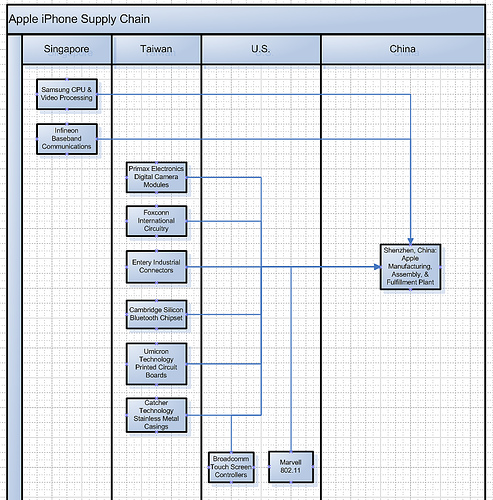
From a high-level, we speculate that the following are the material suppliers of the Apple iPhone:
- Samsung: The Singapore facility manufactures CPU and Video processing chips.
- Infineon: The Singapore facility manufactures Baseband Communications hardware.
- Primax Electronics: The Taiwan facility manufactures Digital Camera Modules.
- Foxconn International: The Taiwan facility manufactures internal circuitry.
- Entery Industrial: The Taiwan facility manufactures connectors.
- Cambridge Silicon: The Taiwan facility manufactures bluetooth chipsets.
- Umicron Technology: The Taiwan facility manufactures printed circuit boards.
- Catcher Technology: The Taiwan facility manufactures stainless metal casings.
- Broadcomm: The U.S. based facility builds touch screen controllers.
- Marvell: The U.S. based facility builds 802.11 specific parts.
- The Apple Shenzhen, China facility assembles the hardware, holds inventory, and handles the pick, pack, and ship steps of the fulfillment process.
If I am correct in any of my research and assertions above, it’s easy to see that if there is any disruption in material flow of any supplier into the Apple Shenzhen, China facility, then production either slows or halts altogether.
Apple Supply Chain: Taiwan Wins Big
Again, if I am correct in my research and assertions in this article, Taiwan supplies 6 of the 10 parts that comprise the Apple iPhone. This can be viewed as a strategic approach by Apple, concentrating sourcing the majority of the parts from one country, or this could be seen as a bottleneck or constraint — a potential risk: if there is any turmoil in political economy in Taiwan, then material and product flow might be disrupted.
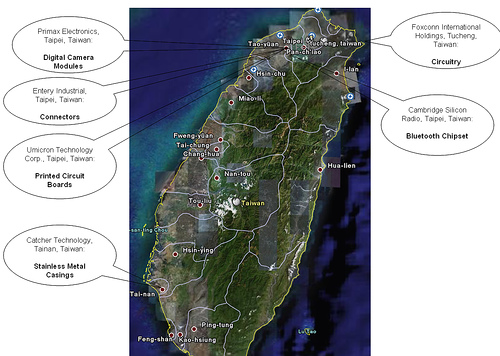
Above are the sourced materials from Taiwan in the alleged Apple iPhone Supply Chain.
Conclusion
Again, if I am correct in my research and claims in this article, then to make one Apple iPhone, material comes from 3 countries, traveling to China to be assembled, inventoried, and then fulfilled to retailers and to customers via purchases from the Apple Store. Is it any wonder they are asking for $500+ per unit? It is important to note, that the price has nothing to do with the costs structure — Lean and Friedman both teach us that the price has everything to do with what the market will bear. The firm has a target cost structure, a break-even point, but the price they go-to-market with is about the market demand, not internal cost structure. Assuming that I’m correct in my assertions in this article, I can only imagine that this complex supply chain is a challenging one to manage.1
- Related Supply Chain and Warehouse Management Article: Warehouse Management System ↩
Become a Lean Six Sigma professional today!
Start your learning journey with Lean Six Sigma White Belt at NO COST




Russell Page says
Thanks for the link to my apple iPhone story Pete. Nice job on this post. Very thorough.
peyv says
iPhone Only Costs $250 to Make; Rest of Price is Fanboy Tax
http://gizmodo.com/gadgets/cellphones/iphone-only-costs-250-to-make-rest-of-price-is-fanboy-tax-229664.php
Mark Graban says
The fact that Apple charges $500 has nothing to do with cost… it’s what the market will bear.
In the Lean/TPS world, price is driven by the market. To make profit, Apple has to get their costs down below a target cost. It’s the old non-TPS mindset that says “this product costs X to make, I’m entitled to 10% profit, so my price I’ll charge is 1.1X”.
With TPS, market says price is Y, for 10% profit, you have to get your cost to Y/1.1.
Interesting analysis of the locations though!
If iPhones and iPods weren’t so small and cheap to ship (and if they were customizable), you’d have to consider making them closer to the U.S. for the sake of supply chain responsiveness.
See this post:
http://kanban.blogspot.com/2007/01/wsj-is-still-shocked-we-build-stuff.html
Mark Graban says
Peter – you’re right that a complex or long-distance supply chain is complex to manage. It might be cheaper than the alternative of a vertical integration model. But, I still think companies chronically underestimate the costs of that complexity.
Mark Graban says
I watched the Steve Jobs iPhone demo (on my iPod) and he talked through the pricing… the $499 decision was based on the market (iPod Nano $199 + Smart Phone $299), so $499 for a combined product with many more features.
It was priced based on the market and value. He said nothing about what it costs to produce 🙂
HM says
Who is supplying charger to iPhone for Apple? Where?
Jeff Morrow says
Very thorough analysis, Pete. FWIW, I work in a consultancy that helps firms bring in oobeya practices. A partner consultancy has a relationship with Foxconn. Last spring they wondered if we knew anyone at Apple (we didn’t). I speculate that they hoped to use oobeya practices to coordinate between Apple and Foxconn but don’t know for sure.
Louis Duran says
Does anyone know who is supplying the NAND Flash? Is the joint Micron-Intel supplier?
Ethan says
Hey, so I am looking to break into purchasing iphones and reselling them and I was wondering if you could tell me how to find a supplier who gets them direct through Apple with out all the brokers in between?
MICHELE says
I need to get the contact numbers for all the companies that make the iphones.
Maria says
Does anyone know where I can find information on bullwhip effect in iPhone supply chain? Thank you for the assistance in advance
spooky says
Perhaps if you’d gone to work for Google you could afford an iPhone!
Jose says
I’m doing a project on the Apple iPhone supply chain and this has come in very handy. Do you have some more up to date info? If interested in our final paper with up to date info, just shoot me an e-mail.
Elle says
Why do you have ‘several’ iPhones? What’s wrong with just one?
Jayadeep Purushothaman says
It might be interesting to read this along with this – http://www.nytimes.com/2012/01/26/business/ieconomy-apples-ipad-and-the-human-costs-for-workers-in-china.html, how the people in this chain is treated!