
Multitasking Leads to Lower Productivity according to Little’s Law. It is a myth: It leads to lower productivity not higher. This article and others like can be found at my Queueing Theory page.
There is a predisposition for firms and people to think that multi-tasking is heroic, leads to more productive employees and, is generally, becoming more and more the accepted norm in business. All of this would be nice, except that multi-tasking actually leads to lower productivity and lower morale.
To belabor my point, here is a recent job posting I found on monster by doing a search on “multi-tasking”:
Medical Claims Coordinator: Showcase your Multi-Tasking Skills!
The above is the title for a job posting for a large insurer.
Learning from Little’s Law
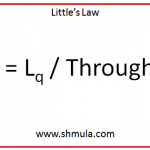
Queueing Theory leads to a fundamental theorem, called Little’s Law: for a queueing system in steady state, the average length of the queue is equivalent to the average arrival rate multiplied by the average waiting time. in other words,
L = λW
Put another way,
Throughput = (WIP / CT)
Where WIP is Work-in-Process and CT is Cycle Time.
What the equation above means, then, is that as we reduce WIP, we can increase Throughput; or, as we reduce Cycle Time, we can also increase Throughput. Or, we can simultaneously reduce WIP and reduce Cycle Time, with a combined effect of higher throughput.
A common result for multi-taskers is that simultaneous projects or items are spawned. Multi-threaded is sometimes the analogy here. But, unlike machines, people have a difficult time completing multi-threaded processes. The end result is that projects and efforts are not complete, time runs shorter and shorter, and demands continue to pile up. Think of everything I’ve just described as Work-in-Process (WIP). So, using Little’s Law above, as WIP grows, then Throughput decreases.
Translation: As we multi-task, we start several projects, complete only a few, WIP grows, Cycle Time eventually lengthens, and we are less productive.
Join the above statement with the fact that as we multi-task, then return to an old task, there is a learning curve involved in getting acquainted again with the context. This can sometimes lead to confusion, lower morale, and dismay for some people. This is especially true for software, wherein an engineer is engaged in code, but is pulled to do something else. To re-engage requires time, thought, and a lot of effort. This ultimately leads to frustration and poses significant risk to the software project not completing by the required date.
A Proposed Solution
I’m not advocating that we only do one thing at a time — although in some industries, that is ideal and necessary. Some situations require that we do some things simultaneously. I propose that the number of items that a person seeks to start is of the right batch size, control WIP, and keep an eye of the Cycle Time from end-to-end for each item started. Also guard against more items entering the queue, by placing them in a buffer, staging area, for prioritization and triage. Once treated in the buffer and a project has left the queue, then pull from the buffer the prioritized item. Common sense, but not common practice — to be sure.
Conclusion
Multi-tasking and its many flavors, such as Task-switching, the near-neighbor of multi-tasking, leads to a similar effect of lower productivity and it impacts morale. Multi-tasking leads to higher WIP, longer and longer Cycle Times, which both lead to lower throughput or productivity, and that impacts morale and the performance of the firm. To control this, I propose implementing a system that enforces the right number of projects to be worked on at a single time and a procedure for treating new projects as they enter a queue. All the while, keeping an eye out for the Cycle Time of completion of projects and also amount in the queue.
As already mentioned: my proposal is a common sense solution; but, it’s not common practice.
Become a Lean Six Sigma professional today!
Start your learning journey with Lean Six Sigma White Belt at NO COST



robert thompson says
You say: multi-tasking actually leads to lower productivity and lower morale. I made this exact point on one for my blogs here: http://tinyurl.com/28j94q.
The main leanring point is what Deming called Consistency of Purpose – focus until the task in had is complete. Here is a great example of a lack of this concept in action (http://pages.citebite.com/p1f4c8e1b9bxu):
I’ve never seen a company with the lack of consistency of purpose as Ford, Mulally told reporters. He stirred up buzz by visiting Toyota, seeking not so much to do business with the company as to learn something more about how the car industry works. “Consistency of purpose” might be the most cogent three-word explanation of what’s behind Toyota’s success. From the top execs down to the guys sweeping factory floors, everyone there knows the mission is to serve its customers.
Rob
james says
Good stuff! We see this everywhere including in personal time. How many times have you held a conversation with someone who is simultaneously working on their e-mail? The end result is that neither task gets completed as well as it should.
james
Gary Patton says
I currently own the domain name multitaskingsucks.com
I am just getting started but wondered if you would be interested in advertising on my new site.
Please let me know if you would have any interest.
Gary Patton
jack says
Your math doesn’t work at all. You’re making a great point, but this equation just doesn’t work:
Throughput = (WIP / CT)
since the math means that increasing WIP would *increase* throughput given a constant cycle time. Maybe you meant CT / WIP , where CT is time to complete 1 work unit and WIP is in work units?
The rest of the article implies that the concepts of WIP and CT are interrelated; taking that in to account would definitely help the explanation.
robert says
I was going to say the same thing as jack above. From a mathematical standpoint, that equation doesn’t make sense.
If you increase WIP and TP = WIP/CT, then you increase TP as well.
If you define WIP as, WIP = CT x TP, then you have CT (seconds) x throughput (units/time). This gives you [units] as an output, which works for work in progress. I think the thing that makes this analysis not work, is that when you increase the work in progress, you also increase the cycle time because your attention is divided and tasks take you longer than if you hadn’t split them up.
Your throughput will change depending on how efficiently you multitask. If you increase the the WIP, and keep CT the same, you increase TP. Likewise, if you keep WIP the same, and reduce CT, you will increase TP. All multitasking articles and research I’ve read says that you actually increase CT more relative to WIP increase and hence, decrease total TP.
I suggest that someone study multitasking efficiency, especially of those supposed supertaskers out there. One article I’ve just read says that 1 out of 40 people are supertaskers (2.5%). There is current research being done to see whether these people can perform more complex tasks than just driving.
robert says
Sorry.
psabilla says
@Jack,
You’re intuition is spot-on. These are equivalent, in fact:
(WIP=CT×TP) == (TP=WIP/CT)
The bok “Factory Physics” explains this much, much better than I have.
Thanks for stopping by.
lucky says
what you have not considered is that certain human brains are desired primarily for multitasking/multithreaded concentration. adhd if the clinical term we typically use for these sorts of people. so to design a system around a common human weakness is only going to reduce the productivity of people who are stronger at multi tasking than singletasking.
it’s something you should at least consider.
Dave Crenshaw says
Multitasking has become something of a heroic word in our vocabulary. Many executives pride themselves on their ability to “multitask”. Recent job descriptions that I have seen even ask that potential employees have the ability to multitask. A current national commercial sings the praises of multitasking. However, multitasking, as most people understand it, is deceptively counter-productive. Multitasking is tremendously costly and hurts us every time we attempt to engage in it.
To learn more about the effects of multitasking, take my free exercise at http://www.davecrenshaw.com/exercise