Aza Raskin on Quasimodal Design & The ATM

This entry is part 3 of 5 in the series Aza Raskin

In a previous post on Ethnography, I invited Aza Raskin, founder of Humanized, a company that designs more humane products — from consumer packaged goods to software interfaces — and, son of Jef Raskin, the inventor of the Macintosh and author of The Humane Interface: New Directions for Designing Interactive Systems — to possibly answer reader’s questions about design, visual management, ethnography, genchi genbutsu, man-machine interactions, or anything related.  Several readers responded with interesting questions for Aza.  In today’s post, Aza Raskin responds to a reader’s question regarding the interface of Automated Teller Machines (ATM) and a quasimodal and more humane approach to design.

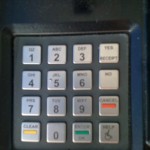
Aza, the following picture was taken by a friend. It is an ATM at an airport.  I know the image is difficult to see, but would love your thoughts on the interface of this ATM machine.
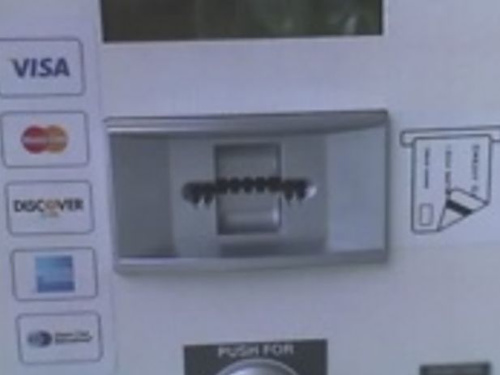
aza raskin, quasimodal design, humane interface

Below is Aza’s response to this reader:

Here’s how the machines like the one in the picture normally work:

(1) Feed your card into the machine. The ATM eats the card, quarter-inch by quarter-inch.
(2) Now that the card has been read, you enter your PIN.
(3) Select how much money you want to withdraw.
(4) Take your cash.
(5) The ATM spits out your card and you take it. If you don’t take it, the machine beeps incessantly.

Despite the beeping, I have forgotten my card in such machines. The problem stems from a mode: the credit card is either in your possession, or being read by the ATM.  As is almost always the case when a direct solution to a mode is required, the solution is to use a quasimode.  The user should perform a kinesthetically active action while the card is being read by the machine.  Such actions can be unwieldy and impractical (like pressing a foot pedal) or they can be simple and effective (like holding onto the card).

Citibank ATMs do this well — they ask you to dip or swipe your card.  This forces you to be touching the card during the entire time in which the the card is being read.  With the quasimodal solution, you won’t ever forget your card (unless you are foolish enough to set the card down).

Other articles in the "Ask Aza Raskin" Series:

  1. Ask Aza Raskin
  2. Aza Raskin on Poka-Yoke & The Humane Interface
  3. Aza Raskin on Quasimodal Design and The ATM
Series Navigation«Aza Raskin on Google Search ResultsAza Raskin on Poka-Yoke & Humane Interfaces»

Short URL: http://bit.ly/fL4X

Share This Post:


  • Digg
  • Facebook
  • del.icio.us
  • Suggest to Techmeme via Twitter
  • StumbleUpon
  • LinkedIn
  • email

2-pizza teams (10)
3 C's (3)
5S (38)
A3 Report (9)
adoption (7)
agile/software (59)
ajax (4)
amazon (53)
apple (3)
apple iphone (7)
axiom (3)
Aza Raskin (9)
backcountry.com (2)
berlin (1)
bill gates (1)
bill marriott (1)
blog tag (1)
book reviews (4)
bullwhip effect (5)
business (394)
business plans (3)
busm361 (13)
BzzAgent (12)
call center and queueing (11)
car buying (2)
Carbonite (1)
change management (5)
chicago (1)
click fraud (1)
click-to-ship (21)
clocky (2)
colin powell (2)
community (2)
company interviews (18)
company interviews (6)
complexity (32)
costs (8)
culture (7)
customer experience (10)
customer obsession (52)
customer recovery function (1)
customer segmentation (8)
customer service (17)
design thinking (14)
digg (4)
drum-buffer-rope (38)
dublin (1)
dynamic systems (24)
eBay (6)
economics (3)
efficiency (4)
ethnography (29)
family (18)
featuritis (15)
flexibility (1)
forecasting (2)
four performance dimensions (2)
Fun With The 2×2 Matrix (1)
game theory (7)
Gemba (67)
genchi genbutsu (68)
general (135)
germany (1)
google (15)
heijunka (65)
holidays (1)
hoshin kanri (1)
how to be a human (1)
IDEO (2)
image uploading (1)
iphone (5)
ishikawa (69)
IT at Toyota (67)
just-in-time (4)
kaizen (4)
kanban (46)
law of instinct (1)
Leadership (43)
lean (165)
Lean Consumption Maps (98)
learning curve (1)
licketyship (1)
mark cuban (1)
martin luther king (1)
mary poppendieck (1)
metrics (73)
microsoft (6)
milton friedman (1)
moving average (1)
muda (68)
nba fines (1)
net promoter score (nps) (1)
obeya (39)
Off-Topic (1)
onstar (1)
operations (108)
pageviews (3)
pareto principle (39)
patent (1)
peanut butter manifesto (2)
philosophy (3)
Poka-Yoke (6)
poppendieck (3)
powerpoint sucks (2)
private equity (4)
process measures (6)
product development (20)
productivity (4)
quality (41)
quasimodal design (1)
queueing theory (41)
Raffle (1)
rational choice (2)
regression analysis (18)
respect for people (6)
root cause analysis (60)
sarah+palin (2)
seth godin (1)
simplicity principle (10)
six sigma (128)
snowboarding (2)
social media (3)
spam (1)
statistical process control (46)
strategy (46)
suburban (1)
supply chain (24)
takt time (8)
teaching (2)
team size (9)
technology (104)
the beer distribution game (1)
the profit tree (7)
The Visual Factory (11)
theory of constraints (41)
time (2)
timeline (3)
tony+hsieh (11)
toyota (75)
travel (1)
trump bankruptcy (1)
turnaround (5)
twitter (8)
uspto (1)
utah deal flow (2)
variation (69)
venture capital (1)
Visual Management (11)
waste (59)
website traffic (2)
Wing Chun (2)
wisdom of crowds (1)
wisdom teeth (1)
word-of-mouth marketing (18)
yahoo (2)
zappos.com (12)
zero defects (3)

WP Cumulus Flash tag cloud by Roy Tanck and Luke Morton requires Flash Player 9 or better.


If you enjoyed this post, please consider to leave a comment or subscribe to the feed and get future articles delivered to your feed reader.

Comments

Here in Europe, ATMs usually invert steps 4 and 5. First they return you the card, and only when you have taken it, they spit out the money. IMHO just as effective as the Citibank approach.

[...] Aza Raskin on Quasimodal D… [...]

This is true but the other notable thing about most ATMs is how DUMB they are! They fail to identify you, don’t change their UI based on who you are or what accounts you have or what is known about your use of ATM etc.
Check out http://www.edmblog.com/weblog/.....sioni.html for some discussion on this
JT

Leave a comment

(required)

(required)


Additional comments powered by BackType