You are here: Lean Six Sigma Home » Queueing Theory » Call Centers as Queueing Systems

Call Centers as Queueing Systems

by Pete Abilla on October 20, 2006

Interested in a free 25+ eBook on the 7 Wastes? Please DOWNLOAD HERE.

It’s clear that a Call Center is a Queue.

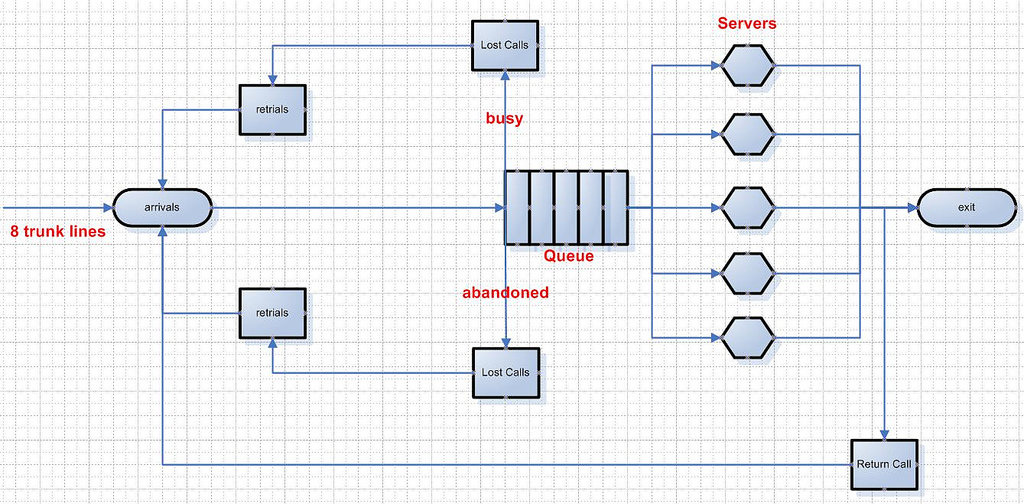
The flow of calls begins with K trunk lines that connect to the Call Center. There are wk work stations, or seats, at which Nw agents serve incoming calls. An arriving call that finds all k trunk lines occupied (let’s assume there are 8 trunk lines), receives a busy signal and is blocked from entering the system. Else, it is connected to the Call Center and occupies one of the free lines. If fewer than N agents are busy, then the call is routed directly to an agent and is served. But, if there are more calls in the system and all agents are occupied, then the call waits in the queue until an agent serves a call and that call exits the system. Once the call is served, the resources are released — trunk line, agent, work station.

Some calls are considered retrials, because they are not served and attempt to re-enter the system. For some calls, the customer voluntarily abandons the call and does not call back. Also, customers that are served may attempt to re-enter the system; this happens sometimes if there was no first call resolution (for customer service centers) and/or if the customer needed to order something else (for inbound order centers).
call center, queueing theory, contact center

Given the simple system above, the number of trunk lines acts as an upper bound (k). The number of agents acts as an upper bound on how many simultaneous calls can be in service simultaneously. A Call Center manager dynamically changes the number of agents on and off the floor based on expected demand and staffing availability.

Call Centers and other operation centers like it are highly complex and dynamic. The model above is a very simple system (read: simplistic). But, it’s easy to see how Call Centers are Queues and all the tools that Queueing Theory makes available to us can be applied to Call Centers.

There is much I have not discussed in regards to Call Centers. There is much I can say, still, about Call Center terminology, mechanics, mathematics, metrics, how to reduce costs at a Call Center, and the applicaion of Erlang C in most Call Centers and how Erlang C isn’t a very good model. I’ll discuss all these at a later time. For now, just bask in the glory of knowing that Call Centers are, indeed, Queues.

search terms for this article:

queuing theory call center, queuing system, call center queuing model, call center queueing theory, illustration of queuing theory, queuing theory in call centers, queuing systems, call center queuing, call center Queues, call center queue, system call center, queuing model for call center, queuing for call centers, call center theory, QUEUING call center, call center queuing theory, call centre queuing theory, call center queue theory, call center queueing model, queueing theory and little’s law call center, queue in a call center, queue in the call center, queuing model of a petrol station, queueing call center, queuing analysis for call centers, queueing system for two pump gas station, queuing in call centers, queueing on call center, QUEUING FLOW CHART, queuing model example simple, queuing theory and call center, what queue in call center terminology, what is queue in call center, what is call center queuing model, Trunk call center, three parts of a waiting line or queuing system, software development queueing model, simulation modeling of calling center, service desk queuing theory, service center in queueing systems, queuing theory tools call centre, trunk lines call center, queuing theory medical call center, queuing theory in call center, queuing theory for call centers, simple call centre, which queueing model is followed in call centre mathematics, queing theory in call centre, callcenter com, call queing, call centre theory, call centre queue system, call center which serves customers queuing, call center trunk lines, call center teori, call center system, ano ang flow chart?, call center queue system, call center queue model, Call center queue flow, call center management system flowchart, call center flow chart queue, CALL CENTER CALL Connected QUEUE, call center and queuing theory, callscan, complex queuing models, queing of calls, queing in calls, number if call attemps, in bound call center, ER IT service help desk, how is queueing theory applicable in call centre, helpdesk queue model, help desk telephone queue, flowchart queuing system, flow incoming call center, flow chart of queuing based system, flow chart help desk call center, erlang call center queue, erlang c call center models, electronic Helpdesk queue telephone, customer service center, ano ang queuing sa call center

Related Articles:


This post was written by

Leave a Comment