The typical consumer packaged goods manufacturing process goes through the following steps:
- Procure Material
- Manufacture Product
- Ship to Retail Customer
But, with the rise of private labels and national brand equivalents and requirements from retailers and added international requirements, more and more we see the same product in different packaging.
Consider these products:
- Great Value Brand Lasagna, sold at Wal-Mart. Great Value is one of Wal-Mart’s many private label house brands. This Great Value lasagna sells for a retail price of $9.48.
Now, consider the product below:
- This product is labeled as Sam’s Choice 9-Layer Lasagna, with a retail price of $9.99.
Yes, you guessed it: they are the same product but in different packaging.
Private Labels and National Brand Equivalents complicates manufacturing process for consumer packaged goods, given the different packaging and also the demands of retailers.
In this environment where we see the same product is in different packaging, the process is typically like the following:
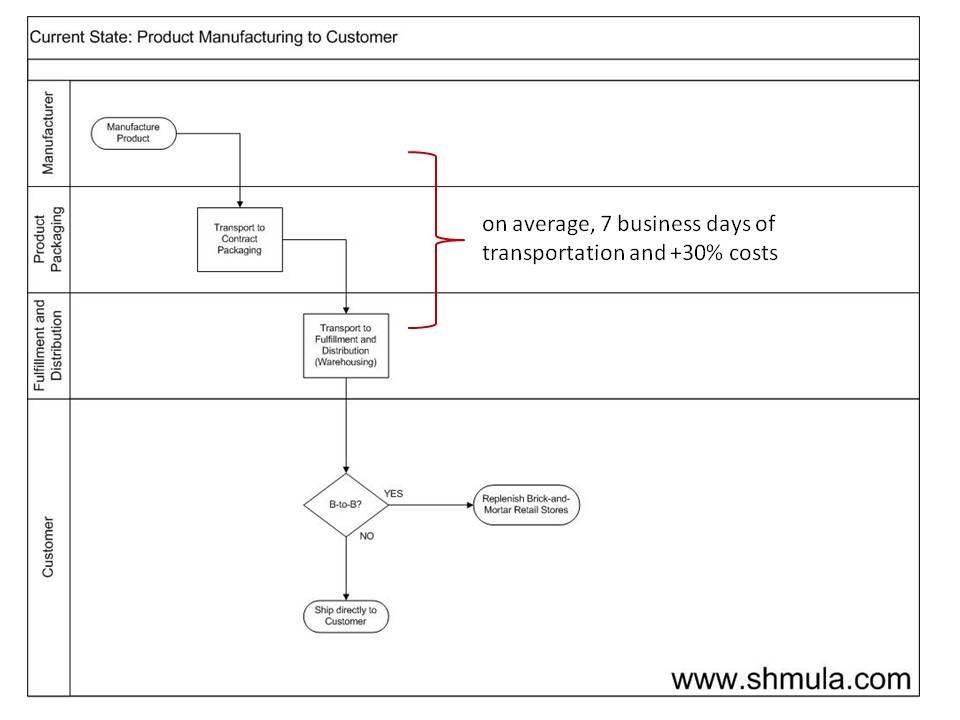
As you can see, there are added steps from the manufacturer to contract packaging, then to fulfillment and distribution. By some estimates, these added steps can add an average of 7 days and an estimated 30% to transportation costs. Not to mention that the added transportation means a larger impact on the environment.
A Lean Fulfillment Stream
The approach lean manufacturing would take to this problem is to find a way to shrink the supply chain, reduce lead time, and fulfill product to the customer when they need it. The added 7 days of transportation is also seen as a form of waste that, if eliminated, could reduce costs and also fulfill product to the customer sooner.
One approach would be to move the contract manufacturing activity either to Fulfillment and Distribution or on the manufacturing end. The most ideal would be at the point of manufacturing, but that could also get very complicated, taking the focus away from manufacturing and quality. So, the next best step is to place the packaging activity within Fulfillment and Distribution.
If the packaging activity were at the point of Fulfillment and Distribution, there would be additional costs such as packaging equipment and labor and complicated packaging requirements from retailers. But, there are advantages:
- Reduction of Transportation Time
- Reduction of Transportation and Freight Costs
- Lower Inventory Carrying Costs – because of the 7 days of almost no visibility to inventory, most retailers and manufacturers usually carry additional safety stock to account for the 7 day lead time. As we reduce lead time, we also reduce the need for large inventory safety stock.
The approach of Lean Manufacturing within this context (and to some degree, Six Sigma) would be to see how product could be manufactured with as little effort and steps and time from the point of origin to the customer.
Same Product, Different Packaging
For further examples, consider the items below:
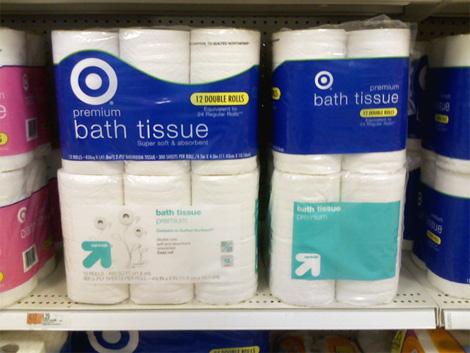
The product above, toilet paper, is the same product but packaged in two different types of packaging: one to represent the “generic” brand and the other to represent the Target private label brand.
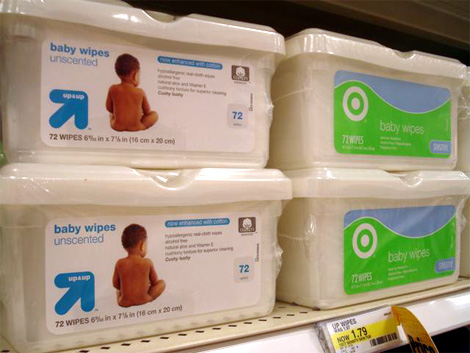
The baby wipes above (sometimes called wet ones) are the same product, but in two different types of packaging.
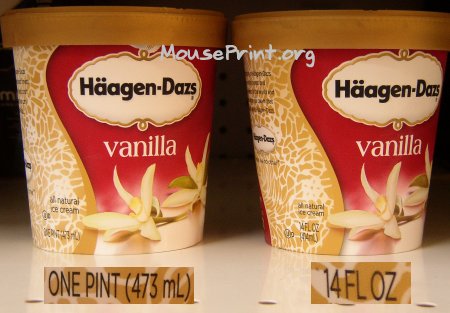
This final example is interesting because the product is the same and the packaging is seemingly the same, except for one big change: the amount of ice cream and how it’s messaged. The left Haagen-Dazs says “one pint (473 ml) and the Haagen-Dazs to the right says “14 FL OZ”. Yes, that small textual packaging change, probably because of different international standards, adds to the lead time in the supply chain.
Become a Lean Six Sigma professional today!
Start your learning journey with Lean Six Sigma White Belt at NO COST



Leave a Reply