Featured Image

Interested in a free 25+ page eBook on the 7 Wastes?

Topics covered are the 7 Wastes in:

Software Engineering, Human Resources, Affiliate Marketing, Paid Search Marketing, the Office, Customer Service, the Environment, Product Development, and Medical Billing


47,176 other people have already downloaded it!

You are here: Lean Six Sigma Home » Leadership » Motivation Matters

Motivation Matters

by Pete Abilla on May 23, 2010

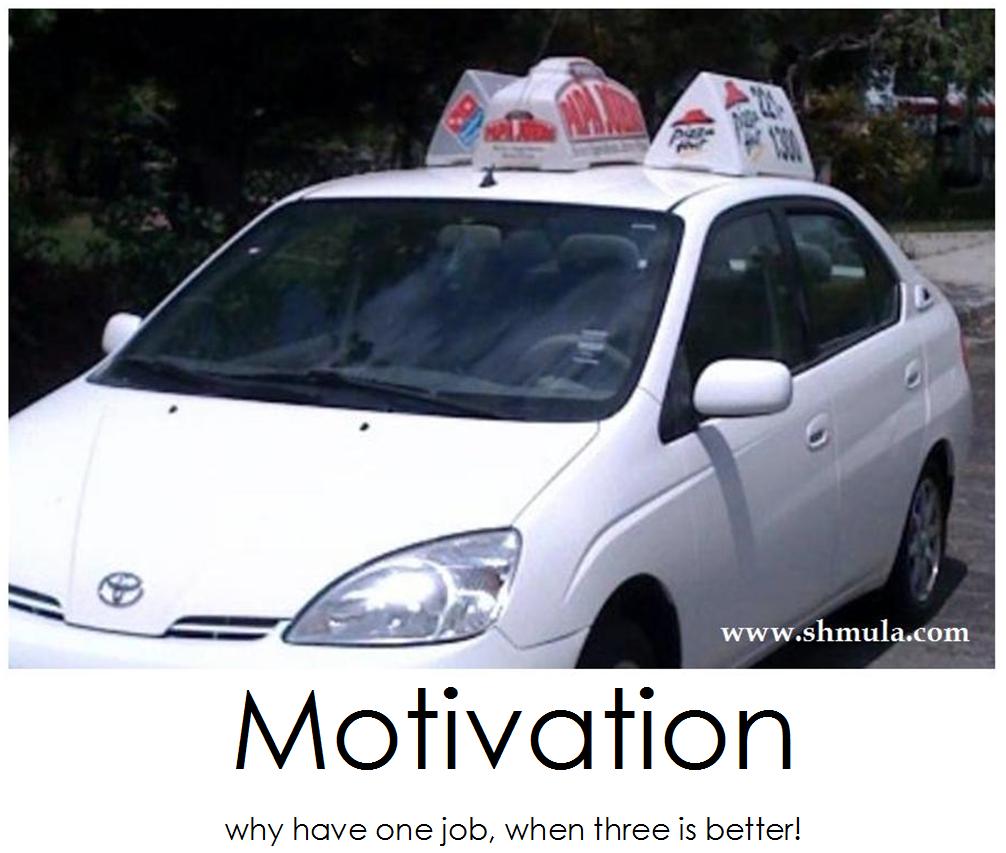
Every one in a while, I’ll see something funny, inspirational, and motivating 1 at the same time. This picture is of a car with THREE pizza delivery thingies on the roof – from Pizza Hut, Domino’s Pizza, and Papa Murphy’s Pizza, Little Ceasar’s Pizza, Papa John’s Pizza.  Yeah, this guy delivers pizza for 3 different pizza companies. 

To me, I think it demonstrate motivation 2, diligence, hard work, ingenuity – and, it’s also a funny and humurous thing to see.  So, enjoy this picture I’m calling “Motivation Matters” 3.

Image of ”Motivation” 4

motivation-diligence-recession-work-hard-shmula-abilla

It’s Your Turn

What motivates you?  Do inspirational acts or stories?  Does money motivate you?  What about opportunity – does that motivate you?  Is the chance to make a difference a motivating factor?  To you, what is the definition of Motivation?  If you’re familiar with Daniel Pink, what would Daniel Pink say about the image of motivation above?

  1. Motivation is the inner power or energy that pushes toward acting, performing actions and achieving. Motivation has much to do with desire and ambition, and if they are absent, motivation is absent too. Often, a person has the desire and ambition to get something done or achieve a certain goal, but lacks the push, the initiative and the willingness to take action. This is due to lack of motivation and inner drive. Motivation strengthens the ambition, increases initiative and gives direction, courage, energy and the persistence to follow one’s goals. A motivated person takes action and does whatever it needs to achieve his/her goals. Motivation becomes strong when you have a vision, a clear mental image of what you want to achieve, and also a strong desire to materialize it. In this situation motivation awakens and pushes you forward, toward taking action and making the vision a reality. Motivation can be applied to every action and goal. There could be motivation to study a foreign language, to get good grades at school, bake a cake, write a poem, take a walk every day, make more money, get a better job, buy a new house, own a business, or become a writer, a doctor or a lawyer. Motivation is present whenever there is a clear vision, precise knowledge of what one wants to do, a strong desire and faith in one’s abilities. Motivation is one of the most important keys to success. When there is lack of motivation you either get no results, or only mediocre results, whereas when there is motivation you attain greater and better results and achievements. Compare a student who lacks motivation and who hardly studies, to a student who is highly motivated, and who devotes many hours to his studies; they will get absolutely different grades. Lack of motivation shows lack of enthusiasm, zest and ambition, whereas the possession of motivation is a sign of strong desire, energy and enthusiasm, and the willingness to do whatever it takes to achieve what one sets out to do. A motivated person is a happier person, more energetic, and sees the positive end result in his/her mind. What can you do to enhance your motivation and awaken the power that will push you toward accomplishing your dreams, small and big? Here are a few suggestions: (a) Set a goal. If you have a major goal, it would be a good idea if you split it into several minor goals, each small goal leading to your major goal. In this way, you will find it easier to motivate yourself, as you will not feel overwhelmed by the size of your goal and the things you have to do, and the goal would seem more feasible and easier to accomplish. (b) Understand that finishing what you start is important. Hammer into your mind that whatever you start you have to finish. Develop the habit of going to the finish line. (c) Socialize with achievers and people with similar interests or goals, since motivation and positive attitude are contagious. Associate with motivated people, who share your interests. (d) Never procrastinate anything. Procrastination leads to laziness, and laziness leads to lack of motivation. (e) Persistence, patience and not giving up despite failure and difficulties keep up the motivation to succeed. (f) Read about the subjects of your interest. This will keep your enthusiasm and ambition alive. (g) Constantly affirm to yourself that you can and will succeed. (h) Look at photos of things you want to get, achieve or do. (i) Visualize your goals with happiness and joy. Remember, if a certain goal is really important, you need motivation to keep you going.
  2. Motivation is the activation or energization of goal-oriented behavior. Motivation is said to be intrinsic or extrinsic. The term is generally used for humans but, theoretically, it can also be used to describe the causes for animal behavior as well. This article refers to human motivation. According to various theories, motivation may be rooted in the basic need to minimize physical pain and maximize pleasure, or it may include specific needs such as eating and resting, or a desired object, hobby, goal, state of being, ideal, or it may be attributed to less-apparent reasons such as altruism, selfishness, morality, or avoiding mortality. Conceptually, motivation should not be confused with either volition or optimism.
  3. This form of motivation has been studied by social and educational psychologists since the early 1970s. Research has found that it is usually associated with high educational achievement and enjoyment by students. Intrinsic motivation has been explained by Fritz Heider’s attribution theory, Bandura’s work on self-efficacy, and Ryan and Deci’s cognitive evaluation theory. Students are likely to be intrinsically motivated if they: attribute their educational results to internal factors that they can control (e.g. the amount of effort they put in), believe they can be effective agents in reaching desired goals (i.e. the results are not determined by luck), are interested in mastering a topic, rather than just rote-learning to achieve good grades.
  4. Extrinsic motivation comes from outside of the performer. Money is the most obvious example, but coercion and threat of punishment are also common extrinsic motivations. While competing, the crowd may cheer on the performer, which may motivate him or her to do well. Trophies are also extrinsic incentives. Competition is in general extrinsic because it encourages the performer to win and beat others, not to enjoy the intrinsic rewards of the activity. Social psychological research has indicated that extrinsic rewards can lead to overjustification and a subsequent reduction in intrinsic motivation. In one study demonstrating this effect, children who expected to be (and were) rewarded with a ribbon and a gold star for drawing pictures spent less time playing with the drawing materials in subsequent observations than children who were assigned to an unexpected reward condition and to children who received no extrinsic reward.

This post was written by

{ 0 comments… add one now }

Leave a Comment


search terms for this article:

how to demonstrate motivation, demonstrate motivation, motivation, funny motivation, hard work work hard, how to get good grades motivation, motivation at work, work motivation funny