
How to Recognize a Bottleneck or Constraint in Your System is no easy task. You can also view all 40+ articles on Queueing Theory.
All dynamic systems – online or offline, such as restaurant operations or an ecommerce store – consists of discrete and dependent processes. Each step in the system has a finite capacity. When one step is feeding more than what the next step can handle, you’ll have yourself a constraint. Constraints or Bottlenecks aren’t bad, they’re expected and are found in any process. The key is recognizing and then managing the constraint.
Recognizing Your Constraints
Imagine the following generic process:
It doesn’t even matter what IPH stands for – just look at the raw outputs, because that is what will “feed” the next dependent process step. Do you see the constraint?
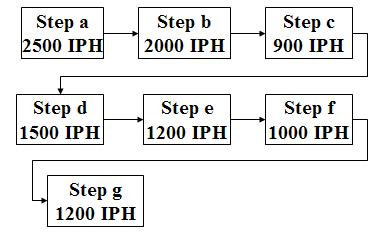
The Role of a Bottleneck
- Bottlenecks determines the throughput of a system.
- An increase in the bottleneck rates is the only way to increase throughput.
- All other process steps should be slaves to the bottleneck.
- It’s okay to take resources from a non-bottleneck if it will help the bottleneck.
Managing Constraints & Bottleneck Principles
- Bottlenecks should never be idle; to lose time on a bottleneck, is to lose throughput.
- Never let a bottleneck run out of work. It’s okay to build inventory in front of a bottleneck.
- Increase productivity rates (offline and online processes) by reducing down-time, change-over time, and off-task time.
- Reduce defects by having Quality Assurance and Quality Control in front of a bottleneck, not after.
- Focus all improvements on the bottleneck.
In any offline or online process, there will be contraints. It’s important that you identify the contstraint, then manage it; once you manage it, it’s important to remember that bottlenecks move. When this happens, follow the above steps again to identify, then manage your bottlenecks.
Become a Lean Six Sigma professional today!
Start your learning journey with Lean Six Sigma White Belt at NO COST





Arturo Tejada says
What is the constraints?