Part 1 explained the Red Bead Experiment. In Part 2, I’ll share the a video tutorial on the Red Bead Experiment – part 2 of that video series.
Before we get to the video, below are Dr. Deming’s Fourteen Points – the principles by which he practiced management and quality management.
Deming Fourteen Points
- “Create constancy of purpose towards improvement”. Replace short-term reaction with long-term planning.
- “Adopt the new philosophy”. The implication is that management should actually adopt his philosophy, rather than merely expect the workforce to do so.
- “Cease dependence on inspection”. If variation is reduced, there is no need to inspect manufactured items for defects, because there won’t be any.
- “Move towards a single supplier for any one item.” Multiple suppliers mean variation between feedstocks.
- “Improve constantly and forever”. Constantly strive to reduce variation.
- “Institute training on the job”. If people are inadequately trained, they will not all work the same way, and this will introduce variation.
- “Institute leadership”. Deming makes a distinction between leadership and mere supervision. The latter is quota- and target-based.
- “Drive out fear”. Deming sees management by fear as counter- productive in the long term, because it prevents workers from acting in the organisation’s best interests.
- “Break down barriers between departments”. Another idea central to TQM is the concept of the ‘internal customer’, that each department serves not the management, but the other departments that use its outputs.
- “Eliminate slogans”. Another central TQM idea is that it’s not people who make most mistakes – it’s the process they are working within. Harassing the workforce without improving the processes they use is counter-productive.
- “Eliminate management by objectives”. Deming saw production targets as encouraging the delivery of poor-quality goods.
- “Remove barriers to pride of workmanship”. Many of the other problems outlined reduce worker satisfaction.
- “Institute education and self-improvement”.
- “The transformation is everyone’s job”.
Red Bead Experiment Video Tutorial
This is part 2 of 6 of the Deming Red Bead Video Tutorial:

Video Transcript
Male Speaker 1: And as part of doing it right the first time, we of course have a procedure to make our white beads. Now the government wants white beads only, untouched by human hands. They want white beads. We don’t know what they do ’em them, but they want white beads.
So here is our finely engineered procedure. Now this took many years to develop this procedure, many very qualified professional engineers worked on this procedure. It is a beautiful procedure. It will be followed.
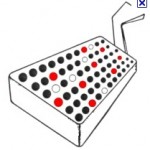
Now I will demonstrate. First the procedure number is WBDHT81-C, white bead generation. Required tools and materials: paddle for retrieval of beads. We have a paddle. It has 50 holes in it. Five rows of ten, 50. Your quota is 50. I don’t see what’s so funny…fifty.
[laughter]
This is not humorous. We are at work. Now this is step two. Grasp the paddle by the handle, insure that the holes are orientated facing upwards. Now if you put in upside down, then you don’t get any beads, you don’t get your 50, you get fired.
Hold the holes the right way up. You rotate it in ’til the paddle is covered with beads; very easy.
Now to make sure you don’t get any more than 50 you raise the paddle four inches above the bead box and you tilt it exactly 47 degrees.
[laughter]
And then you go to QA.
So you walk around in front of here and we go to the QA inspectors.
Now QA, here’s your training. Now I’ve made sure that there are some red beads here because I want to be sure they can distinguish red from white.
So this is your test, your qualification test. You are to count the number of beads. The two inspectors write the number of beads on the piece of paper, the red beads. These are bad; they are defects. We’re not supposed to make reds, but we do have to make sure that you identify which ones are defects.
The inspector general, you compare the two numbers, and you announce in a loud voice that number and then dismiss the workers. So in this case you’d say, ten, dismissed. Now you try it.
Male Speaker 2: Ten, dismissed.
Male Speaker 1: I thought you had a loud voice, [laughter] come on…gusto.
Male Speaker 2: Ten, dismissed.
Male Speaker 1: That’s better, I guess. And then the worker comes back, puts the beads back in the supply and we move onwards.
Now that is the system. This is all in compliance with DOE orders. We have a pay-for-performance contract. None of this cost plus mamby-pamby stuff; we get paid for our product. And they’ve been setting aside some money for us, so we gotta deliver white beads.
Now we will start day number one. Curt, willing worker number one, you’ve received your on-the-job training, right? Do you have any questions?
Curt: No, sir.
Male Speaker 1: Good. I’m glad to hear it. Come forward, do your first day’s work.
They’re empty and you rotate in. The beads cover all the holes, up four inches and 47 degrees; 47 degrees. That was only two; [laughter] 47 degrees. Okay, that’s better; on to QA.
We have a finely engineered procedure here.
Male Speaker 3: Eight, dismissed.
Male Speaker 1: Eight. This is the white bead company. You just made eight defects that we don’t get paid for. Well, put ’em back in and follow the procedure, put the beads back in. I’m sure the next worker can do better, just tilt them back in; back in. Just tilt it over, there we go.
Now willing worker number two. Take your spot at the end of the line. That was your day, eight red beads. [laughter] Oh and yes; I’m glad you’re waiting to follow instructions, because the instruction is record the number eight by Curt’s name in Day Number One; eight.
Very good. Willing worker Number Two, you have your paddle. You’ve read your procedure, now execute it.
Now just dip it in, just smooth action, there you go. Now up four inches and…oh, you got that 47 degrees; very good, very good. I’m impressed.
[laughter]
The Quality Assurance Inspectors count the number of red beads and record that number.
Male Speaker 4: Ten, dismissed.
Male Speaker 1: Ten! I’m very disappointed. You saw he got eight. You got a ten; two worse. I don’t understand.
Oh, write the number ten in. When he says ten, dismissed, you write the number ten in. It should just go on automatic here; very good.
Willing worker Number Three; I’m going to watch you very closely here. And up four inches, and yep, there we go, and on to QA.
Oh, the first day always has its trouble spots, learning curves and all that.
Ed: Ten, dismissed.
Male Speaker 1: Well we’re nothing if not consistent, Ed. Ten. Okay, put the beads back in the bin.
Now we have Debbie, D-E-B-B-I-E. And are you following your procedure? Well it’s 47 the other way, 47 forward; there you go.
Now up and on to QA, on to QA we go. A little bit shaky there, but we expect that the first day.
Debbie: Nine, I’m down one. Cool.
Male Speaker 2: Nine, dismissed.
Male Speaker 1: You see, the QA determines how many there are.
[laughter]
Then I will tell you, you got nine, which is down by one, yes, so okay we have an improving trend here. Do you see what my fine management here is doing by watching these procedures? We have an improving trend from ten to nine. I’m very pleased.
Now we need to continue this improving trend with willing worker Number Five, Ken.
Well you didn’t really cover the beads there. Now you didn’t pay attention to on-the-job training here. We put the paddle against here, and go all the way into the beads. Don’t try to just get a small amount.
Now this is the first day, so I’m giving you a little slack here. There you go; see how easy that is. Still, boy…
[laughter]
Okay, what does accounts say?
Male Speaker 2: Eleven, dismissed.
Male Speaker 1: Eleven. Ken, do you see what happens when you don’t follow the procedure?
[laughter]
Take this as a note. Now I do need to ask, where is my cams rep? Who’s got the DTS computer here so we can record our corrective action problem here?
‘Cause we have an adverse trend from nine to eleven, plus we had a procedure violation. So we do need to satisfy our corrective action management and log that in the system.
NTS finding if it doesn’t improve.
Okay Sid, you’ve seen your pre-workers do this. You now know what to do. Oh, very smooth action, very good, four inches and 47…47 degrees. [laughter]
There we go, on to QA.
Male Speaker 2: Eight, dismissed.
Male Speaker 1: Ah, very good. You see, corrective action management works.
[laughter]
You take the corrective actions, you get your eight. Now I would like you to total me up for the whole day. How many red beads did all six workers make?
So we can review this. Although I’m not very pleased; we are the white bead production corporation. We’re not getting paid for these red beads. How are we doing here?
Male Speaker 2: Sixty-six.
Male Speaker 1: Ah, QA is helping here, okay. Well write in 66 then; I’ll take the word of our lead inspector here.
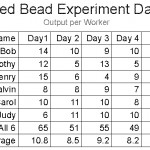
Let’s see, 18, 28, 37, 48, 58, 66; ugh, 66.
[laughter]
No, you don’t count my practice ten. That was just demonstrating when I did that. We just do the six workers, 56 then, okay. You see why we have QA?
[laughter]
Fifty-six is the number. Yes, initial your line out.
[laughter]
Yes. Okay, Mr. President, we completed the first day’s…work, and we unfortunately made 56 red beads in the first day.
Male Speaker 3:Well I have reviewed the results and I must say that our customer will not be satisfied with this level of defects, and we do need to do better.
We do recognize that it was just the first day of production with a new process. I would like to recognize though the workers who have performed better than the others.
If you would send those two to my office, please.
Male Speaker 1: Curt and Sid. The President has beckoned; please proceed to the President’s Office.
Male Speaker 3: I would like to congratulate both of you on your excellent performance.
You are Curt, you are Sid, please keep up the good work. And in addition to the certificate I’d like you to stop by the Payroll Office, pick up a little monetary reward.
Please keep that to yourself, though. We don’t need to discourage the rest of the workers.
[laughter]
Their morale is already low enough and you guys deserve what you get. So please go by and pick that up, and good luck tomorrow.
Male Speaker 1: And a big round of applause for the workers of the day.
[applause]
Get instructions on how to conduct the Red Bead Experiment >>>
 |
 |
 |
 |
 |
| Blog Article | Excel | PowerPoint | Video |
| Module | Description | Type | |
| Overview |
What is Six SigmaThe various definitions of Six Sigma is explained in this 5:42 video. We specifically discuss 6 definitions of "Sigma", ending with the most relevant definition which is related to the DMAIC Method of Problem Solving. |
 |
|
| Overview |
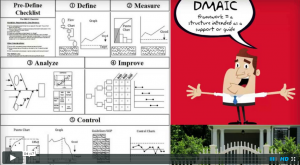
The DMAIC FrameworkIn this 4:17 video, we explain the DMAIC framework and give an introduction to each phase in DMAIC. We specifically show the storyboard for each phase in the DMAIC framework. |
 |
|
| Overview |
DMAIC versus PDCAArticle describes how PDCA is used in Lean and the similarities and common history between PDCA and DMAIC. |
|
|
| Overview |
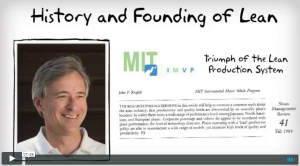
History of Six Sigma and LeanIn this video, we go through the various contributors of Six Sigma, their contribution, and why it's important in the practice of modern Six Sigma. We also go into the history of the Toyota Production System and how the term "lean" was coined. Video is 7:36 long. |
 |
|
| Overview |
Lean History and TimelineThis article shows a comprehensive history and timeline of Lean and of continuous improvement beginning in the 1600's. |
|
|
| Overview |
Black Belt CertificationIn this article, we provide various resources where you may take the Black Belt exam should you choose to do so. We also discuss the positive and negative of Black Belt certification. |
|
|
| DEFINE | |||
| Define |
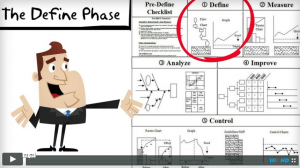
The Define Phase StoryboardWe introduce the Define Phase and show the Define Storyboard, a high level map of what the phase is about and the expected outputs. Video length is 3:50. |
 |
|
| Define |
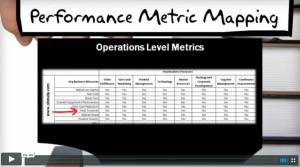
Business Needs AssessmentIn this video, we discuss how to identify business needs of an organization and how to take that knowledge and transform it into a formal DMAIC project that will get the backing and support from top management. Video length is 6:46. |
 |
|
| Define |
Project CharterIn this 5:37 minute video, we explain the role of the project charter and its importance in Six Sigma DMAIC projects. Video length is 5:37. |
 |
|
| Define |
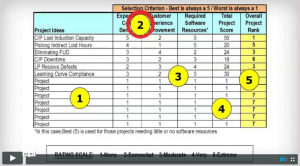
Project Selection MatrixIn this short 2:51 minute video, we learn a simple and effective method for prioritizing between competing priorities. This method is important for the selection of an improvement project. |
 |
|
| Define |
Problem StatementArticulating the problem well gets you much closer to a solution. In this video, we show you how along with several real world examples of effective problem statements. Video length is 5:42. |
 |
|
| Define |
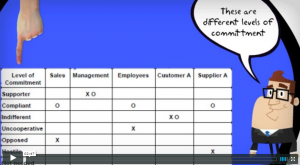
Stakeholder AnalysisIdentifying stakeholders and their needs is one of the most important steps in Define. This is especially crucial if there are any influential stakeholders that are resistant to your message. Video length is 2:47. |
 |
|
| Define |
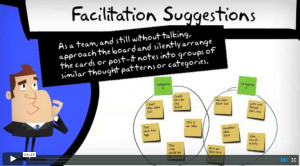
Affinity DiagramAffinity Diagram is a tried and true method for brainstorming and coming up with ideas. Learn how to apply this technique in this video. Video length is 4:25. |
 |
|
| Define |
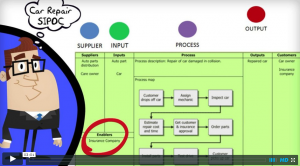
SIPOCIdentifying the key spots where measurements can be taken in crucial. This video will show you how to do it. Video length is 3:01. |
 |
|
| Define |
Voice of the Customer and CTQIn this video spanning 5:11, we explain Voice of the Customer and how Six Sigma is rooted in the customer. We explain how to translate Voice of the Customer into Critical to Quality Metrics. |
 |
|
| Define |
Critical to Quality TreeArticle explaining the critical to quality tree, with examples, and a template to download so you can create your own for your six sigma projects. |
|
|
| Define |
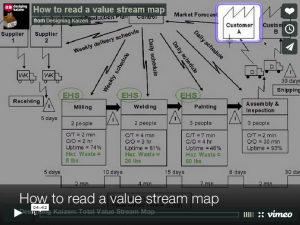
Value Stream MapIn this 4:42 video, you will learn understand the value stream map symbols and learn how to design your own value stream map. We provide a zip file of VSM Symbols for you to download. |
 |
|
| Define |
Kano ModelWe explain the Kano Model to identify service and product characteristics that should be "satisfiers" and the ones that be "good enough" and don't need to go any further. |
|
|
| MEASURE | |||
| Measure |
The Measure Phase StoryboardWe introduce the Measure Phase and show the Measure Storyboard, a high level map of what the phase is about and the expected outputs. |
|
|
| Measure |
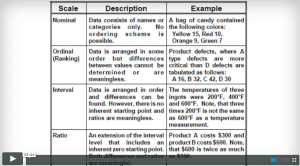
Data Types in Six SigmaIn this article we explain the various types of data, how they're different, and what they tell us about process behavior. We will also learn how to collect data. Video length is 5:24. |
 |
|
| Measure |
Descriptive StatisticsIn this module we learn various data measures that tell us key characteristics of a data set. We also begin the foundation for our discussion on distributions in a later module. |
|
|
| Measure |
DistributionsThis is a brief introduction to statistical distributions and what inferences we can draw from them. |
|
|
| Measure |
Graphical Representation of DataGraphically representing data effectively is required to effectively communicate meaning. In this module we learn various graphical methods and how to do them. |
|
|
| Measure |
7 Quality ToolsWe briefly introduce each of the 7 quality tools. We follow this video several videos where we focus on the detailed of each of the 7 quality tools. Video length is 4:46. |
 |
|
| Measure |
Check SheetsIn this HD video, we explain the checksheet, what it is used for, see various examples of checksheets, how to create one, and be able to download a checksheet template from the Shmula content library. Video length is 3:53. |
 |
|
| Measure |
Pareto ChartIn this 4:48 minute video, you will learn the history of the Pareto Principle, why it's important, and how to apply the Pareto Principle in your lean and six sigma efforts using excel. |
 |
|
| Measure |
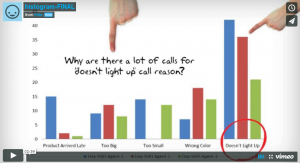
HistogramThis video on the Histogram explains what it is, when to use it, and how to use it. Video length is 3:01. |
 |
|
| Measure |
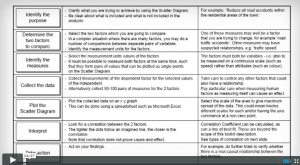
Scatter PlotIn this 4:27 short video, we introduce the Scatterplot, what it is, why use it, and how it can be helpful in your six sigma projects. |
 |
|
| Measure |
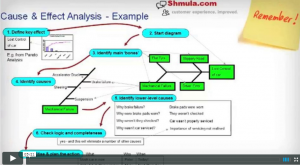
Cause and Effect DiagramThis 5:21 minute video explains the cause and effect diagram - what it is, when to use it, and how to create one. |
 |
|
| Measure |
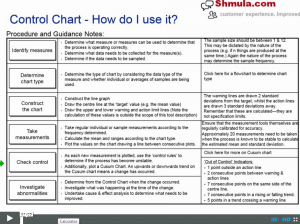
Control ChartIn this video, we introduce you to the control chart - what it is, where to use it, when to use it, and how it's used. Video length is 7:05. |
 |
|
| Measure |
Run ChartIn Progress |
In Progress | |
| Measure |
Process Cycle EfficiencyProcess Cycle Efficiency is a more modern tool that looks at processes from the perspective of value and waste. We show you how to do it and why it's important. |
In Progress | |
| Measure |
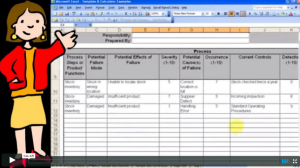
FMEAFailure Mode Effects Analysis is a tried and true method and technique for quickly identifying ways where process problems can occur and how to quickly mitigate them. Video length is 4:45. |
 |
|
| Measure |
Basic StatisticsIn this article, we go in depth to explain basic data types, scales, and the language of six sigma. |
|
|
| Measure |
Using Z ValuesWe learn about Z Values or the Z Score with applications in Six Sigma projects. |
|
|
| Measure |
Sample Size CalculationsIn this module we learn the underpinnings of sample size calculations and how they are used in six sigma. We provide a sample size calculator in the template section also. |
|
|
| Measure |
Introduction to VariationThis article introduces the learner to the concept of variation and how it impacts the customer experience. |
|
|
| Measure |
Red Bead Experiment Part 1Introduction to red bead experiment. |
 |
|
| Measure |
Red Bead Experiment Part 2In part 2, we actually do a quick run through the experiment. |
 |
|
| Measure |
Red Bead Experiment Part 3In this video, we explain and go through more runs of the experiment. |
 |
|
| Measure |
Red Bead Experiment Part 4In this video we continue our experiment and go through some of Dr. Deming's most famous quotes. |
 |
|
| Measure |
Red Bead Experiment Part 5Continuing the experiment, with a focus on how to best facilitate an event. |
 |
|
| Measure |
Red Bead Experiment Part 6In this last video in the series, we go through the key lessons learned from Deming's famous experiment on variation. |
 |
|
| Measure |
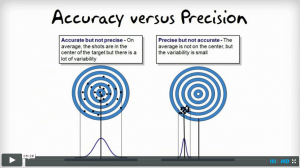
Measurement System AnalysisIn this video we discuss variation and how it impacts our methods of measuring. Video length is 5:28 and we show examples along with tips on how to deal with bad metrology. Video length is 5:28. |
 |
|
| Measure |
Gauge R&RIn this video we explain the Gauge R&R Test and provide various examples of where and how it may be applied in industry. |
In Progress | |
| ANALYZE | |||
| Analyze |
The Analyze Phase StoryboardWe introduce the Analyze Phase and show the Analyze Storyboard, a high level map of what the phase is about and the expected outputs. |
In Progress | |
| Analyze |
BrainstormingWe introduce various methods of brainstorming. Some conventional and some not very and more modern. Some of these methods are taken from Design Thinking and have been found to be very effective in identifying innovative and simple solutions to problems. |
In Progress | |
| Analyze |
5 Whys and Fishbone DiagramIn this video we explain the 5 Why exercise and show many examples. We extend the 5 Whys and show how it naturally leads to the Fishbone Diagram. |
In Progress | |
| Analyze |
Verifying Root CausesWe introduce hypothesis testing and various methods for doing so including the Regression, T Test, Chi Square, and ANOVA. |
In Progress | |
| Analyze |
Hypothesis TestingIn Progress |
In Progress | |
| Analyze |
RegressionIn Progress |
In Progress | |
| Analyze |
T TestIn Progress |
In Progress | |
| Analyze |
Chi SquareIn Progress |
In Progress | |
| Analyze |
ANOVAIn Progress |
In Progress | |
| IMPROVE | |||
| Improve |
The Improve Phase StoryboardWe introduce the Improve Phase and show the Improve Storyboard, a high level map of what the phase is about and the expected outputs. |
In Progress | |
| Improve |
Change ManagementWe introduce you to several change management models that have been found to effective in practice. We show what they are, how to do them. |
In Progress | |
| Improve |
Solution Selection MatrixThe Solution Selection Matrix is a simple tool that helps a team vote and decide on which solution makes the most sense to put resources behind in improvement projects. |
In Progress | |
| Improve |
Process CapabilityWe discuss process capability and how it's different from a process not in control. We discuss its importance. |
In Progress | |
| Improve |
Cost / Benefit AnalysisWe introduce the concept of Cost and Benefit Analysis and provide several ways at showing cost savings from Six Sigma Projects. |
In Progress | |
| Improve |
Poka YokeAs part of the Improve Phase, we introduce the concept of Poka Yoke, or error proofing, as a way to prevent defects before they even occur. We show may examples and teach the principles behind Poka Yoke. |
In Progress | |
| CONTROL | |||
| Control |
The Control Phase StoryboardWe introduce the Control Phase and show the Control Storyboard, a high level map of what the phase is about and the expected outputs. |
N/AN/A | |
| Control |
Before / After ParetoWe show ways to visually see before and after results of your project. |
In Progress | |
| Control |
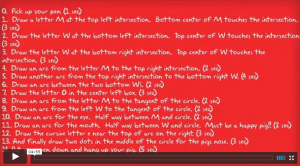
Standard Pig GameIn this 4:55 minute video, we show you a simple and effective game that teaches the importance of Standard Work. This video should be watched prior to the video on Standard Work. |
 |
|
| Control |
Standard WorkStandard Work is a foundation of Lean and Six Sigma. In this 5:36 minute video we explain Standard Work and show its role in continuous improvement. |
 |
|
| Control |
Control ChartsWe discuss the various control charts, why they're important, and how to create them given your process and given your data type. |
In Progress | |
Become a Lean Six Sigma professional today!
Start your learning journey with Lean Six Sigma White Belt at NO COST